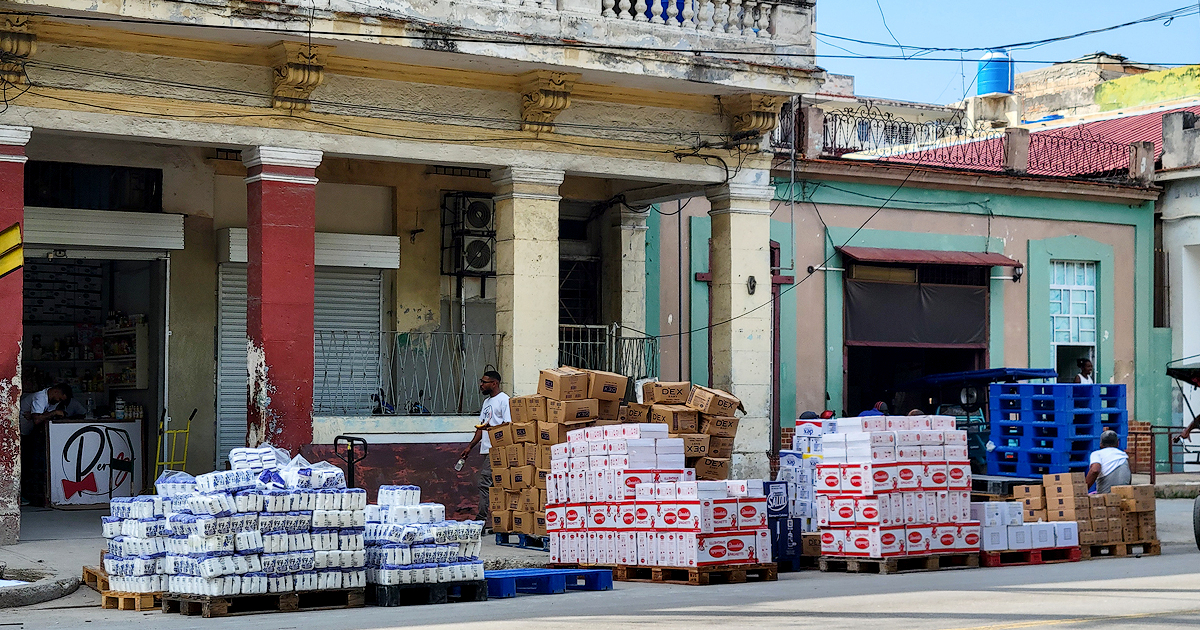
The swift reaction of the Cuban regime to the new measures from the Office of Foreign Assets Control of the United States (OFAC) not only aims to denounce another supposed "attack on the people."
Also revealing something more uncomfortable for Havana: the private sector, which for years was presented as marginal, tolerated, and politically subordinate, has become a sensitive piece within the economic architecture of power.
Washington was the first to open the door to the private sector
The sequence matters. Washington did not reach this point after a linear closure policy against small and medium-sized enterprises (mipymes).
In May 2024, during the Biden administration, the Treasury Department modified the regulations regarding Cuba to expand support for independent private entrepreneurs, allowing them to open and use bank accounts in the United States, including through online payment platforms, and to facilitate certain financial operations related to the private sector.
Even under the Trump administration, the initial logic was not to completely shut down all possibilities for Cuban entrepreneurship.
In February 2026, the Bureau of Industry and Security of the Department of Commerce updated its guidance to allow exports and reexports of gas and other petroleum products of U.S. origin to eligible private Cuban entities and individual consumers, under the exception “Support for the Cuban People”.
CiberCuba reported later that the United States had sent approximately 30,000 barrels of fuel to the Cuban private sector since early February and that dozens of ships with products imported by private companies had unloaded on the island, primarily at the Port of Mariel.
In other words, the U.S. administration opened a specific avenue: no fuel for the Cuban state, no oxygen for the Armed Forces, no resources for GAESA, but operations formally aimed at the private sector.
This distinction has been essential from the beginning.
The trap of the Cuban model: private on paper, state-controlled in reality
But the Cuban reality soon revealed the trap. Even though the purchase was made by a small and medium-sized enterprise, the operation within Cuba could not easily escape state control.
Fuel imports had to go through intermediaries authorized by the regime itself, such as QUIMIMPORT or MAPRINTER; then ports, nationalization, CUPET, CIMEX, storage, distribution, and consumption points were managed under state control.
CiberCuba documented since February that small and medium-sized enterprises could import fuel, but the regime maintained total control over the process.
The first alarm bell rang very early. On March 4th, the Department of Commerce suspended the use of the exception “Support for the Cuban People” for operations involving the deposit of foreign funds in Cuban-owned banks, deeming that these transactions posed an unacceptable risk of primarily benefiting the Cuban regime or its military or intelligence services.
It was not a measure against a private café nor against a small family business. It was a warning about the point at which private money could end up entering the state's financial machinery.
The reforms in Havana expanded the channel, but they did not relinquish control
Meanwhile, the regime accelerated its own reforms. In June, it approved a package of 176 economic and social transformations that included private banking, private currency exchange, private remittance operators, opening up to foreign investment in the non-state sector, removal of the 100-worker limit for small and medium-sized enterprises, and allowing private entities to directly import and export, although always under state authorization.
That package was presented as a sovereign and necessary opening in response to the crisis. However, it can also be interpreted in another way: the regime, lacking foreign currency, insufficient fuel, and with the state economy collapsed, sought to expand private channels while maintaining control points.
The government, whose economy was planned and centralized by state institutions until very recently, understood that it needed to evolve and develop channels that would allow it to access and manage resources through "new economic actors".
It allowed for more activity from the emerging "non-state sector," but retained control over licenses, banks, customs, ports, importers, permits, oversight, and the capacity to impose penalties. The private sector could move goods, but the state continued to decide the routes, partners, conditions, and costs.
Díaz-Canel summarized it in April 2021: " The revolution will not hand over the non-state sector to the enemy. The non-state sector is ours."
In September, the Central Bank of Cuba took another step in that direction by authorizing private businesses to receive cash in foreign currencies and deposit it directly into bank accounts denominated in foreign currency. This measure paved the way to formalize foreign currencies held by private actors, but within the Cuban banking system and under state supervision.
The OFAC shift targets the gray areas
The OFAC shift, effective September 30, should be understood in that context.
Washington has removed the authorization that allowed U.S. banks to open and maintain accounts for independent private Cuban entrepreneurs; it ordered the blocking of affected accounts unless a specific license is granted; it eliminated the U-Turn financial operations related to Cuba, and expanded restrictions to prevent not only direct transactions but also indirect ones, with entities on Cuba's Restricted List.
The keyword is «indirects». OFAC is not only examining whether a transfer mentions GAESA, CUPET, or a military company. It is investigating whether, through intermediaries, supposed private companies, or more opaque financial routes, the ultimate benefit could end up in the structures of the military, intelligence, or security apparatus.
Therefore, it is manipulative to present the measure as a mere attack on entrepreneurship or on the population.
The real discussion is not whether some SMEs may be affected. They will be, especially those that had access to accounts or payments linked to the United States.
The main discussion is why Washington, after having opened channels to the private sector, decides to close some of them.
The most likely answer is that it detected a boundary that is too porous between the private and the state sectors.
Thus expressed the Secretary of State Marco Rubio in mid-September: “On the issue of Cuba, what we will not continue to do is allow a military company called GAESA to keep stealing money from Cuba, and that is why we have implemented the strongest sanctions in the history of our relationship with Cuba.”
And he added: «Tragically, the Cuban people are suffering, but they are not suffering because of us [but because of a model that] does not work and has never worked».
The regime's response: turning a financial dispute into a national grievance
The regime understood the blow and reacted immediately. Miguel Díaz-Canel accused the United States of harming the Cuban private sector and stated that the measures aimed to cause "the maximum suffering" to the people.
"These actions against the Cuban private sector clearly demonstrate that their only intention is to inflict maximum suffering on our people and to limit the implementation of economic and social transformations," the ruler asserted.
Bruno Rodríguez Parrilla also presented the restrictions as part of a policy aimed at blocking exchanges, private businesses, and economic reforms.
"These new blocking measures are intended to hinder the ongoing economic transformation process. Both the public and private sectors are openly targeted, the latter of which some U.S. officials claim they wish to support in its development," denounced the regime's foreign minister.
To this line, voices from MINREX were added, such as Sonia Hernández Camacho, identified as the Director of Bilateral Affairs of the General Directorate of the United States, along with official accounts on social media that echoed the idea that Washington is not targeting the regime, but rather the entire Cuban economy.
The rhetorical maneuver is evident: to transform a dispute over financial channels, sanctions, intermediaries, and state control into a national grievance.
The regime needs to present micro, small, and medium enterprises as synonymous with the people, because in this way, any measure aimed at cutting the potential state exploitation of that circuit can be denounced as collective punishment.
But that equivalence does not withstand the everyday reality of Cuba.
SMEs are not "the people."
For millions of Cubans, small and medium-sized enterprises (SMEs) are neither a widespread nor affordable solution to their basic needs. In many cases, they are the only places where products are available, but at prices that far exceed salaries and pensions.
CiberCuba has reported one pound of chicken costing 800 pesos, six eggs for 960, and bags of milk ranging from 5,500 to 6,500 pesos as well as estimates exceeding 200,000 pesos per month to support a small family in Havana, compared to a minimum wage of 3,210 pesos.
The Cuban people, therefore, are not the primary beneficiaries of that circuit. They are rather the forced spectators of an expensive, effectively dollarized market, supplied irregularly and marked by privileges, connections, and permits.
The regime tries to hide that distance because it suits them to present any private channel as if it were automatically a popular achievement.
In reality, a large portion of the population only accesses those products in a limited way, sacrificing remittances, selling belongings, or relying on relatives abroad.
Not all of the private sector is controlled, but no channel operates outside of the State
The new OFAC measures do not prove that the entire Cuban private sector is controlled by the regime.
It would be unfair to group together thousands of small entrepreneurs who work under pressure, with blackouts, inflation, taxes, inspectors, and a lack of legal security.
What they do confirm is a suspicion that is increasingly difficult to deny: in Cuba, no economic circuit that involves foreign currency, fuel, or foreign trade operates entirely outside the State's influence.
The label "private" does not guarantee independence.
In a system where the regime controls banks, ports, customs, licenses, import companies, storage, distribution, and regulation, any economic channel of significant scale can end up being a source of foreign currency, commissions, supply, or legitimacy for the power itself.
That is the part the regime in Havana does not want to discuss. Because doing so would force them to answer uncomfortable questions: who are the real owners of certain companies, what connections do they have with officials, military personnel, or family members in power, what commissions does the state charge on each import, which banks process the funds, and how much the state apparatus ultimately captures in the name of a supposed private market.
A course correction, not an offensive against Cubans
Washington does not seem to have closed these pathways because it is bothered by the existence of Cuban entrepreneurs. The logic points to something else: sealing gaps through which the regime could turn the private sector into an intermediary, front, collector, importer, or indirect channel for resources that the sanctions aim to deny the State.
"Every time they create a new mechanism to try to untangle the knot, we tighten it," Rubio stated in early August. "Of course, they cannot expect this to pass. This will not disappear in the next two and a half years."
The falsehood of the official report does not lie in acknowledging that OFAC measures can have effects on certain private actors. That is real.
The manipulation lies in omitting the complete sequence: the banking openings of 2024, business licenses and exceptions, authorization for fuel, early warnings about Cuban banks, state control of logistics and the reforms in Havana to absorb foreign currency through private channels.
That's why the regime is upset. Not because Washington has discovered that private micro, small, and medium enterprises exist, but because it seems to have understood that the line between private enterprise and state benefit was too weak.
The official reaction, with its automatic appeal to the "people," aims to mask this logic. But the complete sequence tells a different story: first, there were openings to favor the private sector; next, signs of capture, intermediation, and financial risk emerged; finally, the closure of the most vulnerable channels came.
What the regime refers to as asphyxiation against Cubans may actually be a course correction regarding its ability to disguise what remains under the control of a State that flatly refuses to discuss its internal political matters, through which it retains and seeks to perpetuate its totalitarian power.
Related videos:
Filed under: