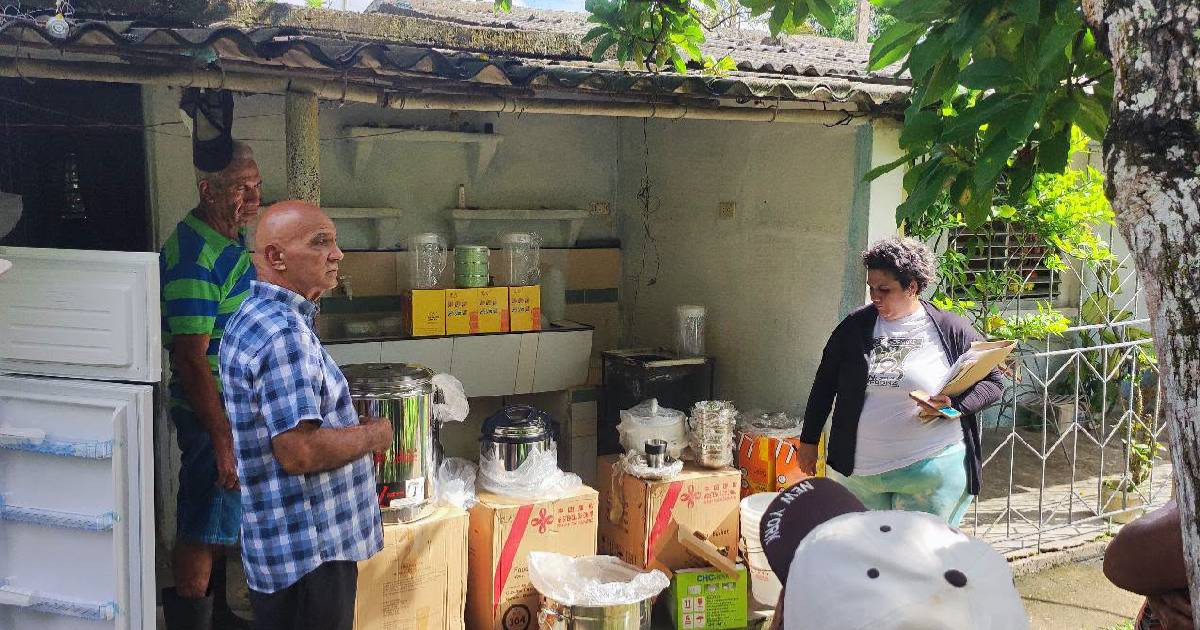
The Cuban government is turning to private homes and self-employed workers to provide food for vulnerable individuals in five rural communities on Isla de la Juventud, while adequate access to food remains limited for a large part of the population.
The communities of La Mina, La Melvis, La Isabel, La Tumbita, and Ciro Redondo have initiated the establishment of Community Food Homes, aimed at elderly individuals without family support, people with disabilities, families in vulnerable situations, and pregnant women who require additional food assistance, highlighted this Saturday by the official newspaper Victoria.
The special municipality’s administrator, Leonardo Cruz Cabrera, toured the settlements and described the initiative as having a "great social impact." This measure is part of the 176 economic and social transformations announced in June.
However, the model presented as "innovative" had already been announced and implemented in other territories. In February, the official newspaper Granma reported plans to create 325 such homes in the country and noted that at least 29 were already operating in Guantánamo, Holguín, and Santiago de Cuba.
In August, Ciego de Ávila inaugurated the first in the province, managed by the self-employed workers project "Los Ramones".
The scheme allows a natural person, chosen by the municipal administration, to assist up to 10 beneficiaries in an authorized private residence.
The service is offered at affordable prices, and when a person cannot travel due to health reasons, food must be delivered free of charge to their home, the source emphasized.
In the Isle of Youth, the launch of the program was accompanied by the distribution of equipment to those who will be in charge of the homes, including refrigerators, pots, rice cookers, plates, and jugs.
The model is supported by Agreement 10418 from the Council of Ministers and Resolution 14/2026 from the Ministry of Domestic Trade, which allow the participation of small and medium-sized enterprises, self-employed workers, and other non-state entities in the management of these services. The selection of beneficiaries remains the responsibility of the local social policy structures.
The Interior Trade provides five products from the regulated family basket: rice, grains, oil, sugar, and salt, depending on availability. Root vegetables and the main dish must be obtained through agreements with cooperatives and other economic actors in each territory.
The expansion of these households occurs while the government itself has acknowledged difficulties in financing the Family Care System (SAF), whose number of beneficiaries increased from about 59,000 people in 2023 to approximately 67,000 by mid-2025.
In September, a report concerning a SAF dining hall in Santiago de Cuba described the food served to the elderly as "a broth of cilantro and minced leeks".
The food context also poses a challenge for a program aimed specifically at individuals who have greater difficulties accessing food.
The Food Monitor Program published a report in April titled "Economic Paralysis and Food Survival in Cuba," documenting critical levels of food insecurity in the provinces of Havana, Matanzas, Cienfuegos, Guantánamo, and Santiago de Cuba.
The economic situation of the elderly adds another challenge. The minimum pension remains at 4,000 pesos per month, while independent economists estimate the basic basket to be 96,000 pesos per month.
Related videos:
Filed under: