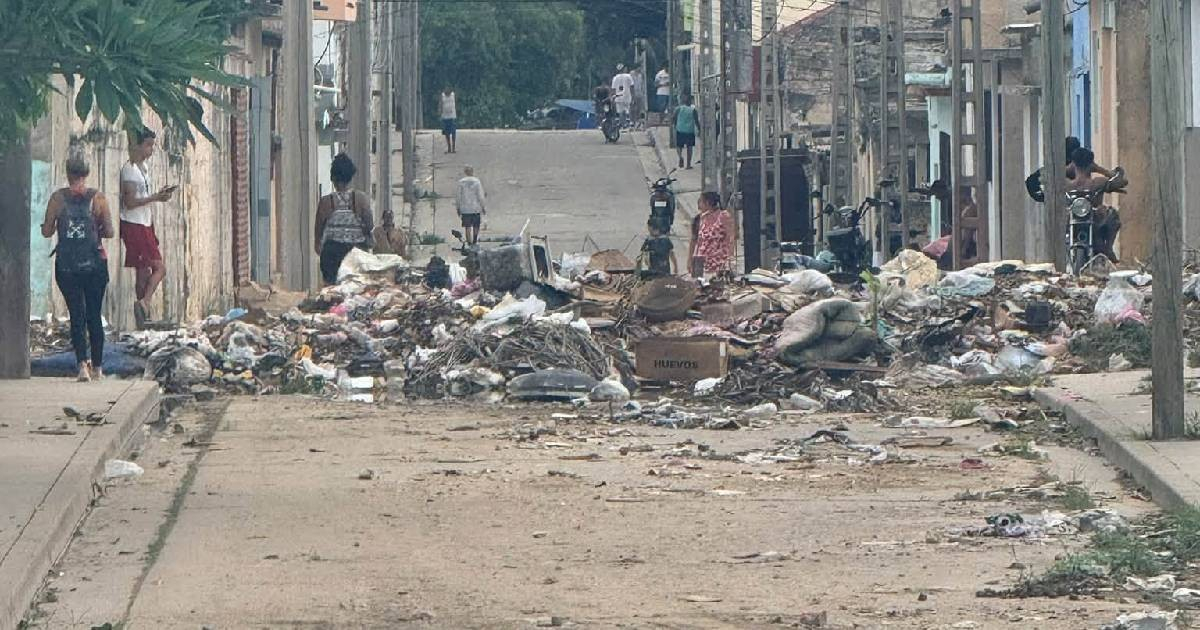
A neighbor from Matanzas, Sergio Julian Alonso, reported on Facebook the accumulation of garbage at the corner of Embarcadero and Mujica and warned about stagnant water and the proliferation of mosquitoes on a block where, he claimed, there are children with dengue.
The resident stated that "the garbage blocked the street from side to side" and that the waste continued to spread along Mujica. He also reported the presence of a water accumulation that he described as a breeding ground for mosquitoes.
"How far are we going to go?" questioned Alonso, who requested that his complaint reach "where it needs to go" so that action would be taken regarding the situation.
The post garnered 554 reactions and ignited the frustration of the neighbors, who asked, "How far are we going to go?" The complainant was even more direct: "Are our leaders blind?"
The shared post does not include a response from the municipal authorities or the Comunales Company.
Another user also reported on social media the same dump and said that the waste extended over more than 100 meters along this last street.
The episode is not an isolated incident. The waste collection crisis in Matanzas has been worsening for months and has a structural cause: the shortage of diesel.
The shortage of fuel is among the main causes of the deterioration of the service. In May, local authorities acknowledged that the allocation of diesel ranged between 300 and 550 liters per day, while the ideal amount was about 112 liters per vehicle to complete two routes a day. At that time, Comunales had about 11 operational trucks and around 930 active workers out of a workforce of approximately 1,400.
The municipal mayor Michel León Rodríguez acknowledged it in May before the cameras of the Con Voz de Pueblo program on TV Yumurí: "We have a debt to the city."
The series of complaints throughout 2026 paints a picture of sustained collapse.
In April, an improvised dump occupied almost the entire intersection of Levante and Solís, with residents going nearly a month without regular waste collection. In May, journalist Yirmara Torres Hernández reported a dump just meters away from the Eliseo Noel Caamaño Pediatric Hospital, amidst outbreaks of hepatitis A, dengue, and chikungunya. Only after pressure on social media did the authorities remove some of the waste near the hospital, although the operation was only partial.
During August, the rains swept the accumulated waste from streets and channels into the San Juan and Yumurí rivers and the bay of Matanzas, having a direct environmental impact. In September, a landfill caught fire in Santa Marta, a municipality in Cárdenas, and a container was completely melted down.
The provincial press went so far as to describe the situation as a "putrid tumor" associated with rodents, flies, and mosquitoes.
The problem is not limited to Matanzas either. In Havana, at the beginning of the year, only 44 out of the 106 garbage trucks in the capital were operational, and up to 23,814 cubic meters of waste were left uncollected each day in the city.
As fuel shortages and limitations of staff and resources affecting community services continue, the residents of Matanzas are still living with the garbage in their streets and asking themselves the same question: "How far are we going to go?"
Related videos:
Filed under: