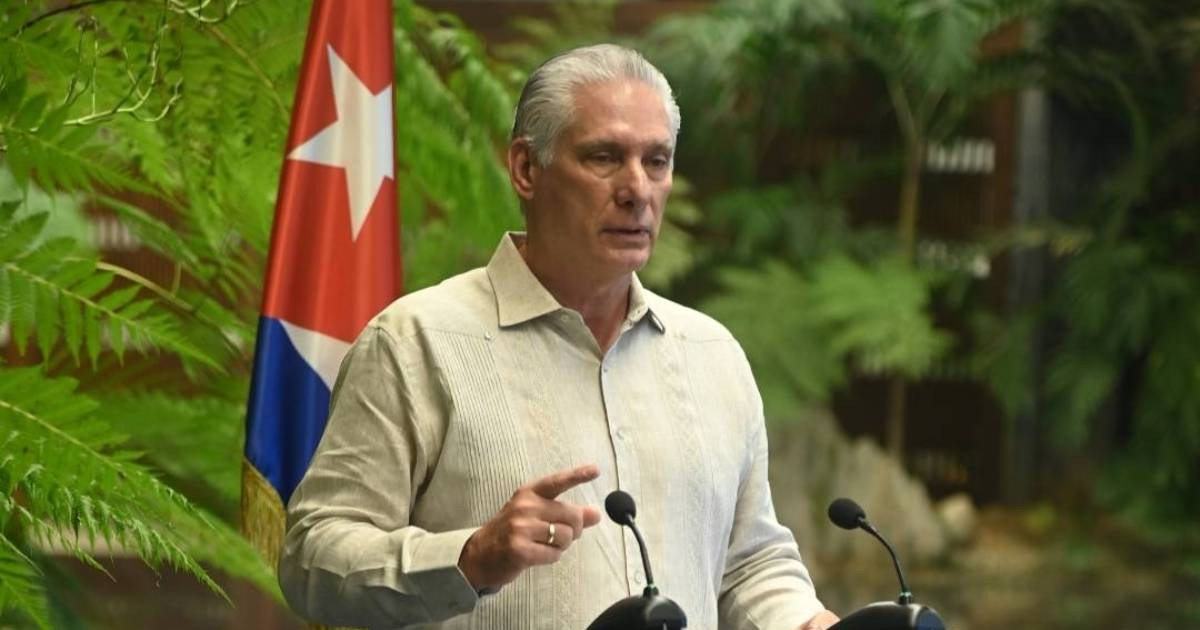
Miguel Díaz-Canel led an official event on Tuesday at the José Martí Memorial in Havana to mark the 50th anniversary of the Barbados crime, the attack that on October 6, 1976, destroyed a Cubana de Aviación aircraft in mid-flight and killed the 73 people on board.
Under the banner “Cuba does not surrender, Cuba does not sell, and Cuba does not forget”, the leader described the meeting as “an act of memory, but also of resistance.” He framed it as “a moment of denouncing impunity” in a political context that he characterized as “as complex as the one we are living through.”
The flight 455 of Cubana de Aviación was covering the route Caracas–Barbados–Kingston–Havana when two explosions destroyed it shortly after taking off from Bridgetown.
Among the victims were 24 young Cuban fencers —none older than 20 years— who were returning after winning all the gold medals at the IV Central American and Caribbean Championship in the discipline held in Caracas.
The Cuban regime attributes the attack to anti-Castro groups linked to the CIA, identifying Luis Posada Carriles and Orlando Bosch Ávila as the intellectual authors.
The material executors, the Venezuelans Freddy Lugo and Hernán Ricardo Lozano, were sentenced in Venezuela in 1985 to 20 years in prison. Posada Carriles escaped from the Venezuelan prison that same year, was never convicted of terrorism in the United States and died in Florida in May 2018.
In addressing the young fencers present at the event, Díaz-Canel stated that the downed flight was "a flight of hope" and that the attack was "an act of revenge, of bitterness, of arrogance" against innocent people who "had done nothing against the United States."
"Those testimonies tear at you, those experiences tear at you, those life stories that you have carried in your hearts and minds all these years," said the leader, referring to the relatives of the victims present at the Memorial.
The event was also attended by Prime Minister Manuel Marrero Cruz, the Secretary of Organization of the Central Committee of the Communist Party Roberto Morales Ojeda, and Gerardo Hernández Nordelo, National Coordinator of the Committees for the Defense of the Revolution and one of the so-called Five Heroes, who moderated the discussion.
Another former spy, Antonio Guerrero, recalled that the Barbados crime was what turned them into "anti-terrorist fighters," and quoted words attributed to Fidel Castro: "We are a vigorous and manly people that resists. Injustice will continue to tremble."
The event is part of a series of defiant statements by Díaz-Canel in response to pressures from Washington throughout 2026. In June, he stated that “Trump does not command in Cuba” and in September reiterated that Cuba “will never again be a colony of any empire”.
The 50th anniversary of the attack coincides with a time of high tension between Havana and Washington, marked by Cuba's continued presence on the U.S. list of states sponsoring terrorism and the tightening of the embargo.
"Our truths must be made known, they must be repeated. We need to bring them to the present moment we are living in, also to find answers," concluded Díaz-Canel before the attendees at the José Martí Memorial.
Related videos:
Filed under: