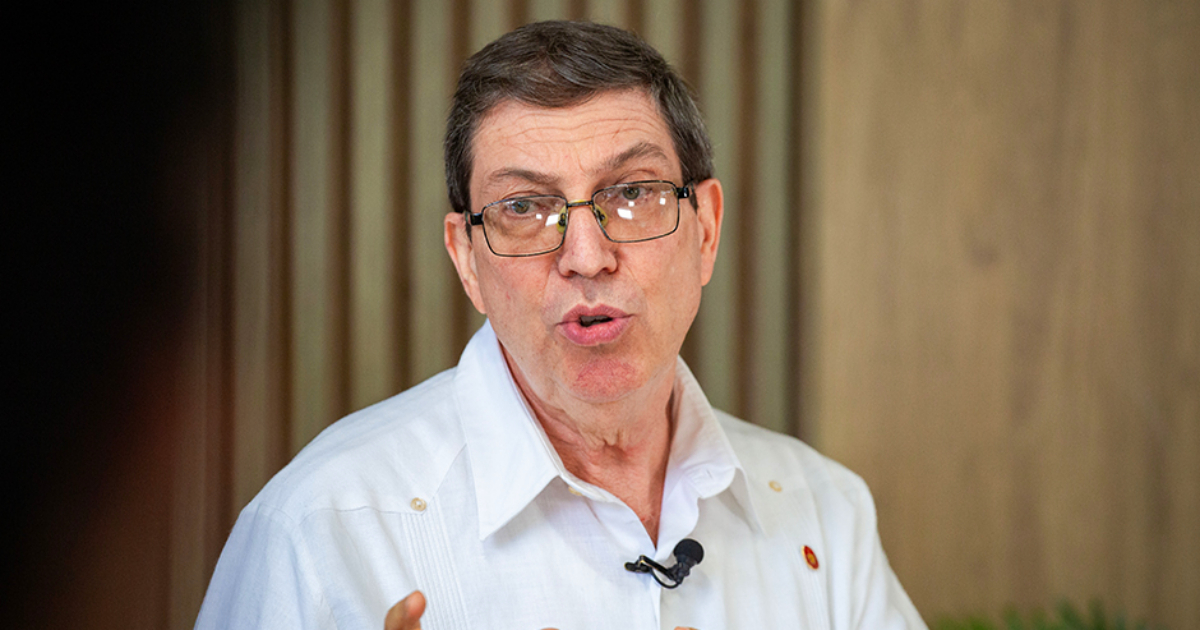
The Cuban Foreign Minister Bruno Rodríguez Parrilla stated this Wednesday that only 17% of Americans support the use of military force to "take control of Cuba", according to a survey by Economist/YouGov, and presented this data as evidence that Washington's policy lacks popular support.
"It is evidence of the overwhelming opposition of the citizens of the U.S. to that government's aggressive policy against the Cuban people," wrote the Foreign Minister on the social network X, accusing Secretary of State Marco Rubio of having chosen the narrative that Cuba represents a threat as a "pretext" to justify what he called an aggression against the island.
What Rodríguez did not mention is that he chose the lowest figure from the entire series of YouGov measurements available in 2026.
The Economist/YouGov poll from August, conducted between the 14th and 17th of that month with 1,611 American adults, recorded that 58% opposed the use of force while 17% supported it. However, among Republicans, opinions were divided: 33% in favor and 30% against. Among those identifying with MAGA, support reached 44%.
Additionally, other measurements from the same series YouGov show a different trend than the one suggested by the chancellor: in July, support was at 18%, which rose to 20% in September, and was at 22-23% in March. Rodríguez took the lowest point of the series and presented it as if it were the complete picture.
This convenient pattern of data selection stands in stark contrast to the complete silence of the regime regarding the broadest survey conducted on political opinion in Cuba in recent years.
In April and May 2026, over 20 independent Cuban media outlets —including CiberCuba, elTOQUE, 14ymedio, Rialta, Alas Tensas, and others— launched a digital poll that received 42,263 valid responses, with 58% coming from Cuba according to anonymous geolocation.
The results were clear: 60.9% supported direct military intervention by the U.S. and 64.9% endorsed the overthrow of the Cuban government “by any means necessary, including armed action.” The average level of trust in the government was 1.09 out of five, with 94% selecting the minimum level of trust.
The regime's response was not to debate those numbers, but to block the link within Cuba and to attack its organizers through state media.
Granma described it as "lies." The official site Razones de Cuba labeled it a "statistical fraud" and "propaganda setup." Juventud Rebelde accused the organizers of manipulation with artificial intelligence funded by the U.S.—the same accusation that the regime systematically throws at any source that contradicts its narrative.
In the same period, a survey conducted for the Miami Herald by Bendixen & Amandi International and The Tarrance Group revealed that 79% of Cubans and Cuban-Americans in South Florida supported a U.S. military intervention in Cuba.
The contrast is hard to ignore: the Cuban chancellor amplifies favorable U.S. polls, but the regime actively blocked and attacked the only large-scale survey that gathered the opinions of tens of thousands of Cubans about their own future.
The question that the regime does not answer is evident: if American public opinion deserves to be cited and amplified, why must that of the Cubans themselves be blocked, disqualified, and silenced?
Related videos:
Filed under: