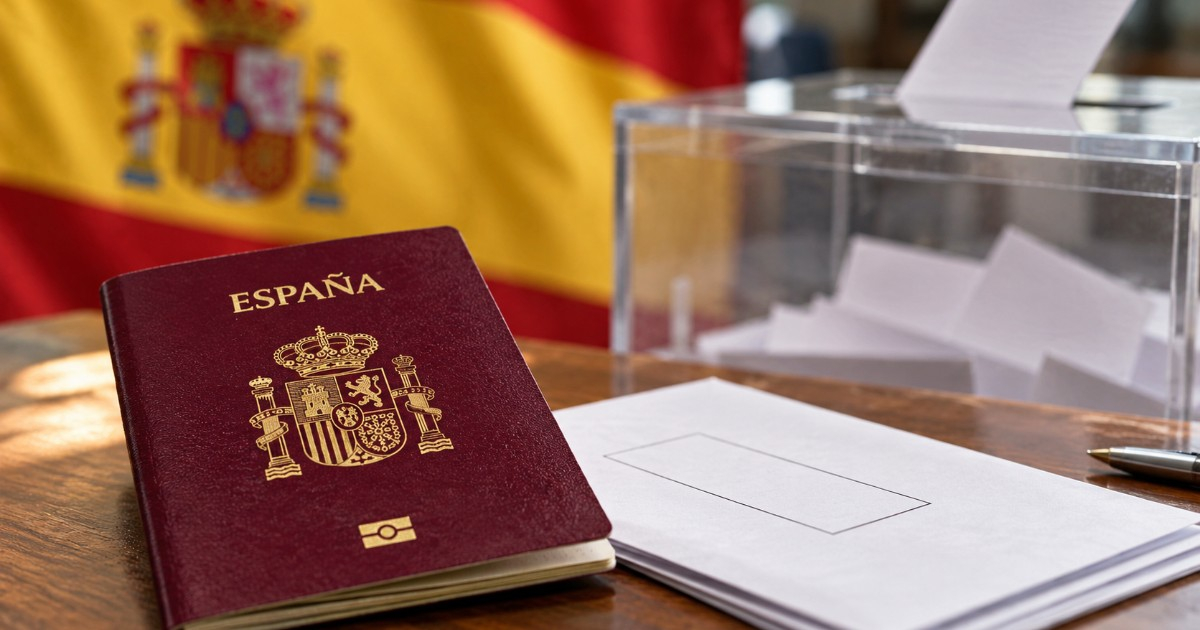
The Supreme Court of Spain faces a crucial day this Thursday, October 8, for the electoral future of citizens who obtained Spanish nationality through the Democratic Memory Law, known as the Grandchildren's Law, including thousands of Cubans residing on the island and in other countries.
At 3:00 PM Spain (9:00 AM Cuba), the non-extendable deadline of 48 hours granted by the Administrative Litigation Chamber to receive the statements from the parties involved in the litigation regarding the registrations in the Electoral Census of Absent Residents (CERA) will end.
The judicial decision made later may determine whether the precautionary measures affecting the votes of certain Spanish nationals are upheld, modified, or lifted in relation to the general elections on November 29.
However, there is an important clarification: the Supreme Court is not obligated to rule this Thursday. The deadline that ends today pertains to the submission of documents, and the court must review the arguments before making a decision.
What is the Supreme Court deciding?
The high court initiated this urgent procedure through two rulings issued on October 6, after the parties Iustitia Europa and Vox submitted new documents following the early call for general elections.
According to EFE agency, the parties have 48 hours to respond regarding the implementation of the precautionary measures adopted in September and the appeal submitted by the State Legal Service to challenge them.
The Supreme Court has also raised a particularly delicate issue: determining whether it should grant a hearing to those who obtained citizenship through the Grandchildren's Law and who could be affected by the proceedings, whether they are already registered in the CERA or have not yet been incorporated.
This is an important issue because those affected are not just numbers in the census, but Spanish citizens whose right to participate in elections may be limited by a precautionary decision.
The court should consider these issues together before making a new ruling.
Justice Europe requests to maintain the suspension of the vote
On Wednesday, October 7, Iustitia Europa announced that it had submitted its arguments to the Third Chamber of the Supreme Court and requested to fully maintain the precautionary measures adopted in September.
The prosecution also requested to dismiss the appeal filed by the State Attorney's Office, which aims to overturn the suspension of the electoral effects of certain registrations in the CERA.
In its official statement from October 7, the party advocated for the necessity of ensuring that precautionary measures are effective during the elections on November 29.
Vox, for its part, has also requested that the court ensure compliance with the suspension and verify the situation of the individuals included in the census through the questioned process of naturalization.
The State Attorney's Office maintains an opposing position. In its appeal, it argues that the measures affect the exercise of a fundamental right of citizens whose nationality has already been legally recognized, and it questions the possibility of reviewing the files en masse before the elections.
Why the vote of some naturalized citizens is suspended
The origin of the conflict lies in the rulings issued by the Supreme Court on September 10, 2026, through which it was agreed to provisionally suspend certain electoral effects of the registrations in the CERA related to the Law of Democratic Memory.
The controversy particularly revolves around a directive from the Ministry of Justice in October 2022, which established a presumption of exile for Spaniards who left the country between 1936 and 1955, facilitating the processing of nationality for their descendants.
The appellants question the effects of that administrative interpretation on voter registrations. The Supreme Court deemed that there was a sufficiently significant risk to justify precautionary measures while the litigation was being resolved.
However, the suspension does not apply indiscriminately to all Spaniards naturalized under the Law of Grandchildren.
The cars provide an exception for individuals for whom consular records certify that they meet the legal requirements of descent and exile without resorting to the presumption established in the administrative instruction.
This is also reflected in the official agreement of the Central Electoral Board from September 14, adopted to comply with judicial rulings.
The State Attorney's Office estimated approximately 169,000 electoral registrations related to the contested administrative process and warned about the material difficulties in reviewing those files within a short timeframe.
CiberCuba reported in September on the precautionary suspension agreed upon by the Supreme Court and its potential consequences for Cubans with Spanish citizenship.
Can Cubans affected lose their Spanish nationality?
No. The precautionary measures regarding the electoral roll do not annul the Spanish nationalities that have already been granted.
The judicial procedure examines specific electoral effects arising from registrations in the CERA, not a general revocation of citizenship obtained through the Law of Democratic Memory.
Therefore, a person can fully retain their Spanish nationality while simultaneously experiencing uncertainty regarding their voting rights in the elections on November 29.
The specific situation will depend on the conditions under which nationality was obtained, voter registration, and the application of judicial measures.
The Spanish Consulate in Havana announces when to check the census
While the judicial conflict is being resolved, the Consulate General of Spain in Havana has already published the instructions for the participation of Spanish residents in Cuba in the general elections.
According to the official information from the Consulate, the electoral roll applicable to these elections is the one closed on August 1, 2026, which will be updated with the accepted claims in accordance with electoral regulations.
Spanish citizens residing in Cuba will be able to consult their data and submit complaints between October 12 and October 19, inclusive.
The in-person consultation will take place without the need for an appointment at the Palacio de Velasco, the headquarters of the Consulate General of Spain in Havana, located at Zulueta Street number 2, corner of Cárcel, Old Havana.
The usual hours will be from 9:00 a.m. to 3:00 p.m. Additionally, the Consulate will be open from 10:00 a.m. to 2:00 p.m. on October 12, 17, and 18.
You can also perform the online consultation of the electoral roll using the Cl@ve identification system.
During that same period, it will be possible to challenge an improper exclusion or inclusion and request the correction of certain census data. However, a regular administrative claim does not, by itself, render judicial precautionary measures ineffective.
What should Cubans who obtained nationality through the Law of Grandchildren do?
The most important thing is to distinguish between having Spanish nationality and being eligible to vote in specific elections.
Those who recently obtained Spanish citizenship through the Law of Democratic Memory should check their status in the CERA during the period established by the Consulate.
It is also advisable to pay attention to the upcoming resolutions of the Supreme Court, especially if your nationality was recognized through the administrative process currently under review.
Being listed in the census does not resolve a situation affected by precautionary measures, just as the judicial suspension does not mean that all beneficiaries of the Law of Grandparents have lost their right to vote.
In a guide published this week, CiberCuba explained how to vote from Cuba on November 29, the registration requirements, and the key dates of the electoral calendar.
For those who are finally able to cast their vote through the CERA, the Consulate has scheduled in-person ballot drop-off from November 21 to November 26, from 9:00 a.m. to 5:00 p.m., at the Palacio de Velasco. Votes may also be mailed within the official deadlines.
What could happen after 3:00 PM this Thursday?
Once the deadline for claims has passed, the Supreme Court will have to examine the arguments of the parties and rule on the issues raised.
Among the possibilities are to maintain the precautionary measures, modify their scope, or reconsider them based on the resources and the circumstances of the electoral process. It will also be necessary to address the issue of how to give a hearing to the potential affected parties.
The deadline of October 8 does not automatically lead to any of those outcomes. Until a new resolution is in place, the current suspension should not be considered lifted or extended.
The situation has taken on special urgency due to the advancement of the elections to November 29, which leaves a limited timeframe to clarify which registrations will have electoral effects.
In parallel, the debate on the Grandchildren's Law has also reached the Congress of Deputies, where there are efforts to modify the legal support for the presumption of exile applied in certain nationality applications.
For thousands of Cubans with Spanish citizenship, the upcoming decision by the Supreme Court could be decisive: the general validity of their Spanish passports is not in question, but whether they will be able to participate normally in the elections on November 29.
Related videos:
Filed under: