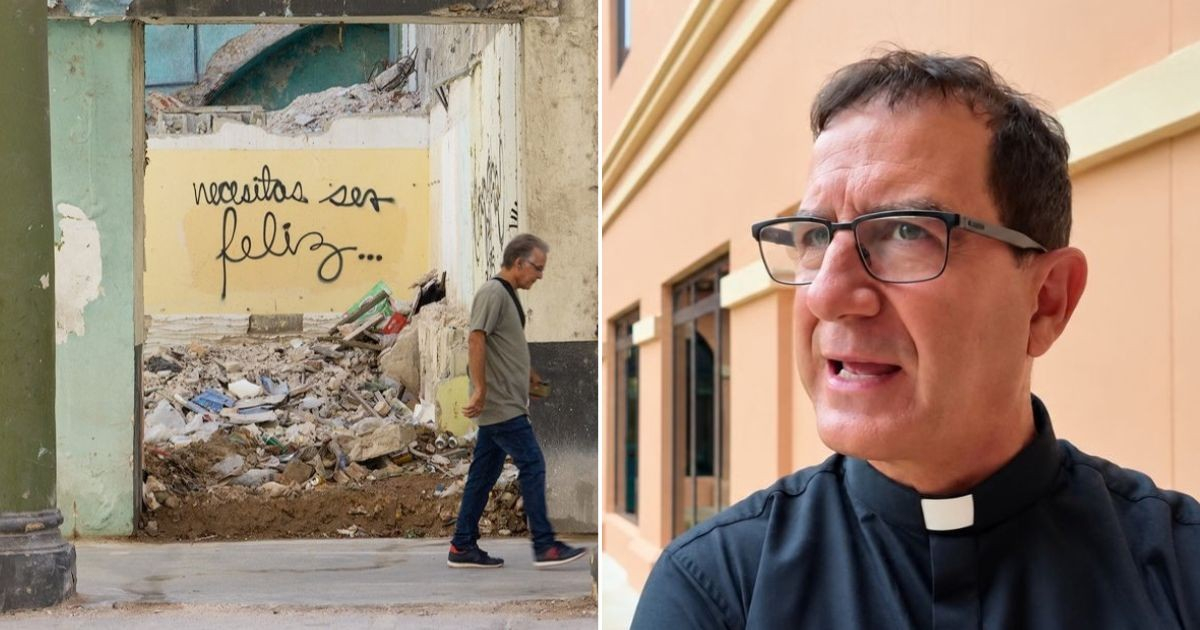
The Cuban priest Alberto Reyes Pías stated this Friday that Cuba needs to move beyond a life reduced to mere survival and urged citizens not to accept as normal the precariousness, fear, and loss of rights.
In his message, published on his Facebook profile, the parish priest of Esmeralda, in Camagüey, reflected on the difference between merely surviving and being able to lead a life with dignity, prosperity, freedom, and future projects.
"We were not born to survive. We were born to live with dignity, to have a prosperous existence, to live freely and without fears," wrote Reyes.
For the priest, surviving has become the daily routine for many Cubans: getting up thinking about how to obtain the essentials to make it to the next day, standing in line after line and dealing with one makeshift solution after another, searching for medicines that are nowhere to be found, facing increasingly expensive food, scarce fuel, and constant blackouts.
To that accumulation of difficulties, he added what he described as a persistent uncertainty that ultimately raises the same question: "How long will this last?"
Reyes warned, however, that one of the greatest dangers arises when this reality ceases to be perceived as exceptional and begins to be accepted as inevitable.
"Surviving means getting used to this agonizing life to the point of considering it 'normal'; it is allowing need to convince us that living this way is our destiny. But it is not, and it does not have to be." he pointed out.
According to the priest, when survival becomes the sole aspiration of a society, the desire to build, the ability to dream, and hope begin to fade away.
"We begin to celebrate what should be guaranteed, we thank as if it were a privilege what should be a right, we settle for crumbs because we have forgotten our worth, our dignity," he wrote.
Reyes insisted that a dignified life cannot be reduced to finding food, obtaining a few hours of electricity, or locating a medication.
In his opinion, it also requires freedom, security, opportunities, quality education, employment that can cover living costs, and real possibilities for developing personal projects.
In another of the most direct passages of his reflection, he stated that “Cuba does not only need a change of system”, but also citizens convinced that the country can have a different future.
"Cuba needs children who deeply believe that this island is not doomed to always be what it is today," he expressed.
The priest suggested that change begins when a society stops considering as normal what harms it and regains awareness of its own rights.
He also listed some actions that, in his opinion, can be undertaken from now on: "Do not lie, do not applaud what binds us, do not leave alone those who raise their voice, do not abandon those who suffer alongside us."
Reyes concluded his reflection by directly linking the recovery of freedom with the loss of fear and the defense of individual rights.
"Perhaps we cannot change everything overnight, but we can start today, because a people begins to reclaim its freedom when it understands that no ideology, government, or power is above its rights, and stops being afraid to voice what everyone whispers in silence," he concluded.
Fear, resignation, and the normalization of the crisis have repeatedly appeared in the public messages of the priest in recent months.
In June, Reyes questioned whether living "in survival mode", caught between exhaustion and constantly postponed projects, could be considered normal.
In that reflection, he linked that reality to power outages, economic hardship, and the deterioration of public services.
A month later, he returned to the theme of fear as a mechanism of control and reflected on the fear of Cubans themselves to imagine a life "without chains", pointing out that the fear of change can end up serving as one of the supports of the system.
At the end of July, Reyes shifted the focus to those in power and stated that those who "took over the country" also fear the people, whom he claimed they have ignored for decades.
In August, he once again intensified his message by stating that the demands of Cubans should not be limited to addressing material needs, but ratherto aspire to a "radical change" and the "end of shackles".
Days later, he directed a reflection specifically at military personnel, police, State Security agents, and others associated with control mechanisms, reminding them that “a people cannot be chained forever”.
In September, on the occasion of the upcoming celebration of the Virgen de la Caridad del Cobre, he urged to maintain "the courage to tell the truth" amidst repression.
More recently, he described the Catholic Church in Cuba as an “uncomfortable neighbor” that the regime has not been able to silence.
Related videos:
Filed under: