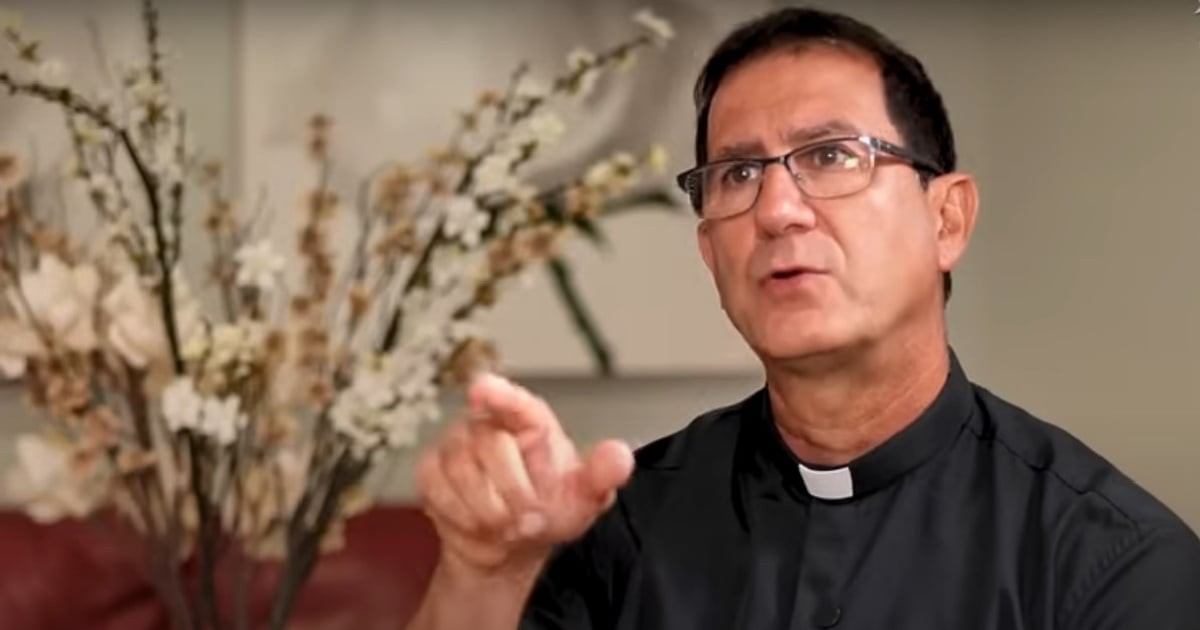
The Cuban priest Alberto Reyes Pías, parish priest of Esmeralda, Camagüey, published this Friday the 168th installment of his weekly column "I Have Been Thinking" with a message that goes straight to the heart of the debate about the protests in Cuba: the cry of the Cuban people is not a plea for basic services, but a demand for freedom and political change.
Under the title "I Have Been Thinking About the Identity of Our Cry," Reyes builds his argument using an unusual approach: he consulted an artificial intelligence about the causes of popular discontent against the dictatorship of Fulgencio Batista, who came to power through a coup in 1952.
The tool identified factors contributing to the public's rejection during that time as censorship, the repression of dissent through arbitrary detentions, widespread corruption within security forces, centralization of power, and significant emigration driven by economic difficulties.
The priest does not need to explain the parallel; he drops it with surgical precision. "It is sad to note that, in reality, we have only transitioned from one dictatorship to another, which not only repeated the same mistakes of the previous one but also plunged the country into misery and destruction, turning us into a people of surviving beggars," he writes.
Reyes acknowledges that the Revolution arrived with concrete promises: a country without fears, without repression, without censorship, where emigration would be a free choice and not a desperate escape. But he concludes that that promise was betrayed from its very foundation.
The core of the reflection is a warning directed both at Cubans within the island and at those observing from the outside: that material precariousness should not exhaust the understanding of what is happening. "That is why now, when we protest against shortages and the precariousness of life, it may seem that our cry is merely for assistance, and that we only take to the streets to demand electricity, water, or food," the priest acknowledges.
But immediately corrects that interpretation: "Let urgencies and needs not deceive us, nor deceive those who see us from outside our shores, because among the cries demanding the basics, this people shouts 'Homeland and life!', shouts 'Change the system!', shouts 'Freedom!', shouts 'Enough already!'."
The column arrives at a time of extreme crisis. Cuba registered three total collapses of the National Electric System in July 2026, with generation deficits exceeding 2,000 MW during peak hours. The failures of the NES have left millions of people without electricity. Essential medications have only been available at 30% of the normal supply since 2025, infant mortality has doubled to 9.9 per 1,000 live births, and food production has declined by several tenths of a percentage point.
In this context, the Cuban Conflict Observatory recorded a historic high of 107 protests in June 2026, with 82 concentrated in Havana. Independent organizations estimate that there are more than 1,300 political prisoners still incarcerated in Cuba, with hundreds directly sanctioned for the protests on July 11, 2021.
Reyes is not a new or improvised voice. He has been publishing his column since 2020 and has built one of the most sustained critical references within the island. In January 2026, State Security summoned him along with another priest in Camagüey. In May 2024, he made a symbolic gesture by announcing that he would ring the bells of his church 30 times every night during blackouts. In recent installments, he described Cuba as a "country at war" due to blackouts and shortages, and last week he suggested that those in power also live in fear of the people.
On the fifth anniversary of the 11J —the largest anti-government protests in Cuba in decades— new protests with pots and pans were recorded in Old Havana and Guanabacoa, a sign that the flame described by Reyes has not been extinguished. His conclusion in issue 168 leaves no room for ambiguity: "Our cry is not for assistance, it is for radical change, it is for the end of the chains, it is for life in freedom."
Related videos:
Filed under: