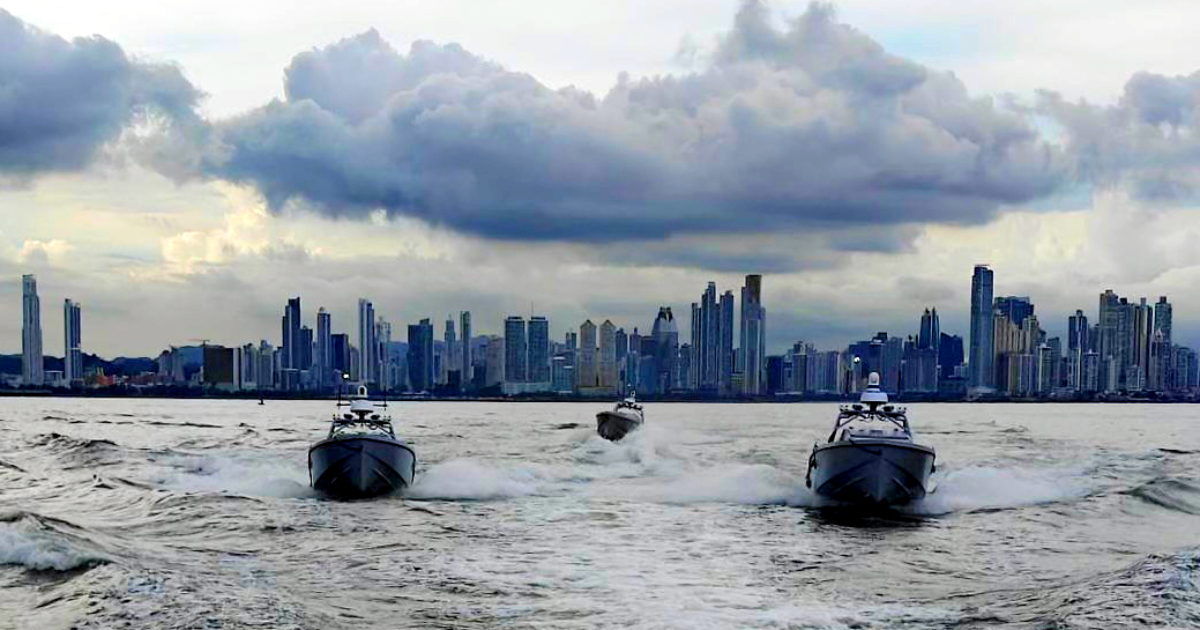
The United States Southern Command (SOUTHCOM) and the National Aeronaval Service of Panama announced on Friday the expansion of the deployment of unmanned autonomous vessels model Corsair in Panamanian waters to reinforce coastal security and combat drug trafficking and transnational criminal networks.
The vessels participated in the exercise Panamax 2026, which concluded in mid-August. After evaluating their performance, the U.S. embassy and SOUTHCOM coordinated with the Ministry of Security of Panama for their continued presence on a maritime security mission alongside the National Aeronaval Service (SENAN).
According to a post by SOUTHCOM on its official account, the newly established SOUTHCOM Autonomous Warfare Command (SAWC) is working with Panamanian personnel to establish "a persistent patrol presence" in key maritime routes, providing tools to detect, monitor, and respond to illicit activities.
The U.S. command described the bilateral deployment as "an important step" in regional strategic collaboration. Official texts place the operations in Panamanian waters, without specifying all the patrol zones.
Persistent surveillance and possible protection of the Canal
The radars and electro-optical sensors of the Corsair enhance surveillance capabilities and distinguish routine movements from activities that require investigation. The platforms complement manned vessels, aircraft, and personnel in Panama, allowing for the concentration of those resources on response and interdiction missions.
Colonel Ian Fletcher, commander of the SAWC, explained in the official statement that the cooperation will also allow for the evaluation of new autonomous capabilities to protect navigable waterways and critical maritime infrastructure, including their safe and effective use in the environment of the Panama Canal.
The stated mission involves the fight against drug trafficking, regional threat networks, and threats associated with organizations designated as terrorist. The statement emphasizes that the systems complement the maritime security forces and decision-making authorities in Panama.
The deployment also supports the objectives of the Americas Counter Cartel Coalition (ACCC): to enhance regional coordination against cartels and other threats while respecting the sovereignty and competencies of the participating countries.
What capabilities do the Corsair have?
The Corsair is manufactured by Saronic Technologies, a Texas-based company founded in 2022. According to data collected by Forbes España, it measures 7.3 meters in length, reaches a maximum speed of 35 knots, and can carry up to 454 kilograms of payload.
Its autonomy exceeds 1,150 nautical miles, approximately 2,130 kilometers. However, this range does not solely equate to an operational radius of the same distance: the effective range depends on the mission profile, navigational conditions, and the needs for return and reserve.
The publication also describes a 360-degree camera, long-range navigation radar, and electro-optical sensors, and places the price of each unit below one million dollars.
The U.S. statement highlights that similar platforms recently participated in the rescue of AH-64 Apache helicopter pilots off the coast of Oman, demonstrating their use in missions other than maritime surveillance.
Guantánamo and the Tension with Cuba
Although the announcement does not mention Cuba, the expansion of SOUTHCOM's autonomous systems gains significance in the context of U.S. pressure on Havana and the incorporation of Guantánamo into the structure of the SAWC.
The autonomous command was established on April 21, 2026, and designated the Guantanamo Naval Base as its first training and mission support site. The presence of this facility in the immediate vicinity of Cuba adds a strategic dimension to the regional development of these capabilities, although it does not justify a mission against the Island by the units deployed in Panama.
The tension between Washington and Havana regarding drones has been escalating for months. In May, a report from Axios based on classified intelligence indicated that Cuba may have acquired over 300 military drones of Russian and Iranian manufacture since 2023, and that officials from the regime had evaluated their potential use against Guantánamo, U.S. vessels, and Key West.
The Secretary of Defense, Pete Hegseth, visited Guantanamo in June and warned that it would be "reckless" for Cuba to acquire weapons capable of reaching the base or the continental U.S. In July, Donald Trump remarked on the potential presence of Iranian drones in Cuba: "If they have them, and they very well could, we'll take care of that in no time."
Havana has reasons to pay attention to that reference to regional threats.
In August, Diálogo Américas, a publication linked to SOUTHCOM, described GAESA's control over strategic infrastructure and its relationships with China and Russia as a threat to the security of the region.
That background, along with the inclusion of Guantánamo in the structure of the SAWC, allows us to situate the expansion of the Corsair in a context that also pertains to the Cuban regime, even though the announcement of the mission in Panama does not identify it as a target.
Related videos:
Filed under: