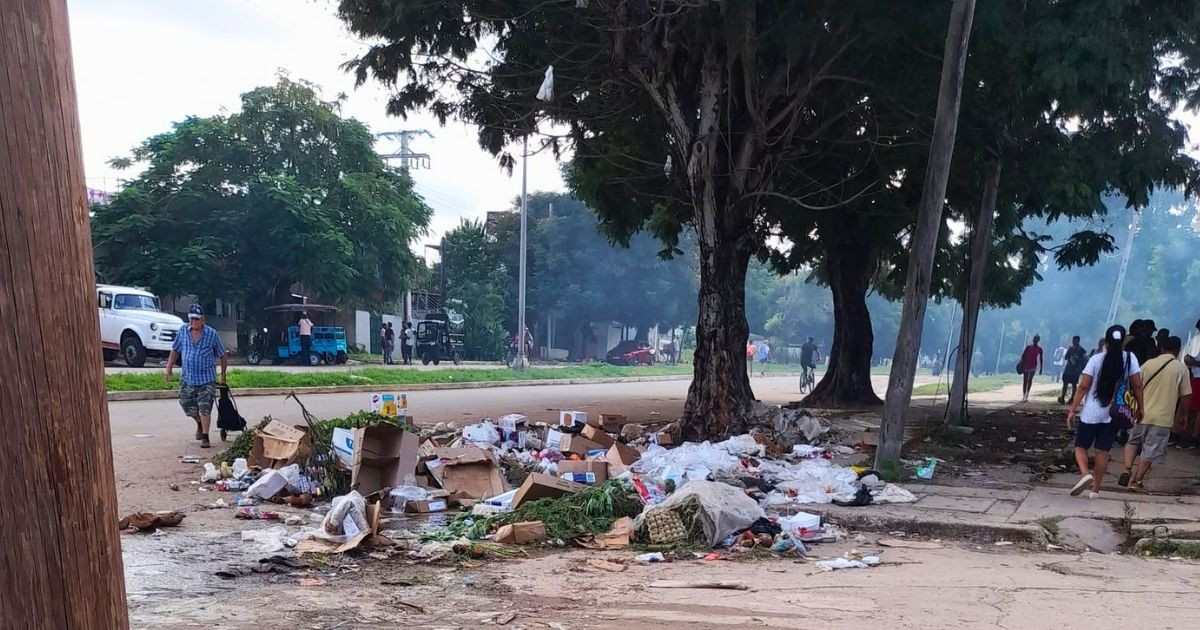
A Cuban identified as Zea Gisselle posted on Facebook a testimony about the extreme unsanitary conditions faced by the municipality of Marianao in Havana, where she described streets turned into dump sites, overflowing sewage, green flies, and scavenger birds soaring over the neighborhoods, along with a stench that, in her words, "sneaks into the lungs, clings to the clothes, to the skin."
The author recounts spending seven days ill with chills, fevers, and watery diarrhea, symptoms she cannot attribute to the water—which she consumes boiled and filtered—or to a lack of personal hygiene. "The only explanation I find is that my body is beginning to react defensively to all the filth that surrounds us. It reacts to the putrid smells, to the stench emitted by the sewage waters that flood the entire city, to the foulness that spreads and takes over every corner," she wrote.
Zea Gisselle accompanied her post with a photograph of a garbage container near her home in the Zamora neighborhood and clarified that she refrained from sharing more photos so as not to "flood Facebook with such unpleasant images." Nonetheless, her complaint was powerful: "Disgusting, walking through all of Cuba right now feels disgusting [...] It's not just one corner, or two or three... it’s not only Marianao, it’s not only Zamora... all of Cuba is dying, they are killing us."
His criticism of the regime was direct: "The State knows all the horror it is subjecting us to, and does absolutely nothing to save us; and of course, it will not do anything. They prefer us dead rather than relinquishing power."
The comments on the post confirmed that the situation is not limited to Marianao. Cubans from Santiago de Cuba, Cojímar, and El Vedado described identical realities. A resident of the Zamora neighborhood wrote that she no longer calls it by its name: "now I call it the underworld."
A healthcare worker who also fell ill twice in a month reflected, "What we are experiencing is exhausting. It drains you and takes all your energy just in the effort to survive every day. [...] I believe it’s part of their strategy. Something they rely on. Leaving us exhausted, without the strength to react." Another person summed it up in a few words: "If it were just Marianao... It’s all of Cuba."
The testimony reflects a structural crisis that reached critical levels in 2026. Havana generates between 24,000 and 30,000 cubic meters of waste daily, of which over 20,000 could go uncollected each day. At the beginning of this year, only 44 out of the 106 waste collection trucks in the capital were operational due to a shortage of diesel and mechanical deterioration.
In light of the collapse, the regime is implementing "band-aids," such as the one led by Prime Minister Manuel Marrero Cruz when he called for a cleanup day in Havana, with over 450 work teams and announced a plan of measures to alleviate the terrible waste situation. The problem, however, continued to grow like the piles of trash on the streets.
Unhealthiness intertwines with an epidemiological emergency. According to the Global Dengue Observatory, Cuba reported 11,235 cases of dengue in 2026 —based on data as of October 4— which is equivalent to 9.2 times the historical average of the previous five years, with all four serotypes circulating simultaneously.
The Ministry of Public Health of Cuba (MINSAP) also acknowledged an increase in acute diarrheal diseases, hepatitis, and respiratory infections, amid the deterioration of the country’s sanitary conditions. The U.S. Embassy in Havana issued a health alert in September regarding the rise in gastrointestinal diseases throughout the country.
Zea Gisselle senses it in her own sick body when she asks herself, "Is this the country we are going to leave to our children? Is living amidst gigantic dumps and rivers of sewage the future we want?"
Related videos:
Filed under: