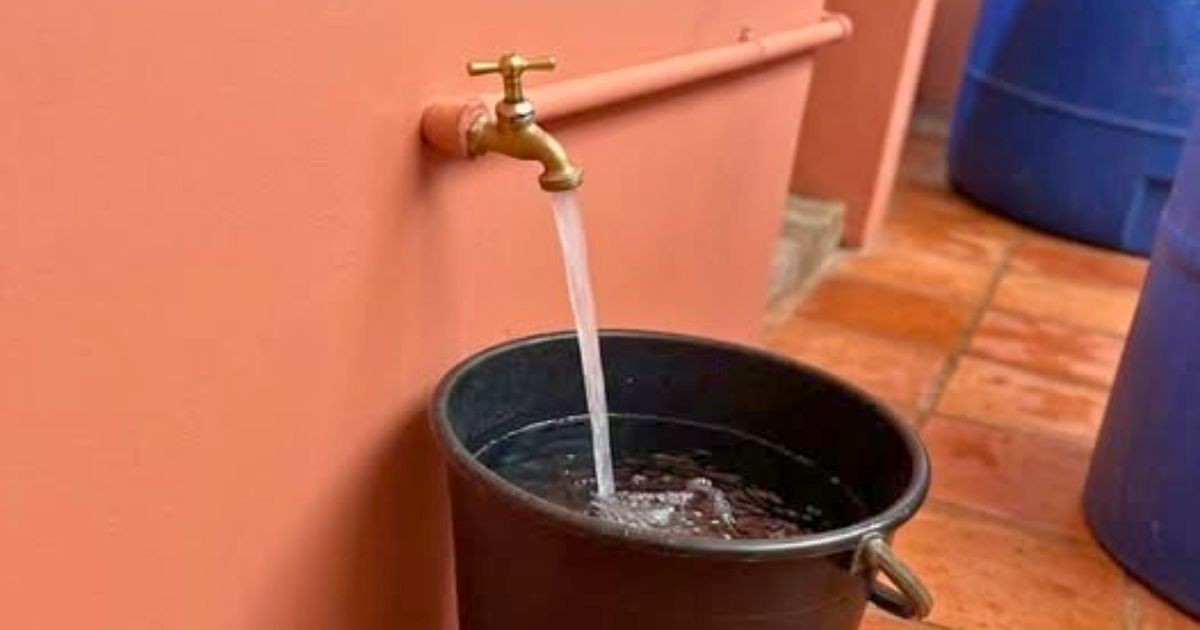
The Holguin writer José Poveda Cruz published a text on Facebook this Sunday titled "The Philosophy of the Little Tap", a chronicle of philosophical irony that accurately portrays the crisis of water, electricity, and money faced by the Cuban population.
The story begins with an image that encapsulates the daily absurdity of the Island: after twenty-eight days without water, a "timid trickle" arrived at his home, which disappeared as soon as the three hours of daily electricity service started in his area of Holguín.
"Then the neighbors with pumps started sucking up water, and my poor little trickle disappeared," writes Poveda Cruz, before posing a question that, according to him, "no philosopher had foreseen": "What good is it that water reaches my house if others have the power to take it away before I can fill a bucket?"
The conclusion drawn by the writer encapsulates the plight of millions of Cubans: “What is extraordinary is that even washing one’s face requires competition for resources, as if survival were an Olympic event and each family had to earn its medal.”
The phenomenon being described is not anecdotal. Suction pumps—popularly known as "water thieves"—are sold in the informal Cuban market for tens of thousands of pesos, and when several neighbors connect them simultaneously during the limited hours of electricity, they reduce the pressure in the network for those who do not have these devices, creating exactly the unequal competition that Poveda Cruz describes.
The structural problem is even deeper: more than 80% of the Cuban water supply system depends on electricity, which means that every power outage equates to a simultaneous water cut.
In Holguín, the situation is particularly severe. Some areas experienced between 70 and 90 days without service throughout 2026, and over 200,000 residents were facing supply cycles exceeding seven days. The main provincial hospital, the clinical-surgical Lucía Íñiguez Landín, was reported without drinking water in September, forcing patients' families to walk almost a kilometer to a private well.
At the national level, the regime itself admitted in October that 2.7 million people were experiencing total or partial disruptions of the essential supply.
Poveda Cruz's text also points to the electrical crisis that underlies everything mentioned above. Daily generation deficits that can exceed 2,000 MW and eight total collapses of the National Electric System so far this year illustrate this quite clearly.
In addition to the water shortages and power outages, the writer adds a third calamity: the inability to withdraw salary from ATMs. "It is deposited on a magnetic card punctually, but then it becomes impossible to take it out from the machines. It doesn't disappear or get spent; it remains in some electronic limbo while its owner watches the month go by. [...] One ends up wondering if they earn a salary or if they periodically receive the news that they have money," he writes.
The precariousness of Cuba's banking infrastructure is reflected in figures documented for years. In 2023, authorities in the sector acknowledged that 100 of the country's 168 municipalities lacked ATMs. The situation also affects Havana, where more than half of these machines were out of service in May 2026, according to news reports.
This publication is part of a series of texts that Poveda Cruz has dedicated to the Cuban crisis throughout the year. In July, he described how basic necessities seem like luxury items, citing specific data from that time: charcoal at 2,500 pesos per bag, rice and beans at 400 pesos per pound, oil at 2,200 pesos per liter...
In September, the writer published "Manual for Lighting Charcoal", addressing the civilizational regression of relying on traditional stoves following the indefinite suspension of liquefied gas in the eastern provinces months earlier.
Poveda Cruz subtly weaves an image at the end of his chronicle that blends resignation and humor: "I suspect that if Aristotle were alive today in Holguín, he would postpone his research on the first causes and spend the morning figuring out when the water will come back."
Related videos:
Filed under: