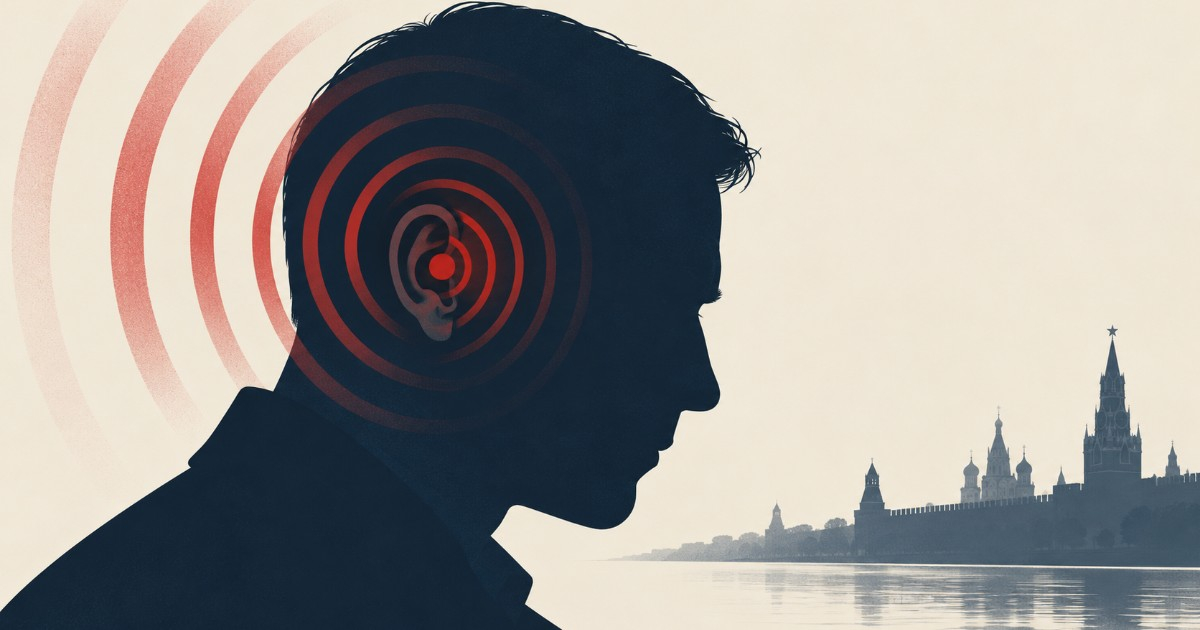
An investigation by the British newspaper The Guardian has rekindled suspicions regarding the possible involvement of Russian intelligence in the incidents known as the Havana syndrome. The report includes new testimonies, evidence related to Russian agents, and information about a supposed device capable of emitting pulsed microwaves. It also examines allegations of a purported cover-up within the U.S. government, dismissed by a former CIA director.
The journalistic work, published on Saturday, October 10, is based on original interviews and early access to The Havana Syndrome: Secret Weapons, a Government Cover-Up, and the Greatest Spy Mystery of Our Time, a book by Michael Rey and Oriana Zill de Granados, producers of the CBS program 60 Minutes, with a foreword by journalist Scott Pelley. The Crown Publishing is set to release it on Tuesday, October 13, in the United States.
Its authors suggest that Russia may have been behind some of the incidents experienced by American diplomats and officials, and they question how intelligence agencies responded. However, neither Russian authorship nor the use of a weapon in those episodes has been conclusively proven.
The Russian lead: agents, movements, and a possible link to Cuba
One of the lines of inquiry highlighted by the newspaper points to Unit 29155 of the GRU, the Russian military intelligence service, associated with covert operations in other countries. Investigative journalist Christo Grozev stated that the leaked travel data allows for the identification of at least four potential matches between the movements of members of that unit and locations where anomalous health incidents were reported.
Grozev also stated that he had tracked trips to Cuba made by individuals linked to what he described as a possible technical unit close to 29155, during the period when the first reports emerged in Havana. These coincidences do not in themselves prove that the travelers participated in attacks or that the Cuban regime was aware of any alleged operation.
The book, according to a review by The Guardian, also describes an internal investigation by the CIA that supposedly located phones linked to Russian agents near some incident sites in 2019. One of these devices was reportedly about ten meters from the hotel room of a U.S. agent in London. These are allegations attributed to sources of the work, not publicly verified evidence.
The testimonies of CIA agents who suffered severe symptoms
One of the most striking accounts comes from a senior CIA official who was involved in operations related to Russia. In April 2019, while in London, he woke up in his hotel with a severe headache, sweating, disorientation, and loss of balance. The next day, he struggled to recall the names of colleagues he usually worked with.
Months later, during another trip to Warsaw, he experienced a similar and even more intense episode. He described the sensation as if someone were hitting him repeatedly on the head with a baseball bat. The persistent symptoms affected his health for years. His testimony does not allow us to determine what caused the episode on its own.
Another case is that of Marc Polymeropoulos, a former senior official of the CIA, who reported that he began to experience vertigo and severe headaches after a visit to Moscow in December 2017. In the United States, he was subsequently diagnosed with a mild traumatic brain injury, and in 2023, he was granted the right to compensation under the HAVANA Act. That acknowledgment also does not identify the source of his symptoms.
A microwave device purchased by the United States
One of the most novel elements of the report is the alleged acquisition by the United States, in late 2024, of a portable device capable of emitting pulsed microwaves. Two sources confirmed to The Guardian that the equipment was obtained during an undercover operation and transported to U.S. territory for study.
A source interviewed for the book claimed that the device originated from an illicit Russian network. According to information gathered by the newspaper, animal tests reportedly produced symptoms similar to those described in certain anomalous health incidents. The technical details and full results of those trials have not been disclosed in a way that allows for independent evaluation.
The newspaper emphasizes that it is not believed that this specific device was used in any of the reported cases. Its existence, if the attributed characteristics are confirmed, could support the technical feasibility of certain hypotheses, but it would not demonstrate who caused the incidents in Havana or those that occurred later in other countries.
The report also recalls a declassified statement from the U.S. National Security Agency (NSA), included in a compensation claim from 2014, which referenced intelligence information from 2012 regarding a potential high-power microwave system associated with a country deemed hostile. Sources from the newspaper identified that country as Russia, although the document did not name it.
What scientists say and why the CIA rejects the accusation of cover-up
David Relman, a professor at Stanford who chaired a scientific panel convened by the U.S. government in 2022, explained to The Guardian that a small group of cases could most plausibly be explained by exposure to pulsed microwave energy. The panel had access to medical records and numerous classified documents, but it was not commissioned to identify the suspected perpetrators.
Relman believes that some clinical presentations exhibit characteristics that are difficult to explain by known medical or environmental causes, although he acknowledged that many other cases could be attributed to different factors. Other specialists have questioned the hypothesis of a directed energy weapon and have suggested environmental, medical, or psychogenic explanations. The origin of the symptoms remains a subject of disagreement.
In 2023, an assessment by the U.S. intelligence community concluded that it was highly unlikely that foreign adversaries were responsible for the reported incidents. In a subsequent review conducted in early 2025, five agencies maintained a similar evaluation, while one agency considered there was an approximately equal likelihood of foreign involvement through a novel weapon in a small number of cases.
According to the British newspaper, Tulsi Gabbard retracted her previous assessments this summer, citing failures in information handling, but did not publicly present new evidence linking the incidents to Russia. For his part, Bill Burns, former director of the CIA, explicitly denied that the agency had covered up the case and defended the rigor of the investigative work conducted.
The question about the Cuban regime
The name of the syndrome originates from Havana, where in 2016 reports began to emerge from American diplomats about strange sounds, pressure, dizziness, and subsequent health issues. The first reports arose during the diplomatic rapprochement initiated between Washington and Havana, a process that, according to the report, unsettled hardline sectors of the Cuban regime and its allies in Moscow.
Cuban authorities have repeatedly denied their responsibility and have questioned the American accusations. The hypothesis that Russian agents, one of the regime's main allies, may have operated on Cuban territory raises an obviously relevant political question: what did the authorities in Havana know? Until now, however, there is no conclusive public evidence to support knowledge, authorization, or involvement of the regime in an alleged attack.
The topic had already resurfaced in reports published by CiberCuba in March, while on October 5, former National Security Advisor John Bolton questioned the investigation by the United States and Canada regarding the possible role of Russia.
The publication of the new book will bring the case back to international debate, ten years after the initial reports in Cuba. The revelations and testimonies provide new leads for investigation, but they still do not definitively resolve what caused the episodes or who, if anyone, was responsible.
Related videos:
Filed under: