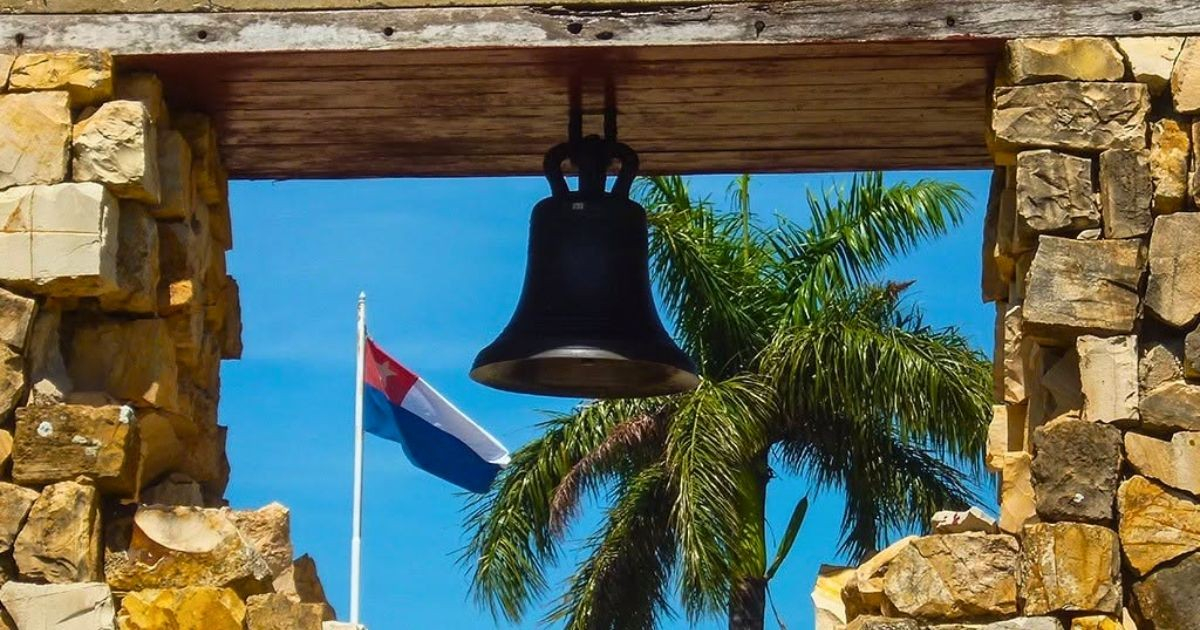
On the 158th anniversary of the Uprising of La Demajagua, historian Ivette García González published a reflection on her Facebook profile in which she shares excerpts from the Manifesto of the Revolutionary Council of the Island of Cuba and argues for its full relevance to today's Cuba.
García González, a doctor in Historical Sciences and former full professor at the University of Havana, invites her readers to a reading exercise that is as straightforward as it is revealing: mentally replace the word "Spain" with "Regime" while going through the foundational document of 1868. Her conclusion is clear: "the method may vary, but the substrate remains the same."
The text that the academic highlights was made public by Carlos Manuel de Céspedes on October 10, 1868, at the La Demajagua sugar mill, near Manzanillo, the same day he declared the slaves he owned to be free and led the uprising that marked the beginning of the Ten Years' War against Spanish colonial rule.
That uprising, later known as the Grito de Yara due to the first combative action of the independence fighters in Yara the following day, opened a conflict that lasted until 1878 and concluded with the Pacto del Zanjón, without achieving independence. The Republic of Cuba would not be established until 1902, after several periods of struggle and a U.S. military occupation.
The Manifesto denounced that Cubans lived "deprived of all political, civil, and religious freedom," that their children were "exiled from their homeland to remote climates or executed without any due process," and that they were even denied the right to assemble. One of its most striking phrases captures the intellectual suffocation of colonialism: "In short, the Island of Cuba cannot thrive [...] Cubans cannot speak, cannot write, cannot even think [...]."
In light of that reality, the document proclaimed: "We are not flattered by ambitions; we only want to be free and equal, as the Creator made all men."
García González emphasizes that this demand, made 158 years ago, resonates strongly in present-day Cuba. "We come from there too," he writes, "we are a people that has risen up one time and a thousand against oppression." The figures from 2026 support this interpretation: the Cuban Observatory of Human Rights documented more than 3,000 repressive actions in the first nine months of the year, while Prisoners Defenders reports over 1,300 people subjected to imprisonment or restrictions for political reasons on the island.
The Manifesto of 1868 was not just a denunciation: it also proclaimed a political program that included universal suffrage, national representation to enact laws and taxes, free trade with friendly nations, and "the religious observance of the inalienable rights of man." Demands that, in 21st-century Cuba, remain unfulfilled under the dictatorship of the Communist Party.
The publication from October 10th is part of a series of analyses that García González has disseminated throughout 2026. In September, he argued that protests must become a strategy for struggle to avoid repeating the cycle of "crisis-protests-retreat." In May, he concluded that "neither Cuba is an exception, nor are dictatorships invincible". And in that same month, he unveiled a strategy to organize a Civic National Movement against the dictatorship.
The Cuban Observatory of Conflicts recorded 1,415 protests and critical expressions just in July 2026, the highest monthly figure ever recorded in a country whose economy has experienced a contraction of over 15% since 2020.
In drawing that line between the Manifesto of 1868 and today's reality, García González concludes his reflection with the emphatic words from the document itself: “No, Cuba can no longer belong to a power that, like Cain, kills its brothers, and, like Saturn, devours its children. Cuba aspires to be a great and civilized nation, to extend a friendly hand and a fraternal heart to all other peoples.”
Related videos:
Filed under: