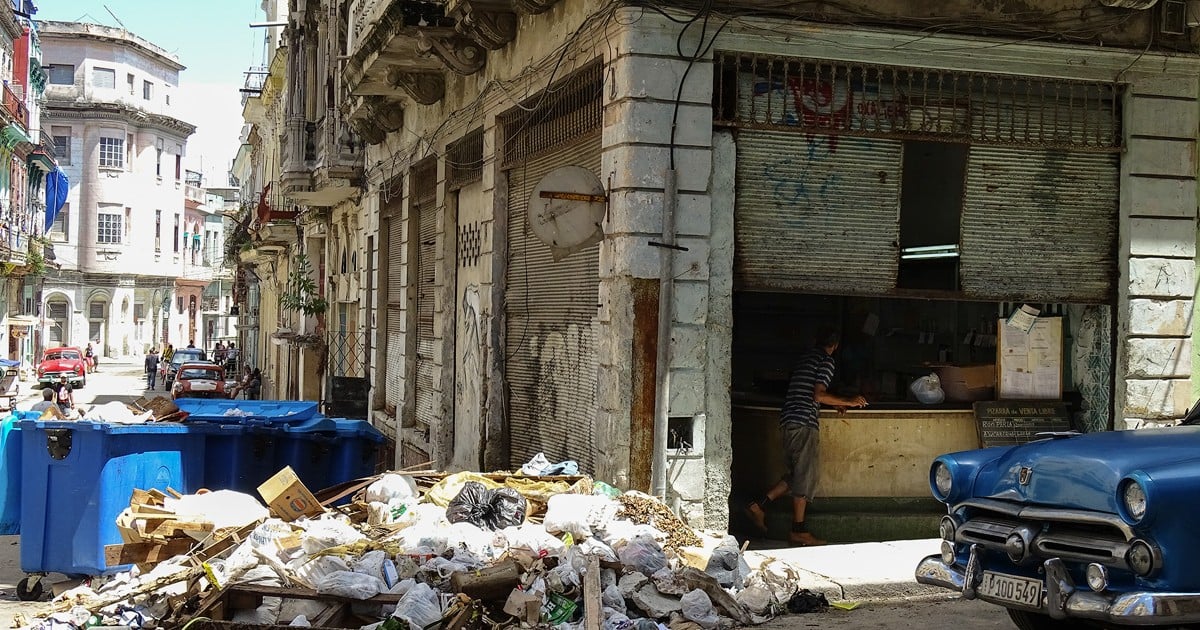
The Cuban government is making progress in the transformation of the bodegas and the gradual elimination of the ration book, two elements that for decades were symbols of the socialist economic model.
Behind the measures announced in 2026 lies a strategy that has taken years to develop and began to be publicly formulated during the presidency of Raúl Castro.
The strategy involves replacing universal subsidies with assistance for specific vulnerable groups and transforming the state distribution network into commercial establishments. The problem is that, while dismantling this system, the regime has not enabled Cubans to purchase the food they need with their salaries and pensions.
The confiscation of warehouses and the emergence of the ration booklet in Cuba
The bodegas were not created by socialism. They were private businesses, many of a family nature, that were part of the economic and social life of Cuban neighborhoods since the 19th century.
There was a store on every corner in the country's major cities. They weren't known for having gourmet or refined products. They simply sold food, drinks, and basic necessities at low prices. The merchants maintained trusting relationships with their customers, even through credit sales or simply "on account."
In the 1960s, the government radically transformed that model of economic exchange. Shopkeepers lost their businesses, many products disappeared, and local establishments were subjected to the decisions of state administration.
On July 12, 1963, the Offices of Control and Food Distribution (OFICODA) officially began operations, and the Consumer Registry was created. The Cuban state imposed the supply booklet, the creation of which had been announced on March 12, 1962, through a decree by the dictator Fidel Castro.
The warehouses began distributing specified amounts of food at officially set prices. The change was much deeper than just a change of ownership. The regime transformed a network of retailers into distribution points for rationed goods.
For decades, that system was presented as a social achievement, while the bodegas lost their original commercial function and, in many cases, ended up as rundown establishments, with scarce merchandise and dependent on irregular deliveries.
Now, more than 60 years later, the same State that eliminated that commercial model is trying to revive part of its functioning through neighborhood markets managed by private actors, at prices that the working people cannot afford.
Raúl Castro announced the end of the rationing booklet more than 15 years ago
The strategy to eliminate the supply voucher did not begin in 2024 or 2026. In December 2010, the economic reforms advocated by Raúl Castro included replacing generalized subsidies for products with assistance targeted toward those who truly needed it.
The then-ruler questioned the continuation of the ration book as a distribution mechanism and defended the need to gradually eliminate universal subsidies. However, the authorities themselves acknowledged a fundamental obstacle: the population's income did not allow for the immediate removal of this mechanism for the regulated sale of food.
In April 2011, the central report to the VI Congress of the Communist Party confirmed that the elimination of the ration book was included among the Guidelines of economic policy. The issue sparked an intense debate, precisely because many Cubans relied on those subsidized products to complete their diet.
Since then, the political orientation was established: the State intended to stop subsidizing products in order to concentrate its resources on certain individuals. However, what remained unresolved was how to ensure that citizens excluded from the aid could purchase food at market prices.
Díaz-Canel and Marrero Cruz continued the same strategy
The transition from Raúl Castro did not change that direction. In October 2020, Miguel Díaz-Canel announced that Cuba would gradually eliminate the ration book, linking that decision to salary reforms, pensions, and prices.
The so-called Ordering Task was intended to create the conditions for removing subsidies. However, its negative results did not allow wages to recover sufficient purchasing power. Inflation, the devaluation of the peso, and shortages worsened the difficulties in purchasing food. Extreme poverty began to rise sharply in Cuba.
In December 2024, Prime Minister Manuel Marrero Cruz confirmed that the decision to eliminate subsidies for the basic basket would proceed despite its social impact.
"This impacts the budget; we are looking for mechanisms and will be implementing it gradually, product by product, but it is a path that has no turning back," said Marrero Cruz.
His intervention revealed a crucial contradiction: the Government acknowledged that many workers could not afford food at market prices, yet it remained steadfast in its decision to eliminate subsidies.
While in 2010 the income of Cubans was insufficient to eliminate the rationing system, by 2024 the problem not only persisted but had worsened. The policy continued even though the State had not met the most important economic condition.
The conversion of the warehouses takes shape in 2026
The commercial transformation announced this year confirms the continuation of that strategy. In September, it was reported thatthe conversion of warehouses and butcher shops into neighborhood markets will be managed by SMEs, cooperatives, and other authorized economic actors.
The State offers tax incentives and temporary exemptions on leasing, but it retains ownership of the properties it confiscated in 1960. It is a historical paradox: after intervening in and ruining private businesses, it now seeks private actors again to reactivate establishments that it keeps under its control.
On October 8, the Ministry of Internal Trade (Mincin) announced the selection of 1,913 bodegas to serve vulnerable individuals, within a national network of more than 12,000 establishments. This figure represents approximately 16% of the total.
The authorities have not announced the closure of the other stores nor explained what their fate will be, but the selection confirms the move towards a differentiated distribution based on the vulnerability criteria established by the Government.
We are not facing a decision shaped by current relations with Washington. The elimination of universal subsidies was defined long before. What we see in 2026 is a new stage in its implementation.
The regime removes subsidies, but not poverty in Cuba
The economic crisis in Cuba highlights the main weakness of this policy. The Government intends to gradually eliminate subsidized distribution without ensuring that citizens can replace it with their income.
Subsidizing people instead of products is not necessarily a bad economic decision. It can enable public resources to reach those who need them most, but it requires adequate wages, well-supplied markets, transparent economic management, and a social protection system capable of reaching all households in need.
In Cuba, precariousness does not only affect those who are unemployed or have health issues that prevent them from working. It also impacts state employees and pensioners who receive a basic income of 3,210 CUP, an amount that is not even enough to buy a crate of 30 eggs (4,000 CUP).
The neighborhood markets do not resolve this contradiction. They offer prices that are 10% to 30% lower than those of other private establishments. The products remain unaffordable for most Cubans.
The announced death of the ration book
The history allows for the identification of a political continuity. The regime seized the stores and transformed them into locations for rationed distribution. Raúl Castro announced the gradual elimination of universal subsidies. The Communist Party incorporated this objective into its Guidelines. Díaz-Canel confirmed it and the economic measures for 2026 are advancing in their implementation.
There is no evidence that all the current transformations were designed from the outset, but there is documented evidence of the sustained decision to eliminate the ration book and replace generalized subsidies, regardless of the consequences this creates in Cuban society.
The regime cannot portray this policy as a response to the current tensions with the United States. Its origins are earlier and stem from decisions made by the Cuban government.
No society should consider it normal for its citizens to depend for generations on a ration card to obtain food and basic products, as if they were living in a post-war situation.
The Cuban government should have eliminated the ration book because economic development rendered it unnecessary, but it made the decision to withdraw it at a time when the population relies on it for survival.
Related videos:
Filed under: