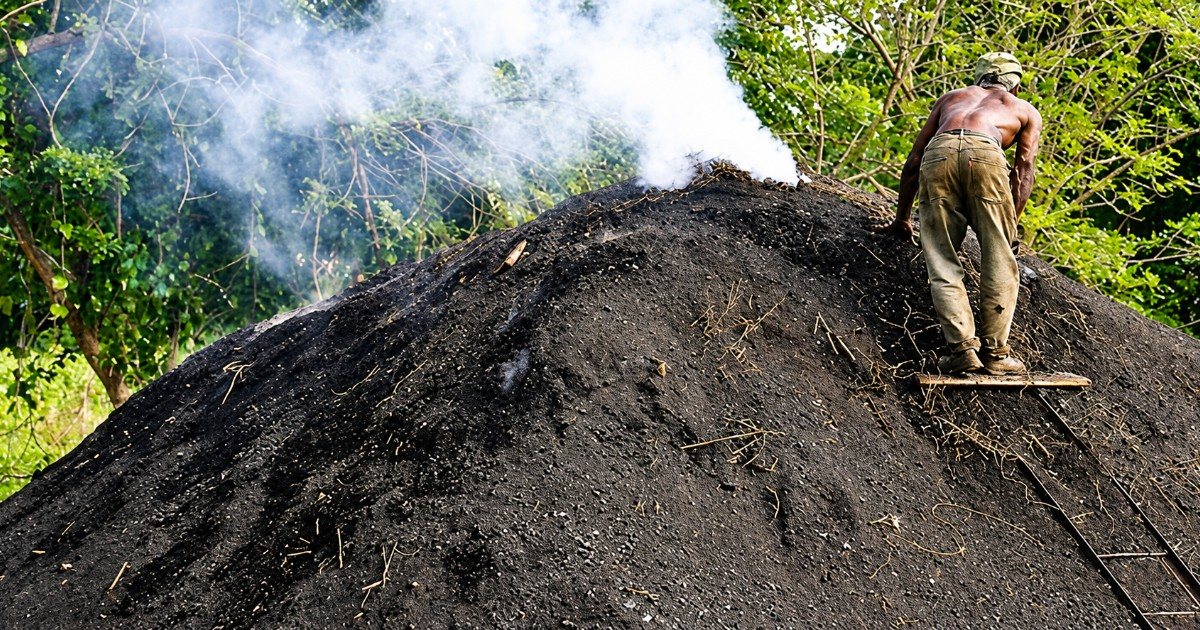
The fines for irregularities in the production of charcoal are increasing in Sancti Spíritus, amid an energy crisis that has forced thousands of Cuban families to turn to this fuel for cooking due to prolonged blackouts and the shortage of liquefied gas.
During 2026, the number of sanctions imposed in that province is already similar to the total recorded for the entire previous year, according to the official magazine Bohemia.
The main offenses are related to the improper use of fire in forest areas and the cutting of unauthorized timber species for charcoal production.
The increase in fines comes as the production of charcoal grows in Cuba, an activity that has attracted inexperienced individuals due to the demand for a fuel that has become essential for many households.
Ernesto Ramón Toledo Medina, technical director-developer of the Agroforestal Sancti Spíritus Company, acknowledged that “the situation is somewhat unregulated”.
"Yes, as a rule, that work was always carried out by charcoal makers, knowledgeable people, but today anyone can decide to make charcoal anywhere. And the reality is showing that not everyone acts in compliance with the custody regulations or the legal framework established for that activity," explained the specialist.
The forestry authorities clarified that producing charcoal is not prohibited, but it must be carried out with the appropriate permits, using permitted species and adhering to safety measures to prevent fires.
Iraida Rodríguez-Gallo Companioni, the second chief of the Forest Rangers in Sancti Spíritus, and Mariela Montelier Montelier, head of the Specialized Fire Management Group, explained that the inspections verify whether the kilns have authorization, what type of wood they use, where it was cut, and if the necessary preventive measures have been adopted.
"Some citizens are complaining, claiming that we prohibit the production of charcoal and that is not true; what we demand is the proper and safe use of fire in the designated areas and the use of approved wood for that purpose," they pointed out.
Among the authorized species are marabou and aroma, while the use of woods such as red mangrove, black mangrove, pataban, and yana constitutes an infringement. There are also restrictions on the cutting of marabou in water protection areas.
The very publication of Bohemia acknowledged that the price of coal continues to rise and that thousands of families rely on this fuel to prepare their food.
Coal, increasingly expensive and necessary for cooking in Cuba
The fines come at a time when charcoal has become one of the main alternatives for cooking in many Cuban households.
The lack of electricity, liquefied gas, and other household fuels has forced many families to resort to using charcoal stoves and firewood.
However, obtaining coal also represents a significant expense. Last July, the prices for a bag ranged between 3,200 and 5,000 Cuban pesos, depending on the province.
A month before, a sack of coal cost 3,200 pesos in Havana, while in Santa Clara it reached 5,000 pesos.
The situation even led the authorities of Sancti Spíritus to order in July that agricultural companies engage in charcoal production, with the aim of increasing supply and controlling prices.
Related videos:
Filed under: