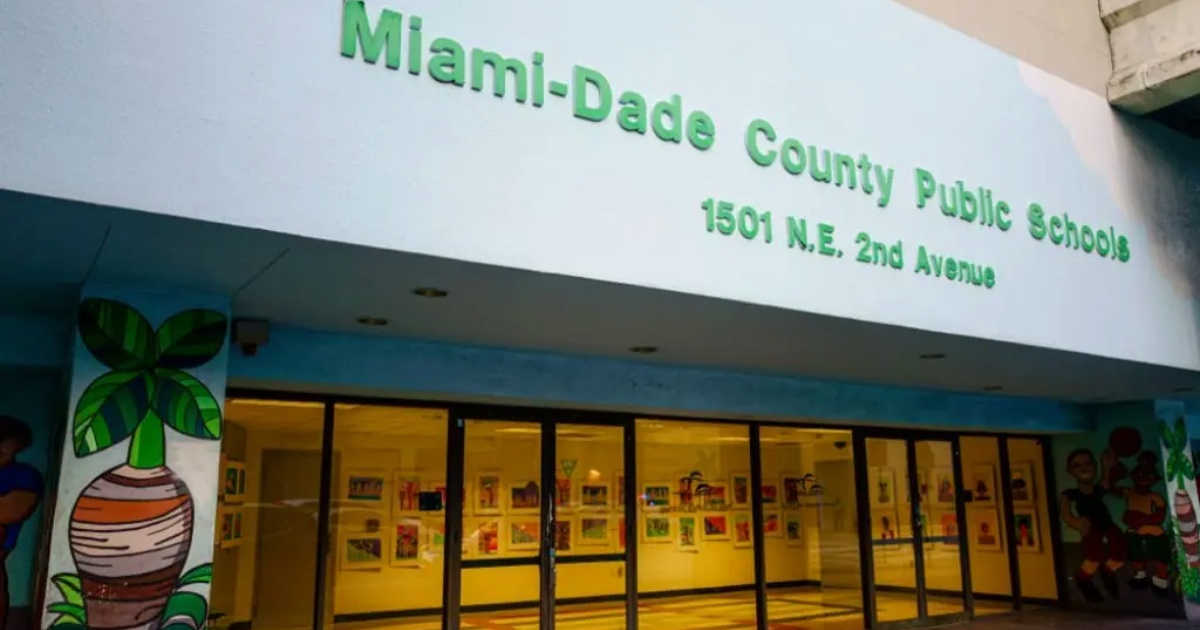
For the first time, Florida will allocate more state funds to scholarships for students in private schools than to traditional public and charter schools in Miami-Dade, even though the latter serve nearly four times as many students.
The situation highlights the challenges of an educational funding model that needs to support an expanding scholarship program while the enrollment in the public system declines.
During the 2026-2027 school year, the state will allocate approximately 766 million dollars for scholarships for about 82,470 students in private institutions, compared to 737 million dollars for 303,506 students in public and charter schools, according to the Miami Herald, based on budget documents from the Florida Department of Education.
The difference amounts to 29 million dollars and makes Miami-Dade the first major urban county in Florida where scholarships for private schools surpass the state allocation intended for public school students.
The distribution amounts, according to published calculations, to about 8,000 dollars per scholarship recipient, compared to less than 3,000 dollars per student in public and charter schools, considering exclusively the state funds included in that comparison.
However, these amounts do not represent the total educational expenditure per student. Florida contributes approximately 25% of the resources allocated to students in Miami-Dade, while local property taxes provide a significant portion of the remainder.
In fact, the county receives about $2.2 billion in local taxes for education, which is approximately 75% of the funding accounted for in that distribution. Therefore, the figures do not indicate that private schools receive more total public money per student than public schools.
The change is primarily a response to two trends moving in opposite directions: the accelerated growth of publicly funded school scholarships and the decline in students enrolled in traditional public schools.
Scholarships, known in English as vouchers, allow families to use state resources to cover certain educational expenses at private institutions, including religious schools.
The program was significantly expanded in 2023 when Governor Ron DeSantis promoted a reform that extended access to these aids to nearly all families in Florida, regardless of their income, although some modalities still have specific requirements.
Since then, the number of beneficiaries has increased, making scholarships an increasingly important part of the state educational budget.
The problem is that the funding formula used by Florida was created in the early 1970s, long before the current expansion of school vouchers.
Although it has undergone modifications over the years, its mechanisms were not originally designed to distribute resources between two systems of this magnitude.
Alex Rizo, Republican representative for Hialeah and former director of a charter school, acknowledged that the model requires a review.
“It’s an old formula and many things have happened since its creation,” he stated to the Miami Herald.
Rizo, who also worked as a public school administrator and is a member of two legislative education committees in Tallahassee, believes that the time has come to reform the funding system.
The situation in Miami-Dade is not entirely new in Florida. Although it is the first major urban county to reach this point, other school districts have already faced budgetary challenges related to the growth of scholarships.
During the 2025-2026 school year, five counties —Monroe, Collier, Martin, Sarasota, and Walton— reported scholarship funding obligations that exceeded their corresponding state allocations, according to budget documents cited by the newspaper.
In accounting terms, the calculation suggested that these districts owed money to the state to cover the private scholarships used by students from their respective areas.
The case of Monroe, where the Florida Keys are located, illustrates the challenges of the model. There were only 851 students with private scholarships, compared to 8,249 students in traditional public and charter schools, but the formula created an imbalance that necessitated the search for additional resources.
Sue Woltanski, a member of the Monroe School Board, explained that the issue was not necessarily due to an increase in scholarship recipients, but rather to a decline in public enrollment.
"Although our scholarship numbers had not increased, the number of students in public schools had decreased, so there was not enough money to pay all the students receiving scholarships," he stated.
Woltanski recalled that the calculation showed the district owed nearly a million dollars to the state due to school scholarships. Ultimately, state authorities provided the necessary funds to resolve the situation.
"They told us not to worry, and in the end, they gave us the money, for which we are grateful," he explained.
The difference between the districts is related to the value of the properties and the proportion of educational funding that comes from local taxes.
In counties with higher value properties, such as Miami-Dade and Monroe, local contributions account for a particularly significant portion of school resources.
This proportionately reduces the available state contribution within the ordinary formula, while private scholarships continue to generate funding obligations.
The Florida Legislature has already introduced adjustments to prevent those liabilities from leaving certain districts without sufficient state resources.
These include changes in the calculations of local contributions and mechanisms that allow for the transfer of additional funds when scholarships exceed the allocated amounts.
However, some officials believe that these temporary solutions will not resolve the problem in the long term.
Woltanski proposes to separate the funding of private scholarships from the formula used to allocate resources to public schools, so that each system has a distinct allocation.
"Wouldn't the scholarships be better protected in a separate fund, where they would have guaranteed funding from the state and not depend on the student population of their district?" she suggested.
The official also warned that covering the imbalances through additional state contributions could create new budgetary tensions if the model is not changed.
But advocates of private scholarships have other proposals.
Danny Aqua, representative of Teach Florida, an organization that advocates for the interests of private schools and Jewish schools in the state, believes that scholarship funding should be calculated using the same general criteria applied to public school students.
Aqua noted that the average public spending per student in public schools reached 11,531 dollars during the 2024-2025 school year, a figure that includes state, local, and federal funds and is therefore not directly comparable to the state contribution of less than 3,000 dollars mentioned for Miami-Dade.
"I believe that financing all students from the same sources would be beneficial and would make resources more predictable for both the district and the scholarship program," he stated.
He also proposed that teachers from private schools could benefit from certain resources generated by local referendums on school taxes.
In Miami-Dade, these mechanisms have been used in 2018, 2022, and again in 2026 to primarily finance teacher salaries and school safety measures.
Aqua argued that teachers in private schools also face salary difficulties and that allowing them to access part of those resources would reduce the funding disparities between the two sectors.
Bruce Baker, a professor at the University of Miami specialized in educational financing, believes it is possible that the rising cost of scholarships will lead lawmakers to consider that part of their funding comes from local taxes.
The specialist pointed out that if scholarships continue to increase, it could become difficult for the state to sustain them solely with its own resources.
For now, there is no definitive legislative decision on that possibility. The various proposals reflect a debate that could become significant during the upcoming sessions of the Florida Legislature.
The discussion also has an immediate dimension for families in Miami-Dade, including numerous Cuban families who use school scholarships to enroll their children in private and religious schools.
Programs such as Florida Tax Credit Scholarship (FTC) and Family Empowerment Scholarship for Educational Options (FES-EO), administered by authorized organizations like Step Up For Students, allow the use of public funds to cover tuition and other eligible educational expenses.
For those who choose these institutions, scholarships can significantly reduce the cost of private education. For families whose children remain in public schools, the debate centers around how to ensure sufficient resources to maintain teachers, academic programs, and facilities.
In statements to NBC6, Roberto Alonso, Cuban-American member of the Miami-Dade School Board, defended the freedom of choice for families.
"We have seen that many families want to send their children to religious schools, and that is their choice," he stated.
Alonso supports scholarships, but also considers it necessary to update the funding formula for public schools to adapt it to the current economic and demographic conditions of South Florida.
"As a district, we will continue to focus on our students, and as long as we do that, at the end of the day, our students will be the ones who benefit, because the competitive environment ensures that we all provide the best service," he stated.
A different perspective was expressed by Crystal Etienne, professor and founder of Eduvoter Action Network, a public education advocacy organization.
"It's not that there are more students in private schools, but rather that more money is being allocated to those students, and that's the problem," he questioned.
Etienne also expressed concern about the oversight mechanisms for public money used in private institutions.
"My first question was: where exactly does that money go? Because we don't know. Private schools do not have the same accountability requirement regarding how those funds are spent," she stated.
The debate over scholarships occurs as Miami-Dade faces a sustained decline in enrollment in its public schools.
The county has lost thousands of students amid the departure of families from South Florida, the slowdown in immigration, and other demographic changes.
The decrease in students directly affects budget allocations because a portion of educational resources is calculated based on enrollment numbers.
However, districts must continue to face personnel, maintenance, and facilities expenses even when the number of students decreases.
The growth of private scholarships also coincides with the emergence of a new federal educational funding mechanism.
Florida has joined a program that will allow federal tax credits of up to 1,700 dollars for certain donations to organizations that provide educational scholarships, an initiative that will begin on January 1, 2027.
Another report published by the Miami Herald explained that the new federal program could also benefit students in public schools, although there are still questions about how resources will be distributed.
Unlike state scholarships, which are funded through the public budget, this federal program will rely on private donations incentivized through tax credits. Authorized organizations will be responsible for distributing the assistance to eligible students.
The journalist noted that Step Up For Students has already established a fund called Step Up, Step Further Scholarship Fund, with which public schools could also collaborate.
The organization also announced an initiative to raise 250 million dollars for students in public schools, although details about its operation are still lacking.
The U.S. Secretary of Education, Linda McMahon, defended the new incentive during a visit to a private Jewish school in northern Miami-Dade, asserting that the program is not aimed exclusively at private schools.
For his part, Josh Cowen, a university professor and critic of state-funded private scholarships, argued that public schools should take advantage of available federal resources, although he warned that these do not replace the need for sustained state investments.
“Is there real money on the table for public schools in Florida? Absolutely. Does it replace all the financial damage caused by the vouchers? No,” he stated to the Miami Herald.
Related videos:
Filed under: