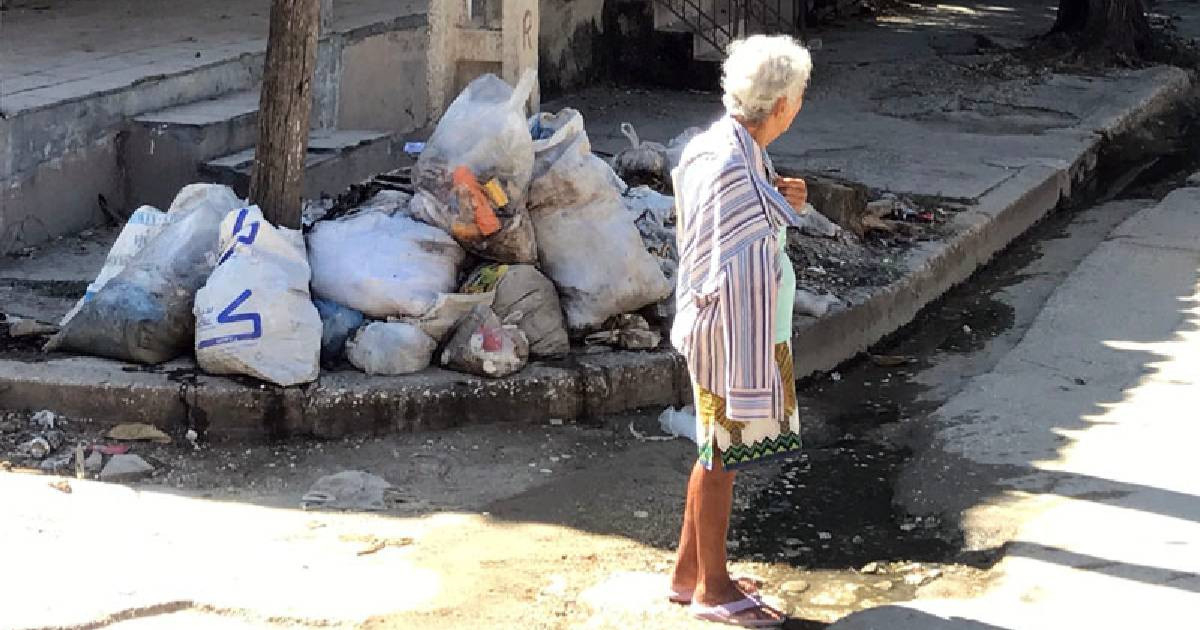
Cuba recorded 883,446 people in vulnerable situations at the end of August, an increase of 6,924 since April, while authorities acknowledge deficiencies in institutional care and demand responses that go beyond the provision of food.
In this regard, the official website Cubadebate reported on Friday that Vice Prime Minister Eduardo Martínez Díaz presented the care for this sector as a governmental priority during a meeting of the National Commission on Social Policies, where he called for a more comprehensive effort from institutions and local authorities.
The increase of nearly 7,000 people in four months highlights the magnitude of the social needs that the government itself acknowledges, although the released data does not detail the causes of this rise or the specific situation of those affected.
Martínez warned that the state response should not be limited to distributing food packages. In this regard, he emphasized that institutions must actively seek out those in need of support and develop specific plans for each case.
He also proposed that all social institutions receive support from some economic entity, according to their social responsibility.
On his part, the Minister of Labor and Social Security, Jesús Otamendiz Campos, announced the distribution of food modules for those identified as being in a higher state of vulnerability. The lists must be reconciled between the municipal labor departments and the Offices for the Control of Supply Distribution (Oficodas).
The Deputy Prime Minister Inés María Chapman Waugh emphasized the need to go directly to the communities. "We must go door to door; there is no other way," she stated, urging for greater sensitivity towards the challenges faced by families.
In the same meeting, Rolando Yero Travieso, head of the Social Sector Attention Department of the Central Committee of the Communist Party of Cuba, questioned the functioning of the commissions responsible for these tasks.
"The actions of the commissions must cease to be bureaucratic," the official stated, before warning that "one cannot be aware of a problem and not seek a solution."
Official statements focus on the need to improve care for vulnerable individuals, but also acknowledge that institutional response requires changes.
After conducting 1,318 interviews between June 27 and July 29, across 79 municipalities, the Cuban Observatory of Human Rights (OCDH) found that 94% of the surveyed population lived in extreme poverty.
The economist Pedro Monreal calculated that extending coverage to all officially recognized vulnerable populations would cost about 24.3 billion pesos, 4.5 times the current spending on social protection, a figure that the government cannot finance.
The practical application of the new system is already leading to arbitrary exclusions. An elderly individual from the Cabrera neighborhood in Contramaestre, Santiago de Cuba, was denied the food module because their daughter lives in Brazil, according to a public complaint.
At the provincial level, Santiago de Cuba identified more than 101,000 vulnerable individuals, over 10% of its population, while Holguín recognized 90,148 cases, equivalent to one in every 10 residents of the province.
The minimum pension in Cuba is 4,000 pesos per month, equivalent to about five dollars at the informal exchange rate, while 79% of those over 70 years old cannot have three meals a day, according to the OCDH.
Related videos:
Filed under: