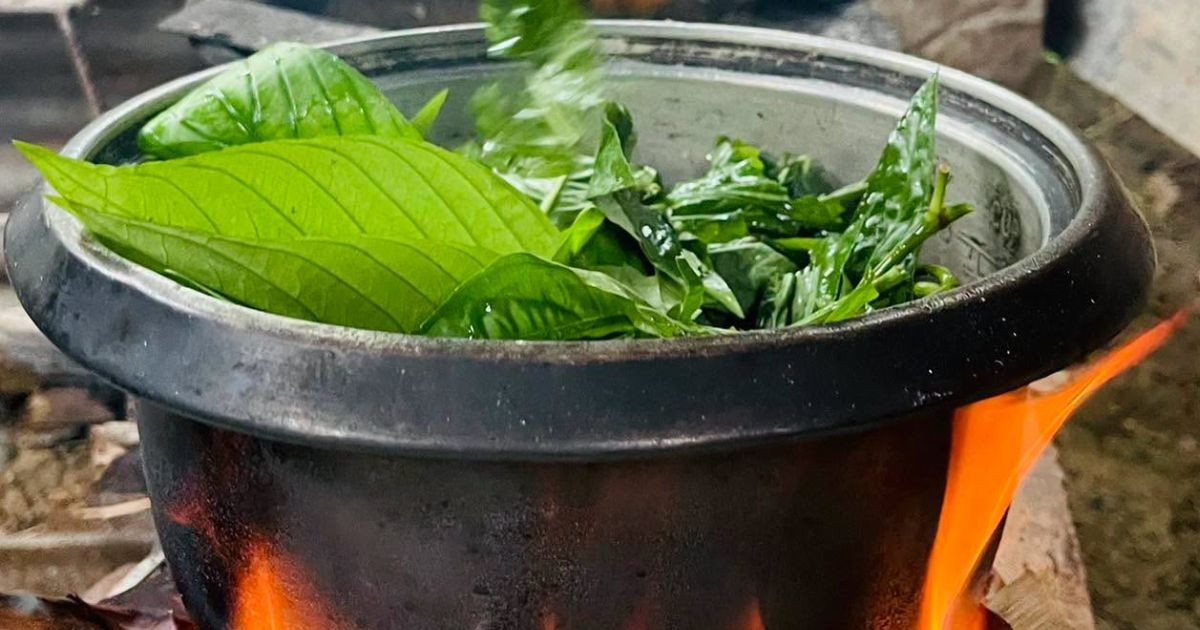
An elderly woman in front of an improvised wood stove in the yard, cooking pieces of a plant she calls "Uña de Dios," which she attributes with healing properties given the high cost of medications: that image published this Sunday by Cuban playwright Irán Capote encapsulates with brutal precision what he found when visiting his grandmother in El Jíbaro, a rural community in the municipality of San Juan y Martínez, in Pinar del Río.
Capote chronicled his visit in a Facebook post after four months of not being able to see his family, bringing "a few things that hardly fit in a Cuban bag." What he found was not the relief he was seeking: no electricity for over four days, no running water for more than 40, the store closed, and high prices for medication.
"In El Jíbaro, San Juan y Martínez, my grandmother, who is neither a witch nor knows anything about witchcraft, throws into the dark cauldron, fueled by all the burning wood, branches of a plant she calls 'blessed' to heal an immense list of ailments," the author wrote. The elderly woman trusts in the healing properties of the plant, which she calls "Uña de Dios." "The name of the plant seems too ironic to me," Capote noted.
The family had a small energy accumulator without a solar panel that they charged during the daily hour and a half of electricity, but that routine was interrupted. The grandmother, amidst the smoke from the stove, "repeats like a mantra that things are very bad and that medications cost an arm and a leg."
The power outage described by Capote is not an isolated incident: some circuits in Pinar del Río experienced more than 90 consecutive hours without electricity throughout the week, as acknowledged this Sunday by the provincial first secretary of the Communist Party. The blackouts also hinder water supply by affecting the pumping systems. In Pinar del Río, 52 of the 177 supply sources had issues, according to provincial authorities.
"There hasn't been water there for over 40 days either. What irony!" wrote the playwright, who had spent many days in the city carrying water in five-liter jugs. The neighbors of El Jíbaro solve their water supply issues by collecting rainwater in containers placed under the roof gutters, he recounted. The recent rains allowed them to gather water, but they also left mud and worsened the difficulties described by Capote.
"The people of the neighborhood already bear on their faces, in their bodies, in their voices, the pain of a country that has abandoned them," Capote wrote. When the neighbors asked him how the city was, he replied that "it's almost the same as in the countryside, though maybe a little bit better." He recounted that the neighbors repeated to him: "This has no end. We need to leave, anywhere. There is no prosperity."
The energy and water crisis is compounded by the collapse of the distribution system. The neighborhood store remains closed, and it has been a long time since bread has been sold. The tobacco farmers are waiting to be paid for their harvest while accumulating debts to buy "the most expensive bag of rice, the most expensive bag of sugar, and whatever else comes up."
The difficulties in obtaining medications were also reflected in a digital survey conducted by CubaData for Diario de Cuba between February 23 and March 13, 2026: approximately 91% of participants reported experiencing some level of difficulty in acquiring them.
The regime itself has promoted the production of medications and plant-based extracts in response to chronic shortages in pharmacies.
Capote closed his chronicle with a sentence that serves as a challenge: "The level of degradation, misery, and suffering of our peasants is painful. If anyone wants to verify it, go there, deep into the countryside… and disprove me."
Meanwhile, her grandmother clings to hope, "not by the hand, but by God's Nail," as Capote wrote.
Related videos:
Filed under: