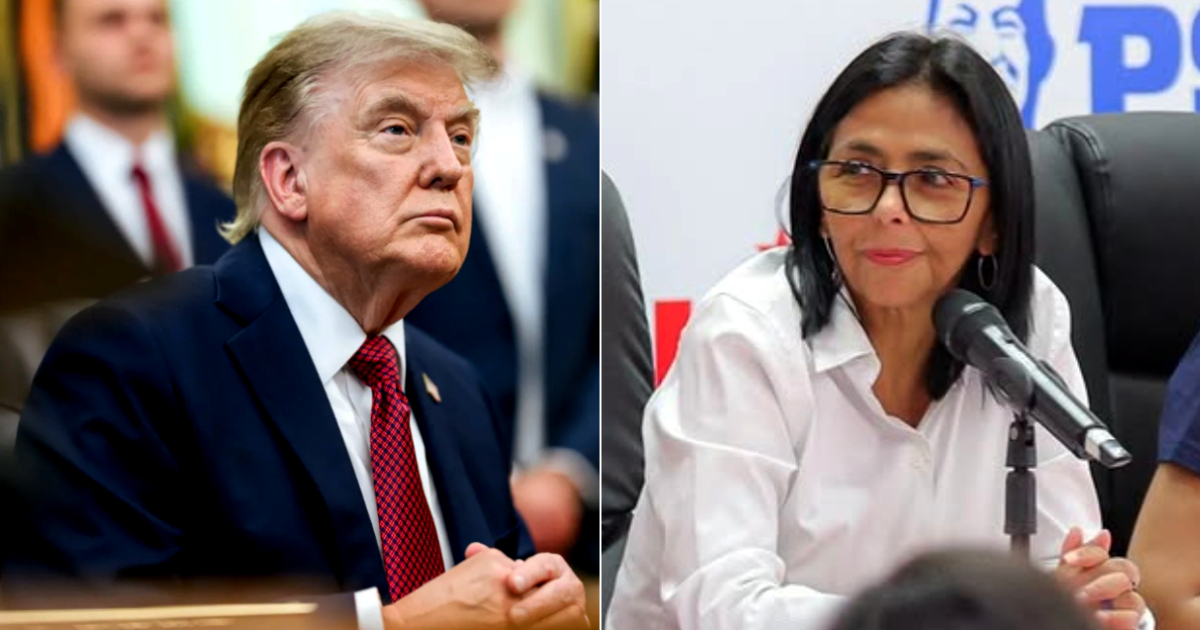
Washington is advancing into a new phase of its intervention in Venezuela, which includes three simultaneous operations: the reorganization of the cabinet of the acting president Delcy Rodríguez, the distribution of major oil fields among multinational companies, and the handover of new chavismo leaders to U.S. justice, as revealed by journalist David Alandete in his weekly letter for ABC España on Monday.
The movement is part of the three-phase plan that Secretary of State Marco Rubio presented to the Senate on January 7, days after the capture of Nicolás Maduro: institutional stabilization, economic recovery with preferential access for American companies, and in a third phase, a political transition towards free elections.
Regarding the cabinet, sources quoted by Alandete indicate that sectors of the Trump administration want to replace ministers more closely tied to Maduro's political apparatus with technical profiles. "Washington aims to diminish the influence of leaders most aligned with the regime and replace them with managers. Delcy would remain in charge, but with a renewed team," the source stated.
The challenge is substantial: Venezuela has 34 ministries, and at least 10 of their heads previously held positions under Maduro, including Diosdado Cabello, who has been accused in the U.S. since 2020 of narco-terrorism, with a 25 million dollar bounty on his head.
Moreover, in the executive branch, chavista leaders such as Héctor Rodríguez, Ricardo Menéndez, Yván Gil, Vladimir Padrino López, and Gustavo González López, the current Minister of Defense and former head of SEBIN, remain. Daniella Cabello, daughter of Diosdado, also continues in the government as the Minister of Tourism.
The possible departure of Cabello from the cabinet, along with the purges already taking place in the military and intelligence structures, is one of the central axes of this transformation.
Meanwhile, reports about a dozen private jets on routes from Venezuela to Turkey, between August and mid-October, fuel speculation regarding a possible transfer of assets belonging to the chavista leader, although there is no documentary evidence to confirm this.
In the oil sector, the Department of Energy is planning an event for January 2027 —the first anniversary of Maduro's capture— to present the detailed allocation of oil fields among major multinational companies.
It would be the next step following the agreement that Trump announced in August with North American Blue Energy Partners (NABEP), a company owned by Venezuelan Alejandro Betancourt, which was granted exploitation rights for 100 years over 17 oil fields with estimated reserves of 65 billion barrels. The preparations are in the preliminary phase and there is no official confirmation.
From Panama, the opposition leader María Corina Machado made it clear in an interview with Fox News that if she comes to power, she will not reverse those agreements: "Absolutely. Each of the agreements signed in accordance with the law will be respected." She added that the United States will be "the strongest and most important ally of Venezuela," although she emphasized that long-term investments require democratic institutions and free elections.
Machado has been out of Venezuela since December 2025, with at least seven failed attempts to return to the country. Her party, Vente Venezuela, called for a national mobilization for this Wednesday with three demands: an electoral timeline for 2027, the safe return of the opposition leader, and the release of political prisoners.
In terms of judicial deliveries, Washington is preparing the transfer to U.S. justice of Tareck El Aissami, former vice president of Maduro, and Alexander Granko Arteaga, head of special operations of the DGCIM.
Maikel Moreno, who presided over the Supreme Court of Justice from 2017 to 2022, may already be under some form of detention, according to Bloomberg and ABC. None of these reports have been officially confirmed.
Several senior executives from oil companies have urged the Trump administration to also negotiate with Machado and his party, arguing that the opposition won the previous presidential elections—whose results were widely disputed—and would likely prevail again in free elections, although this projection cannot be taken for granted.
Related videos:
Filed under: