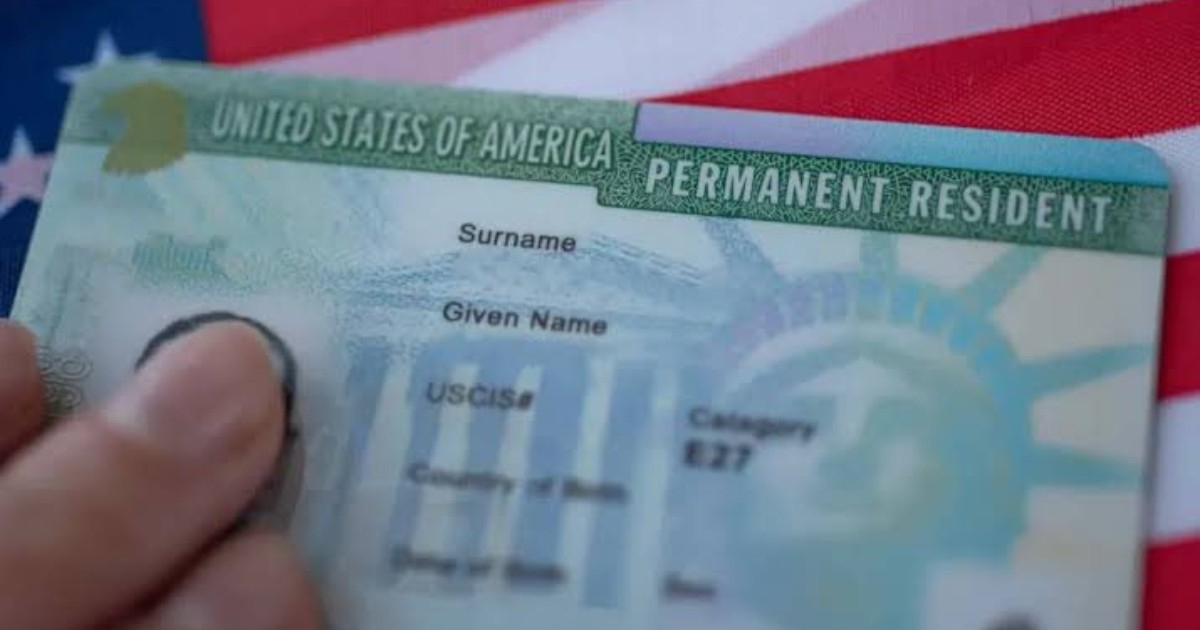
Florida became the state with the highest number of new permanent residents in the United States during fiscal year 2024, registering 219,470 green cards issued, surpassing California for the first time, according to data from the National Security Statistics Office released by Newsweek.
California ranked second with 217,420 new permanent residents, followed by Texas with 160,400 and New York with 136,750.
The jump in Florida was particularly pronounced: it grew by 63,970 new titles compared to the previous year, when it had recorded 155,500, representing a 41% increase.
Florida, las green cards y el panorama migratorio para cubanos siguen cambiando. Mantente informado en nuestra sección de , donde cubrimos todo lo que necesitas saber sobre residencia, visas y más.
At the national level, 1.36 million people obtained legal permanent residency in fiscal year 2024, the highest in the historical series from 2015 to 2024, compared to 1.17 million in 2023.
A key fact partially explains Florida's prominence: 73.3% of the green cards issued in the state —about 160,830— corresponded to status adjustments within the country, not to new arrivals from abroad.
That mechanism has a direct connection to the Cuban community. Nationally, 87% of the 178,130 green cards granted to Cuban citizens in 2024 were processed through adjustment of status, according to data from the Department of Homeland Security, amounting to 155,630 individuals. The Pew Research Center noted that "nearly nine out of ten Cuban immigrants received their green card through adjustment of status in 2024."
This phenomenon is linked to the CHNV humanitarian parole program, which allowed the legal entry of approximately 110,240 Cubans between January 2023 and January 2025. Many of them, upon meeting the requirement of one year of physical presence, began to apply for residency under the , which allows for this process to be processed without leaving the country.
However, that record now belongs to a radically different scenario than the current one.
The Trump administration ended the CHNV program in March 2025 and has progressively tightened access to permanent residency. In May 2026, the U.S. Citizenship and Immigration Services (USCIS) published a memorandum that redefines adjustment of status as a discretionary benefit and states that those who are temporarily present in the country must, in general, process their residency through the consular process abroad.
The impact on Cubans has been the most severe among all groups. Between April and June 2026, USCIS approved only 139 adjustment of status applications from Cubans out of 586 resolved cases, resulting in an approval rate of 23.7%, compared to 52.6% in the previous quarter, according to Newsweek.
In January 2026, USCIS approved only 15 green cards for Cubans despite receiving over 7,000 applications that month.
The slowdown directly affects Miami-Dade, where at the end of 2024 there were 41,171 open immigration cases of Cubans, the largest group in that city.
Related videos:
Filed under: