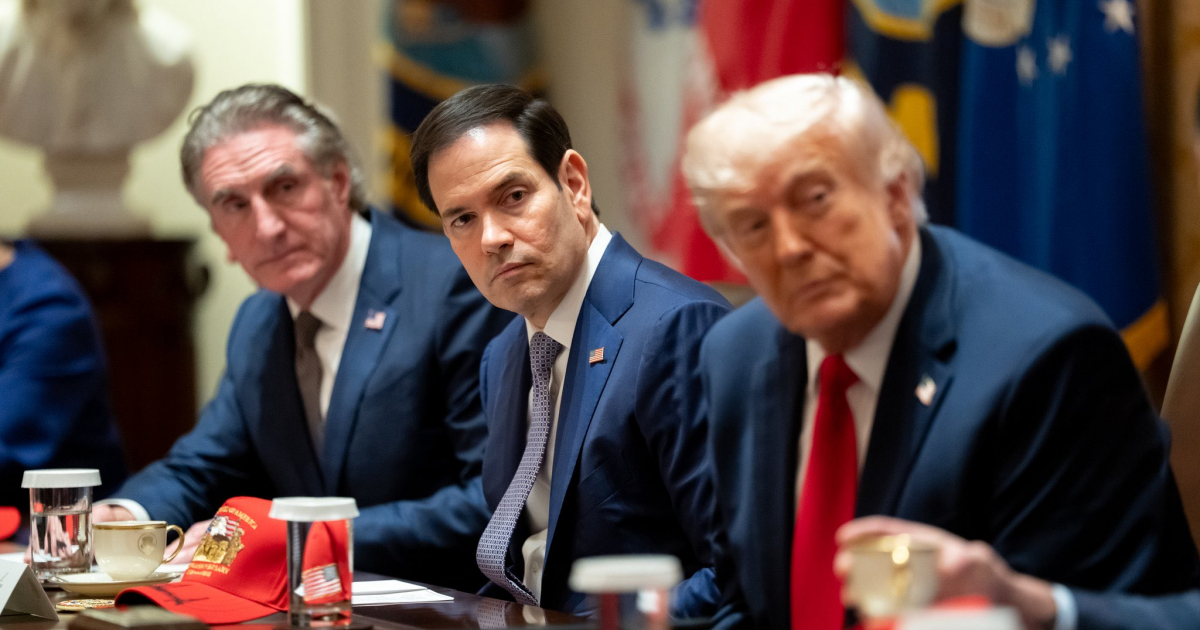
The United States Secretary of State, Marco Rubio, stated this Thursday that President Donald Trump remains committed to a Cuba "governed by its people" and not by what he described as a military elite that controls the country's resources.
"For decades, the Cuban regime has channeled all of the island's resources into the hands of a small, corrupt military elite, leaving ordinary Cubans without reliable electricity, food, or dignity."
He added that "President Trump remains committed to a Cuba governed by its people, not by a military class that treats the island's future as its private inheritance."
The statements come in the wake of new sanctions announced against eight entities and three individuals linked to the Revolutionary Armed Forces (FAR) and the Cuban nickel industry, under Executive Order 14404 by President Trump.
In X, the head of U.S. diplomacy described Cuba as a "corrupt failed state and a persistent threat to the national security of the U.S., located less than 100 miles from American shores," and emphasized that "ordinary Cubans endure blackouts, food shortages, and brutality while the regime's elites hoard the island's resources for themselves and the repressive apparatus."
The sanctions announced this Thursday are structured along two fronts. In the military sphere, four research and development entities of the FAR were designated: SIMPRO (simulators and training), CIDNAV (research for the Revolutionary Navy), CIDAI (development and evaluation of infantry weaponry), and GELCOM (production of military electronics and communications).
Alongside those entities, three high-ranking officials were personally sanctioned: Colonel Joaquín Francisco Cancio Monteagudo, General Director of SIMPRO; Captain Dioglis Pedrera Argüello, General Director of CIDNAV; and Colonel Julio Hurtado Betancourt, General Director of CIDAI.
In the mining sector, the measures affected four companies involved in nickel exploitation: SERCONI, CEPRONIQUEL, CEDINIQ, and PINARES S.A.
The State Department was explicit in stating that "the nickel sector is a critical source of revenue for the Cuban government, generating foreign currency from the exploitation of its natural resources, which supports the regime instead of benefiting the Cuban people."
Washington also warned that Cuban military enterprises "are fundamental pillars of the regime's defense apparatus, supporting the operational capabilities of the armed forces across a wide range of industrial and technical functions."
This is the latest wave of a sustained maximum pressure campaign that started in May with the sanctioning of GAESA and Moa Nickel S.A., continued in June with the designation of MINFAR as an institution and Miguel Díaz-Canel, Lis Cuesta, and Alejandro Castro Espín, progressed in August with Álvaro López Miera and entities linked to arms purchases, and reached in September the economic circle of Raúl Castro, including NICAROTEC and CEXNI.
As a result of the new designations, all property and interests of the sanctioned individuals in U.S. territory or under the control of individuals of that nationality are blocked and must be reported to the Office of Foreign Assets Control (OFAC) of the Department of the Treasury.
Rubio concluded his message with a warning that summarizes Washington's stance: "The United States will continue to expose and sanction those who uphold this system."
Related videos:
Filed under: