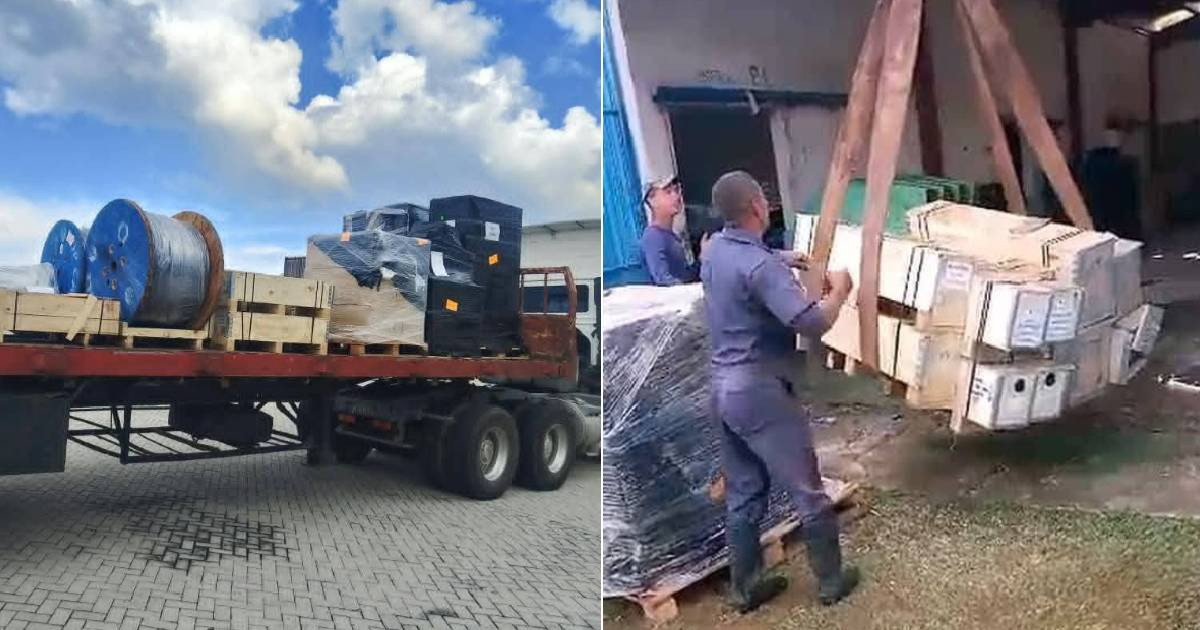
The United Nations Children's Fund (Unicef) donated seven hydraulic units to Manzanillo, in Granma, with the aim of improving water supply for around 105,000 residents in the urban area, in a city where some neighborhoods have been without service for more than a year.
The first secretary of the Communist Party in the eastern province, Yudelkis Ortiz Barceló, announced the delivery this Thursday on her Facebook profile. She specified that two of the larger equipment pieces will be allocated to the upper area of the city, while the remaining five will operate in the lower area known as the Gulf City of Guacanayabo.
According to the official, the systems need to integrate about 396 liters of water per second into the network. However, the announcement did not alleviate the concerns of the residents, whose experiences highlight the seriousness of the interruptions.
In one of the comments on the official post, a resident of Manzanillo stated that the highest part of Manzanillo has been "without service for a year and 10 months." Another user expressed her skepticism about the promise: "I'll believe it when I see the water."
A citizen summed up the frustration of some residents by pointing out that there is "a lot of political will in the face of a lack of funding to address a pressing need of our people."
The water crisis in Manzanillo is due to deficiencies in well fields, storage sites, and distribution networks. The broadcaster Radio Bayamo itself acknowledged that some hydrometric sectors have gone over a year without receiving water.
In September, the precariousness of the supply was exposed when a team of well diggers manually drilled a 36-meter deep well. This case sparked a debate on social media about working conditions and the difficulties in accessing water in the city.
The donation is added to other interventions by Unicef in eastern Cuba. Following Hurricane Melissa in November 2025, the United Nations agency installed water purification plants in Granma capable of supplying more than 21,000 people daily.
In August, it also announced a program to improve water and sanitation in 30 schools in Guantánamo, Granma, and Santiago de Cuba, funded by Japan with approximately one million dollars.
The situation in Manzanillo is part of a national crisis acknowledged by the Cuban authorities themselves. According to official figures, around 2.7 million people, nearly 35% of the population that receives service through networks, do not receive water in their homes or receive it insufficiently.
This problem is compounded by the dependence of the pumping system on the electricity supply. Eighty-seven percent of the country’s aqueducts require electricity to operate, so prolonged blackouts also disrupt the supply.
In this context, the seven donated teams address the needs of Manzanillo, but they do not alone resolve the structural deficiencies that leave some of its residents without regular access to water for months.
Related videos:
Filed under: