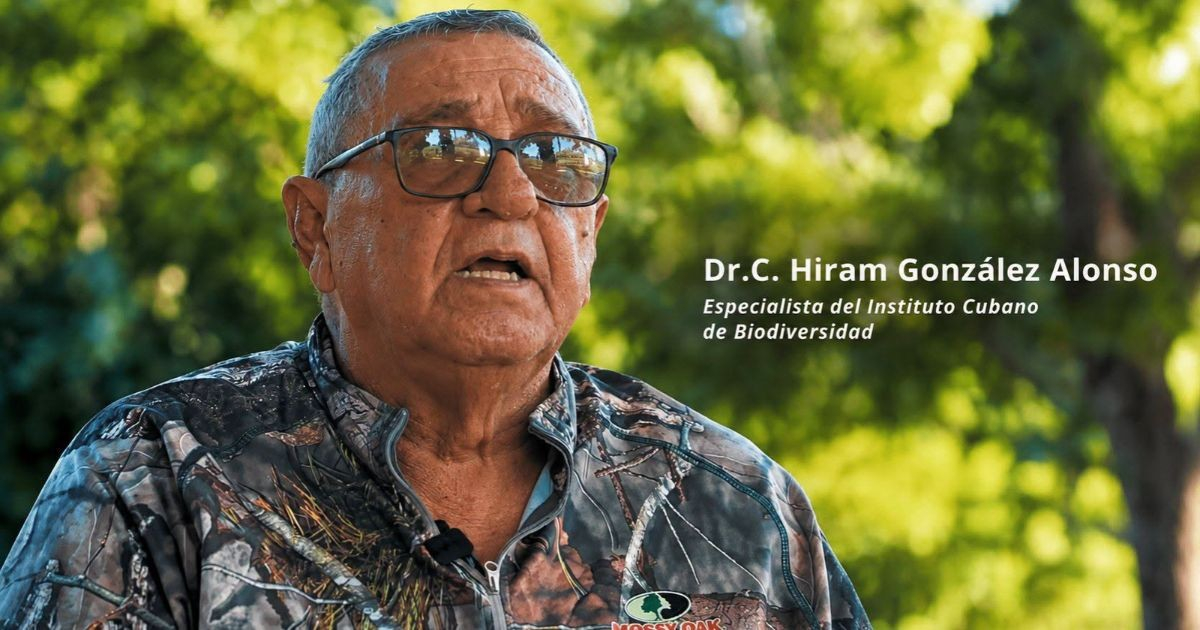
The National Museum of Natural History of Cuba announced this Saturday through its social media the passing of Dr. Hiram González Alonso, one of the most significant ornithologists in Cuba over the last four decades and a renowned "reference of science in our country."
Born on April 14, 1951, in Caraballo, Jaruco, now part of the province of Mayabeque, Hiram José González Alonso dedicated much of his scientific career to the study and conservation of Cuban birds. A Doctor in Biological Sciences, specializing in ornithology and wildlife conservation, he carried out extensive research work, with over 80 publications in national and international scientific journals, several books, and participation in dozens of scientific meetings in various countries
Linked for decades to the Institute of Ecology and Systematics (IES), he directed the Cuban Laboratory of Migratory Birds and presided over the Cuban Society of Zoology. Additionally, at the time of his death, he was leading the Scientific Council of the Cuban Institute of Biodiversity, as highlighted in the publication from the National Museum of Natural History.
Among his bibliographic contributions, Aves de Cuba (2002) stands out, of which he was the general editor. He also participated in significant research on the conservation of threatened species.
His name appears among the main authors of the work "Status of Conservation of Threatened Fauna: Red Books of Cuba," which was awarded a Special Prize by the Ministry of Science, Technology and Environment for its environmental significance. Just days before his death, on October 12, 2026, he was cited as a specialist from the ICB in a CITMA alert regarding the illegal capture of birds in Cuba.
Among the numerous accolades recognizing his fruitful career are the Felipe Poey Award, granted by the Cuban Society of Zoology on three occasions (2003, 2008, and 2013); the Carlos J. Finlay Order awarded by the Council of State of the Republic of Cuba in 2011 for a lifetime of service to science; and the Lifetime Achievement Award presented by BirdsCaribbean in 2017 for his contributions to the knowledge and conservation of the birds of Cuba and the Caribbean
The scientific dimension of Dr. González Alonso was reflected in the condolence messages that were immediately attached to the news. A colleague recalled having worked closely with him "on several projects, starting in the mid to late 1980s within the framework of an international collaboration between IES, Birds Canada/Long Point Bird Observatory, and the Canadian Wildlife Service," and emphasized that this work "enriched the careers of many Cuban biologists, as well as international biologists who visited the country."
Other colleagues and friends agreed in describing the loss as irreparable. A fellow from the Faculty of Biology reminisced that "since his student days [...] his devotion to birds and the conservation of natural ecosystems was remarkable," and concluded: "Cuban science loses a great scientist, and the birds lose their best friend."
A researcher recalled that González Alonso provided the catalog of threatened birds of Cuba to be reproduced and distributed, in his eagerness to always support scientific outreach. From the Sierra del Rosario Biosphere Reserve, a specialist noted that "honoring his legacy is the best way to keep it alive."
The passing occurs at a particularly sensitive moment for nature conservation in Cuba. The archipelago is home to 410 bird species, according to the Annotated List of Birds of Cuba 2026, and around 28 endemic species, including the tocororo, the national bird, and the zunzuncito, considered the smallest bird in the world.
The ornithological wealth of Cuba faces significant conservation challenges, with numerous species under threat and others subjected to environmental pressures that jeopardize their habitats.
The structural crisis facing the country, with decades of institutional decay and resource scarcity, increasingly hampers scientific research and the protection of ecosystems, making the work of those like González Alonso, who sustained this effort for decades, even more valuable.
The National Museum of Natural History of Cuba summarized the scientist's legacy as follows: "His knowledge, commitment to science, and love for nature leave a profound mark on those who had the privilege of working and learning alongside him. His legacy will live on in his research, in the scientific community he helped to shape, and in every person inspired by his work."
Related videos:
Filed under: