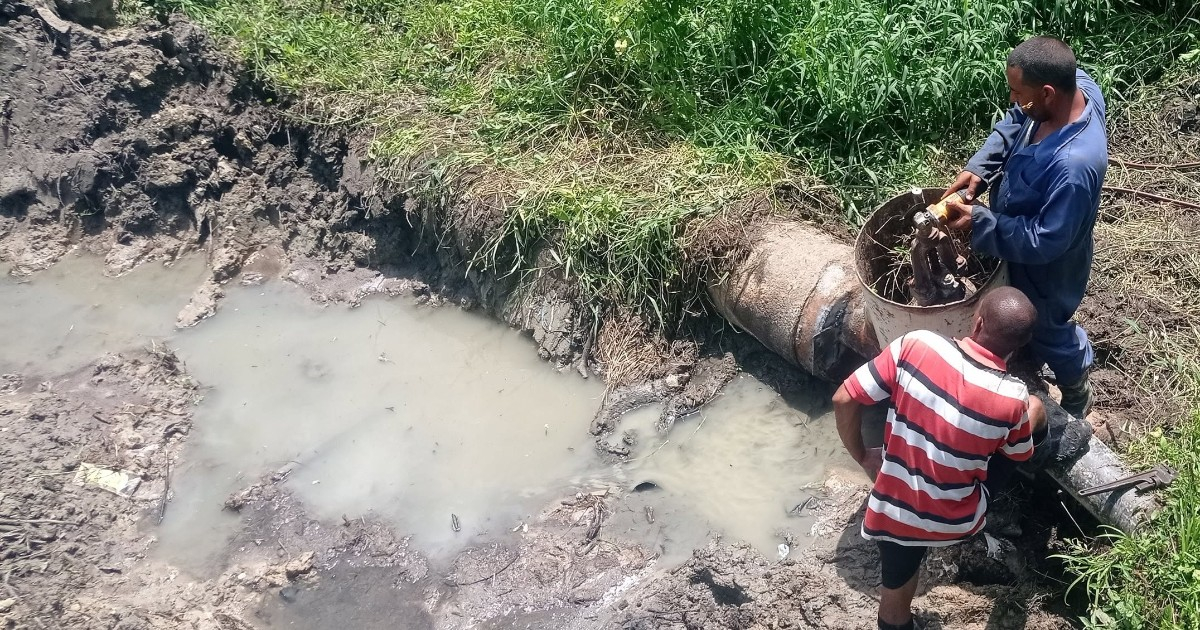
The Water and Sewage Company of Pinar del Río publicly acknowledged this Monday that maintaining a continuous water supply in the city is “materially impossible”, due to a combination of inoperative pumping equipment and severe electricity restrictions.
According to official information, the 20-inch pipeline has a deficiency of two pumping units; the 30-inch pipeline—which supplies more than 60% of the provincial capital's population—is operating at 50% capacity due to the absence of three out of its six units; and the 36-inch pipeline also lacks two units.
In total, seven pumping teams are absent or out of service among the three main pipelines of the city.
"In the face of this combined scenario of energy limitations and breakdowns or deficits in equipment, the continuous provision of service becomes materially impossible," stated the state-owned company.
As a potential solution, the company announces that it expects to incorporate at least one unit for the 30-inch driver and another for the 20-inch driver, along with an improvement in electrical stability; however, it does not provide any specific dates or a distribution schedule by neighborhoods.
The statement concluded by asking for "understanding and support in these difficult times," a phrase that stirred the emotions of the people of Pinar del Río.
"Understanding? We've been understanding the situation for years," replied a resident.
Others were more direct: "No excuses, solutions" and "with complete transparency, I tell you that we cannot live without water. With understanding and without it."
A resident of the Pipo neighborhood reported three months without water in that area. Several neighbors claimed that the situation is not new and that the explanations have been repeated without any changes: "We have known about this complex situation for a long time, what we want is to know what the solution is to this serious problem; justifications are not enough, we want to see results."
Just three days before the announcement, the Deputy Prime Minister Inés María Chapman Waugh visited the province accompanied by the director of the Electric Union and a representative from the National Institute of Hydraulic Resources (INRH), and outlined the need for a comprehensive water-energy program.
At that time, about 169,700 inhabitants of the province lacked regular access to drinking water, with 46 pumping units and six booster stations out of order at the provincial level, and power cuts of more than 16 hours daily at the pumping stations.
In September, the provincial Communist Party had already acknowledged that the complaints about water in Pinar del Río were recurring without improvement and that more than 100 million pesos in investments had not solved the issue.
At the national level, the INRH reported more than 2.4 million Cubans affected by the water service as of October 26, 2026, with over 85% of the hydraulic infrastructure relying on the National Electric System.
The statement from the Aqueduct does not specify when service continuity will be restored, and the people of Pinar del Río continue to wait for a response that has yet to come.
Related videos:
Filed under: