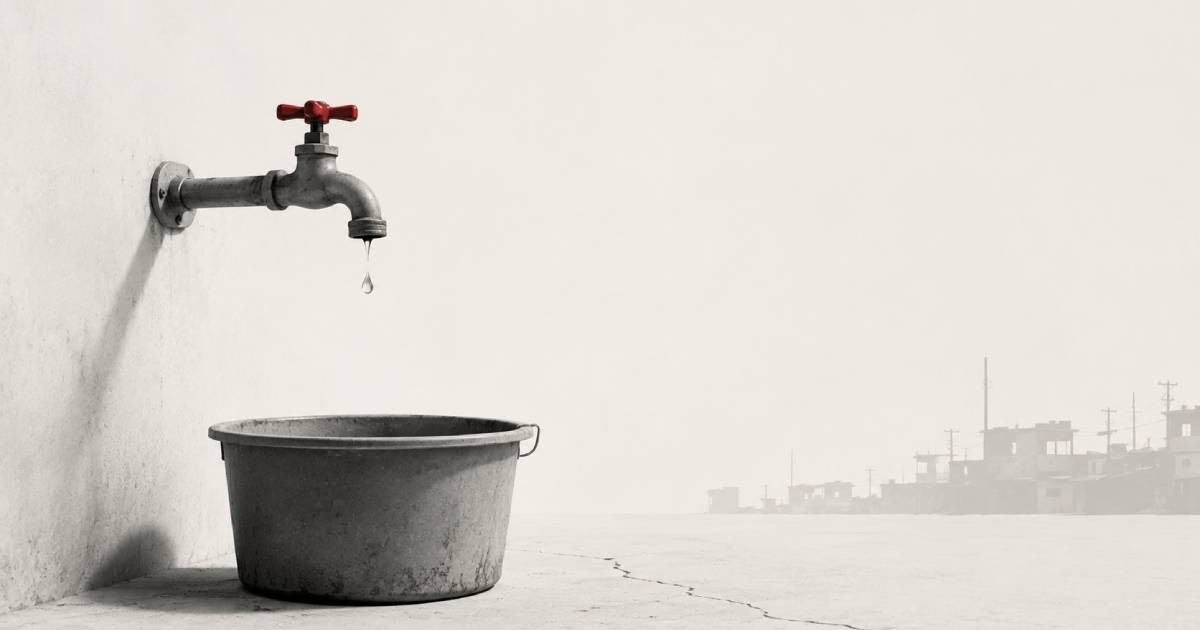
A rupture in the number five pipeline in Zona Alta left more than 93,000 residents of Santiago de Cuba without a water supply early Thursday morning, according to an official statement from the Aguas Santiago Water and Sewage Company.
The breakdown occurred at 1:30 AM at the corner of Federico Rey Avenue and First Street, in a 900-millimeter diameter pipe. The company estimated that the repair work could take up to 48 hours due to the complexity of the intervention.
There are 13 neighborhoods and circuits that are without service: C/U Antonio Maceo, Vista Alegre Bajo Este and Pastorita, Ampliación Terrazas, Sueño–Avenida Américas, Portuondo–Zamorana, Flores Bajo, Vista Hermosa, Mariana de la Torre Alto Parte Baja, Asunción–Municipal, Villalón–Flores Alto, Dessy Zona Alta and Media, Dessy Zona Baja–Chicharrones, and Veguita de Galo Alto. The Micro 1A and Van Van booster stations are also out of service.
"The repair work for this issue is expected to be completed within no more than 48 hours, due to its complexity," the company stated in its notice, adding that its teams would put in "every effort" to reduce that timeframe.
The interruption adds to a series of breakdowns that have plagued the city's water system throughout 2026. In July, there were reported two consecutive breaks in the main pipeline of the Northwest system, each with similar repair estimates. In June, officials from Aguas Santiago acknowledged that neighborhoods such as El Cristo, Altamira, and San Juan-Sevilla had been without water for between 39 and 48 days, worsened by the electricity crisis that has paralyzed the pumping stations.
The problem is not limited to the provincial capital. Residents of Songo-La Maya reported in recent weeks that they have gone between three and four months without access to water through the aqueduct system, while residents of Palma Soriano reported more than six months without regular supply.
Water scarcity has also had health consequences: in October there was a reported increase in diarrheal diseases in Santiago de Cuba amid complaints about the supply of murky water, with residents describing a dark liquid, with sediments and a smell of mud.
At the national level, the National Institute of Hydraulic Resources reported at the end of October that more than 2.6 million people —33% of the population served by networks— were experiencing total or partial disruptions in their access to water. Just three weeks prior, that figure had reached 2.7 million affected Cubans, equivalent to 35% of the population served by networks.
According to the president of the National Institute of Hydraulic Resources, Antonio Rodríguez Rodríguez, 87% of the Cuban population supplied by the water system relies on the National Electric System (SEN), which means that power outages worsen the challenges in water supply.
Those needing information about the outage can contact the Department of Public Assistance of Aguas Santiago at the phone numbers 628010 and 620686. The Cuban government plans to install 200 megawatts of solar generation aimed at pumping water in Havana, although its implementation is not expected before 2027.
Related videos:
Filed under: