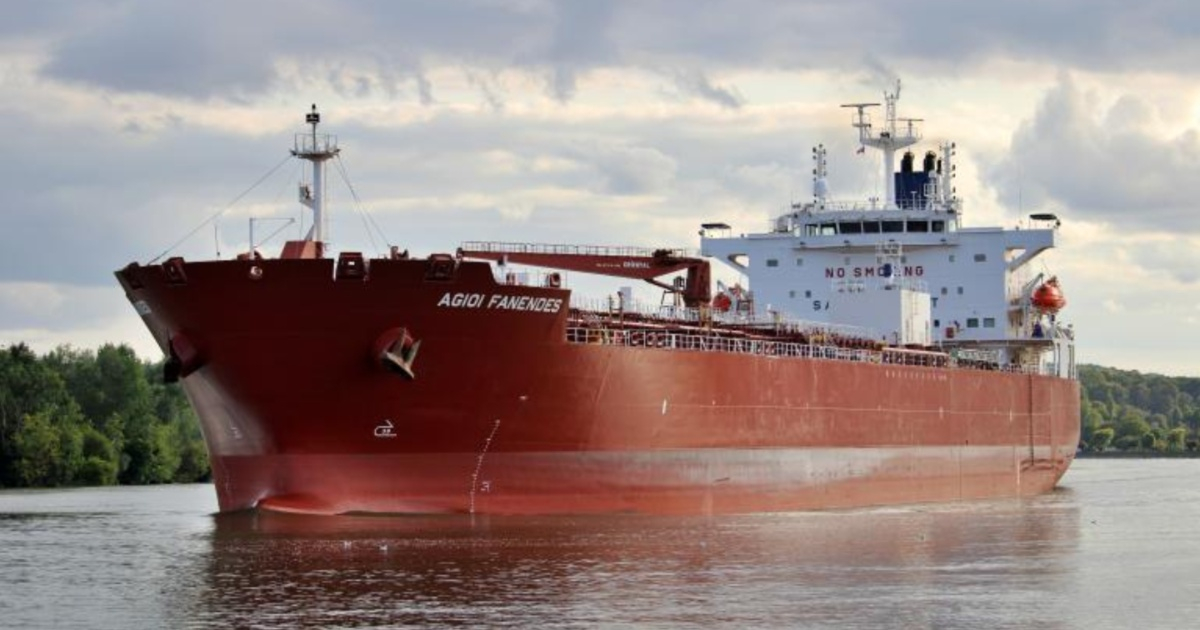
A tanker loaded with approximately 40,000 tons of Russian diesel departed from the port of Primorsk on October 22, with a declared destination of New York. However, it is now sailing aimlessly, and specialized analysts suggest that it could be diverted to Cuba, amid a crisis of power outages.
Thus pointed out OilPrice.com in an analysis published on Tuesday, citing data from Lloyd's List, Kpler, and gCaptain.
The ship in question is the Agioi Fanendes, flying the Maltese flag and operated by the Greek shipping company Eastern Mediterranean Maritime (EASTMED). It was scheduled to dock at the ports of New York and New Jersey on November 7, under General License 135 from the Office of Foreign Assets Control (OFAC), issued on October 9 as part of the Trump-Putin agreement to export Russian diesel to the United States.
However, on Sunday the ship was anchored off Skagen, Denmark, with its positioning signal changed to "on orders," which in nautical terms indicates that it does not have a confirmed discharge port.
The shipping company EASTMED itself acknowledged on Wednesday that the destination "had not yet been nominated or finalized."
The uncertainty has a clear political trigger. Democratic Senator Richard Blumenthal sent a letter on Monday to the managing director of EASTMED, Athanasios J. Martinos, demanding that the company withdraw the vessel if it intends to offload in U.S. territory.
Blumenthal invoked the 2022 law that prohibits the import of Russian oil and its derivatives, warning that doing so could constitute "an illegal transaction or complicity with it."
He set this Saturday as the deadline to identify the seller, buyer, freight forwarder, insurer, terminal operator, and final distributor of the cargo.
The Agioi Fanendes is not the only vessel in this situation. According to the analysis firm Kpler, two other tankers —the Leruo and the Talisman— are also transporting Russian diesel to the United States, and the three shipments total 924,000 barrels.
Both vessels are sanctioned by multiple Western countries, which further complicates their entry into U.S. ports.
It is in this context that the possibility—speculative, unconfirmed—of a detour to Cuba arises. The island ran out of diesel and fuel oil in May, as acknowledged by the Minister of Energy and Mines, Vicente de la O Levy.
The 40,000 tons from Agioi Fanendes would represent, according to the statement by Minister De la O Levy that Cuba needs 1,600 tons of diesel daily for electricity generation, about 25 days of supply for that sector.
The problem is that the recent history does not invite optimism. The only Russian shipment that arrived in Cuba throughout 2026 was that of the Anatoli Kolodkin, which docked in Matanzas at the end of March with 100,000 tons of Urals crude.
The Cuban ambassador in Moscow acknowledged that this shipment reduced blackouts for only two weeks. Afterwards, two ships carrying Russian diesel never arrived: the Universal drifted for over 21 days in the Atlantic and ultimately veered off to Brazil; the Sea Horse headed towards Trinidad and Tobago.
The researcher Jorge Piñón from the Energy Institute at the University of Texas precisely described the pattern: "Even the Russians, for some reason, have become afraid of the United States and have not entered Cuba."
The paradox of the Agioi Fanendes case is that the Russian diesel authorized under the Trump-Putin agreement to supply the U.S. market could, if ultimately diverted, end up relieving the regime that Washington seeks to pressure through the embargo.
Related videos:
Filed under: