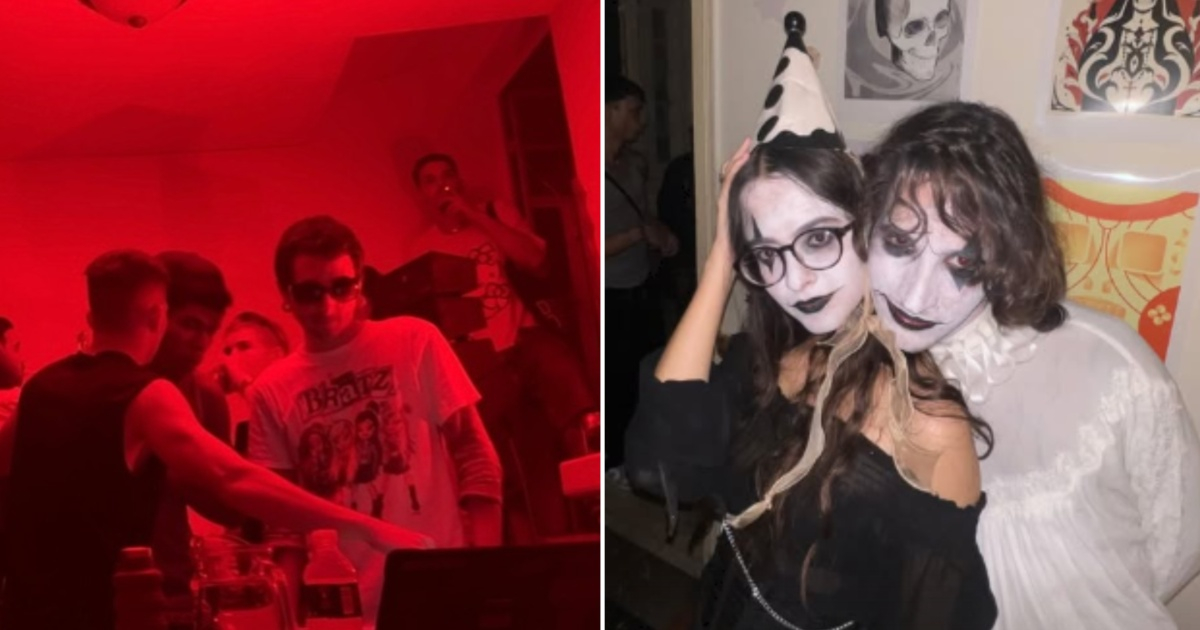
With a red-painted sheet simulating a ghost at the entrance and props of cobwebs competing with the darkness, a group of young people from Havana celebrated Halloween on Friday at El Proyecto, a private cultural space in Vedado, while Havana remained engulfed in a blackout lasting around 30 hours, as reported by the EFE agency.
The corner of 11th and 14th streets in Vedado, where this house converted into a cultural refuge is located, was without electricity that night.
Even so, a makeup artist was working under the glow of a table lamp to transform the faces of those present: a young man wearing a Joker mask, a girl dressed as a nun in heels, and Marcos Dulzaides, a 22-year-old physiotherapist who took advantage of his profession to dress up as a doctor.
"In Cuba, incredibly, despite the heat, despite the lack of resources, and despite the limited options for dressing up, it is always very feasible to share in those types of parties," Dulzaides declared to the EFE agency.
The contrast between the party and the outside reality was striking. According to the predictions of the Electric Union for this Saturday, Halloween day, national availability would barely reach 1,020 MW against a demand of 2,800 MW, with a projected shortfall of 1,810 MW.
On Friday, the Electric Company of Havana reported 173 affected circuits and 355 MW offline just in the capital; the VC100 circuit in Arroyo Naranjo had been without electricity for over 64 consecutive hours.
The Project was born about a year ago as a home film projection among around twenty friends in the doorway of a house.
Today, about 20 young people work there, and it offers cinema, concerts featuring emerging bands, billiards, ping-pong, and reading. Its survival depends on a private energy investor: when electricity is scarce — which happens almost daily — they reduce the lighting to keep the projector running and avoid canceling the concerts.
Érica Martínez, the administrator of the space, acknowledged to EFE that keeping it operational "is extremely difficult" when they are "not accompanied by even one hour of electricity" per day. Nevertheless, she does not contemplate closing it: "It should continue, because the idea is to maintain it as a space of resistance."
The electrical crisis surrounding this celebration is structural. During October, the maximum national impact ranged between 1,725 MW and 2,190 MW daily. The worst moment came on October 16, when a fire at the Santa Cruz thermoelectric plant left only 740 MW available against a demand of 2,900 MW.
The blackouts that no longer allow Cubans to sleep have become the permanent backdrop of daily life on the island.
Halloween is not part of Cuban traditions—there is no "trick or treat"—but it has gained popularity since around 2013, thanks to private entertainment businesses and the expansion of social media.
For Dulzaides, the celebration holds value that goes beyond the costume: "Halloween cannot be overlooked," he asserted, adding that "lately it draws a lot of attention and is popular with Cubans."
Martínez sums it up with the same phrase that inspired the project: the need to "disconnect from the reality" of an island where even fun depends on dimming the lights so the projector doesn’t turn off.
The ruling party has systematically criticized it for being viewed as a "neocolonial" American influence, although this has not halted its growth among young people. A call for a "Terror Party" at La Piragua, near the Malecón, was denied this week by the Municipal Administration Council of Plaza de la Revolución due to lack of authorization.
Related videos:
Filed under: