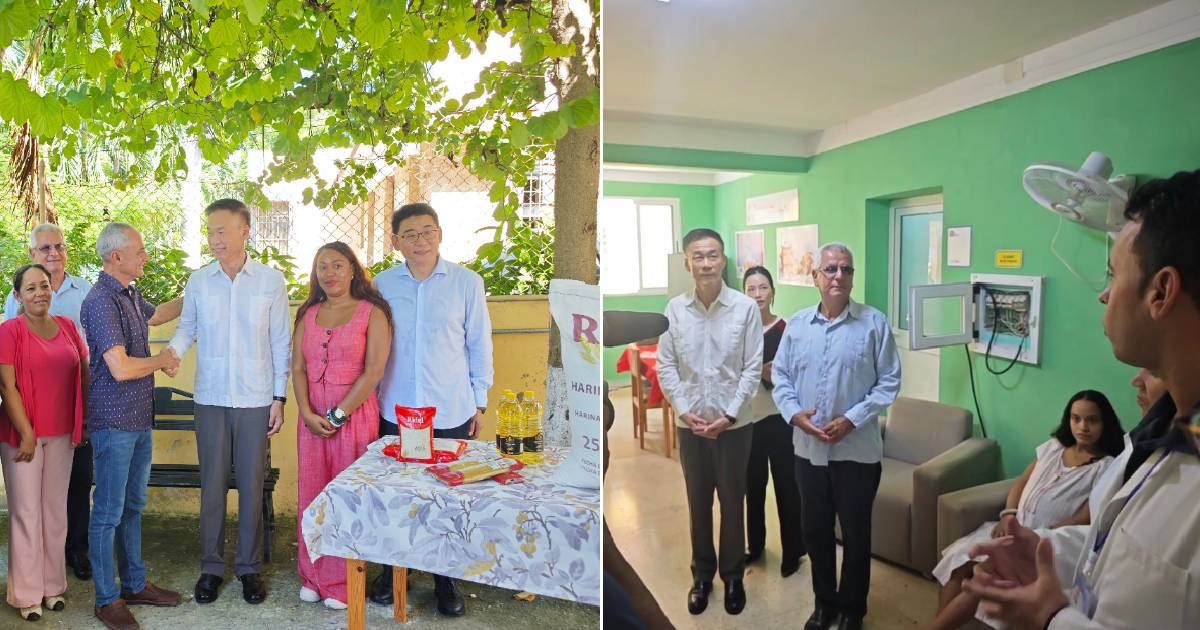
The Chinese Embassy in Cuba delivered a batch of food to the Playa municipality in Havana to assist elderly individuals living alone, pregnant women, nursing mothers, and those with chronic illnesses, reported the official agency Xinhua this Friday.
The ceremony, also highlighted by the embassy's account on X of the Asian country, took place on Thursday at the La Esperanza del Mundo Maternal Home, where 18 women with high-risk pregnancies receive care. The donated items included rice, oil, pasta, and flour, although official information did not specify the quantities or the economic value of the donation.
The final beneficiaries will be institutions in the municipality, including senior centers, psychopedagogical centers, homes for unaccompanied children, and family support systems.
The event was attended by the Cuban Deputy Minister of Foreign Affairs, Elio Rodríguez; the mayor of Playa, William García; and the Chinese ambassador, Hua Xin, who took the opportunity during the ceremony to reiterate Beijing's criticisms of Washington's policy towards Havana.
"United States continues to intensify the illegal energy blockade and unilateral sanctions against Cuba, causing difficulties for the Cuban people," stated the diplomat, according to Xinhua. He also concluded his speech with the phrase "Cuba is not a threat, the embargo is."
Hua Xin also celebrated the vote on October 28 in the United Nations General Assembly, which approved for the thirty-fourth consecutive time a resolution calling for an end to the U.S. embargo.
However, the result was far from the support received in previous years. The initiative received 130 votes in favor, compared to 165 in 2025 and 187 in 2024, marking its lowest support since it was first presented in 1992.
The vote also reflected changes in the positions of several countries. Argentina, Colombia, Costa Rica, Ecuador, and Paraguay voted against it, while Italy abstained for the first time in 34 years. Chile, Honduras, and Peru shifted from supporting the resolution to abstaining. Despite this setback, the island's government and Beijing presented the outcome as a victory.
For his part, the mayor William García expressed gratitude for China's support at the United Nations and stated his interest in "strengthening coordination and cooperation" between both parties.
The delivery in Playa is part of a series of Chinese donations received by Cuba in 2026. In January, President Xi Jinping approved an emergency package of 80 million dollars and 60,000 tons of rice. According to Hua Xin himself, China's commitment to rice this year amounts to 90,000 tons.
In August and September, two shipments of 5,000 photovoltaic systems each arrived, while in mid-October the government of the Asian giant dona 80,000 spare parts for bicycles, in another contribution aimed at alleviating transportation difficulties.
The series of deliveries aligns with a situation of increasing social need. Over 883,000 Cubans were registered as part of the "most vulnerable population," according to the latest official figures.
It is also unclear whether all the assistance received actually reaches the homes that need it the most. Some of the solar systems from the first batch, delivered in November 2025, were reassigned to the state telecommunications monopoly, Etecsa, with the aim of sustaining telecommunications services in Matanzas, instead of being allocated directly to alleviate domestic blackouts.
The contrast also reaches the economic model. In October, the Chinese diplomat accredited in Cuba acknowledged before the official portal Cubadebate that one of the pillars of Chinese development is to "allow the market to play a decisive role" in resource allocation, a principle that stands in contrast to the planned economy system maintained by the Cuban government.
Related videos:
Filed under: