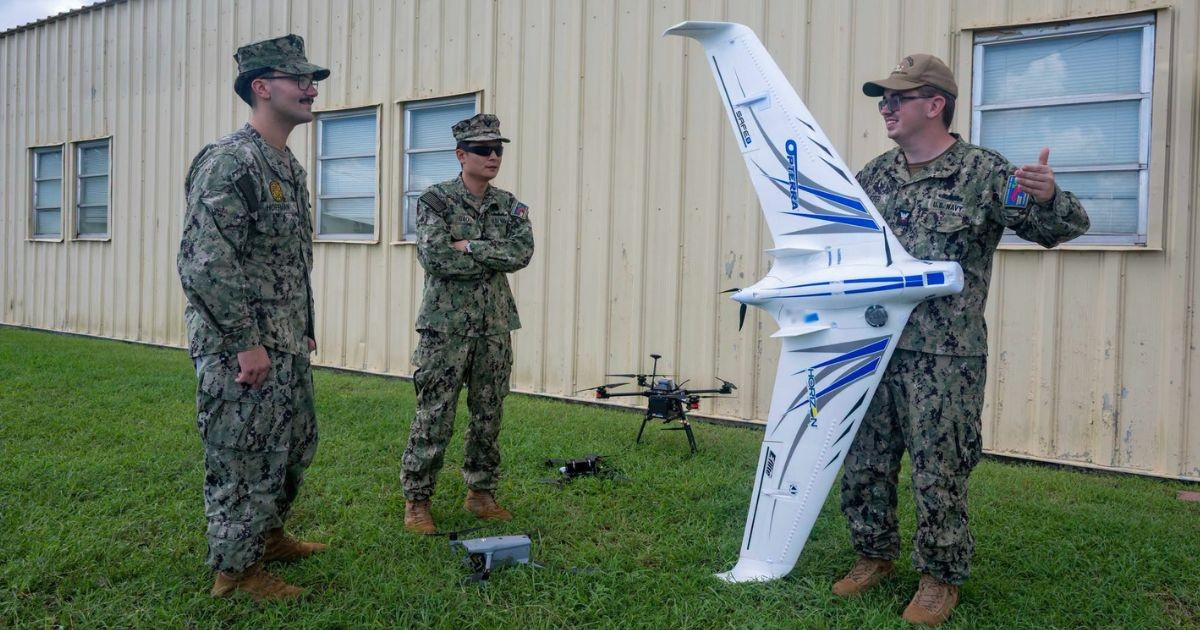
The United States military conducted drone defense exercises at Guantanamo Naval Base, located in Cuban territory, with the aim of testing their capabilities to detect and counter potential unmanned aerial threats.
The military installation reported this Tuesday on its official Facebook page that the maneuvers took place recently and involved various units and organizations of the U.S. Armed Forces.
Under the title No Fly Zone, the publication explained that the training allowed for the evaluation of the base's capabilities to counter small unmanned aerial systems, known in English as UAS (unmanned aircraft systems).
During the tests, the military concept of red air (simulated enemy air forces) was used, in which friendly forces acted as potential adversaries to recreate threatening scenarios in a training environment.
The participants practiced responses against drones that simulated hostile operations.
The exercise involved the Joint Interagency Task Force 401 (JIATF-401), the Naval Forces of United States Southern Command and the Fourth Fleet, the U.S. Army’s Combat Capabilities Development Command, and Southern Command (SOUTHCOM).
The Naval Base accompanied its publication with several photographs of drones of different models and emphasized that the training allowed for practical experience and verified operational readiness against current threats.
The JIATF-401 was established by the United States Department of Defense in August 2025 to coordinate and accelerate the development, testing, and deployment of defense systems against small drones, in response to the increasing threats these aircraft pose to military facilities and personnel.
The exercises in Guantánamo occur months after an investigation by the U.S. media Axios revealed that Cuba has reportedly acquired over 300 military drones from Russia and Iran since 2023, according to classified intelligence information provided by U.S. officials.
The report, published in May, indicated that the devices would have different capabilities and would be stored in strategic locations on the Island.
According to U.S. sources cited by Axios, Cuban military officials have also reportedly discussed possible scenarios for using those drones against the Guantanamo Naval Base, U.S. military vessels, and even Key West, Florida.
The information also indicated that Havana had requested more drones and military equipment from Moscow, while Cuban intelligence officials expressed interest in the capabilities used by Iran against the United States.
The existence of that alleged arsenal and the plans attributed to the Cuban authorities have not been publicly confirmed through independent evidence.
The Russian government denied the report about the acquisition of over 300 military drones. The spokesperson for its Ministry of Foreign Affairs, Maria Zakharova, described the information as part of a disinformation campaign.
Cuban authorities also dismissed the accusations regarding alleged aggressive plans. The government of Havana defended its right to possess means for its defense, without publicly providing details that would allow verification of the composition and origin of the mentioned drones.
The issue garnered attention again in July when a replica of the Iranian drone Shahed-136 was displayed in Coral Gables, Florida, during an event organized by United Against a Nuclear Iran (UANI).
The meeting featured the participation of former Florida Governor Jeb Bush, Congressman Carlos Giménez, and representatives from the organization, who expressed concern over reports of potential military cooperation between Cuba and Iran.
More recently, on October 3rd, Southern Command announced that the Naval Base at Guantanamo would host a regional training and mission support center for its Autonomous Warfare Command, aimed at integrating drones, unmanned platforms, communications, and other military capabilities.
Also in October, the United States announced measures to speed up the use of anti-drone systems at its military installations, with increased coordination among various agencies and branches of its Armed Forces.
Related videos:
Filed under: