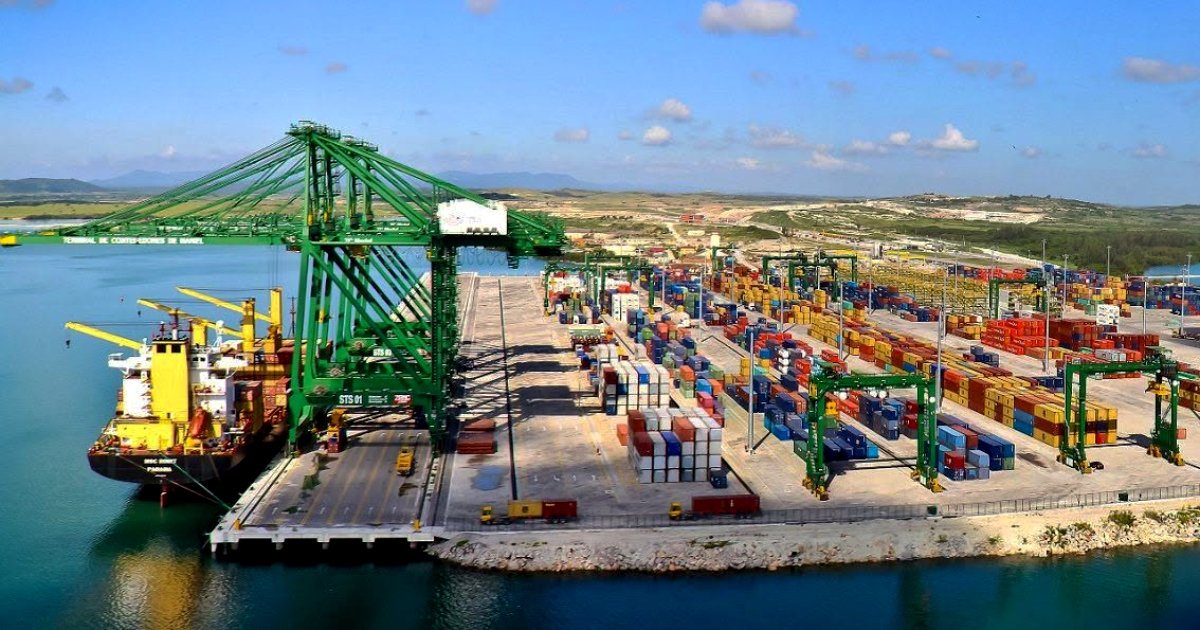
Thirteen years after its inauguration, the Mariel Special Development Zone (ZED Mariel) celebrated its anniversary with a trade fair, revolutionary tributes, and institutional messages about productivity, unity, and the future.
The images from the exhibition showed an apparently modest turnout, far from the expectations that accompanied the launch of Raúl Castro's flagship project.
But the real problem of Mariel does not lie in the attendance of a fair. It is in the results of thirteen years of million-dollar investments, promises of modernization, and successive economic reforms that have failed to turn the enclave into the productive and exporting engine that was promised.
The area features modern port infrastructure, factories, and foreign companies in operation. However, only a portion of the approved projects is operational, and the container terminal operates well below its capacity. The Prime Minister Manuel Marrero Cruz himself acknowledged in December 2024 that the project had not met its objectives and had lost competitiveness.
What explains that an area designed to attract international capital, equipped with modern infrastructure and exceptional tax incentives, has not managed to take off?
The response requires looking beyond the port and examining the Cuban economic model, its contradictions, and the way reforms have been managed for over a decade.
An economic opening without transforming the system
When Mariel began operating in November 2013, Raúl Castro's government was promoting the so-called updating of the socialist model. The area was meant to demonstrate that Cuba could attract significant foreign investments without relinquishing state control over strategic sectors.
The bet was based on a contradiction: to create a competitive space, connected to the international market, within a centralized economy, with little business autonomy, currency restrictions, and a bureaucracy that influenced investors' decisions.
The new Foreign Investment Law of 2014 expanded incentives, but did not resolve those issues.
The Cuban economist Ricardo Torres Pérez, in a study published by Columbia University, points out that the tax advantages do not compensate for the lack of economic stability, confidence, administrative simplification, and productive relationships with the rest of the country.
A factory established in Mariel needs suppliers, transportation, energy, labor, and access to foreign currency. It cannot operate independently from a national economy characterized by scarcity, deindustrialization, and administrative restrictions.
The special zone could offer privileged conditions within its facilities, but it could not isolate itself from the deficiencies of the economic system to which it belonged.
Thirteen years correcting the same distortions
Mariel's trajectory coincides with a succession of government programs presented as solutions to the problems of the Cuban economy.
First came the Guidelines and the update of the socialist model. Then arrived new measures for foreign investment, the expansion of private work, and attempts at monetary unification.
In 2021, the so-called Ordenamiento Task promised to eliminate exchange rate distortions and reorganize salaries and prices. Its implementation ultimately worsened monetary imbalances and fueled inflation that eroded the purchasing power of Cubans.
That same year, the establishment of private micro, small, and medium enterprises (mipymes) was authorized, though they were subject to restrictions and subsequent regulatory changes.
In 2024, the government launched another program to "correct distortions and revitalize the economy". A year later, the authorities continued to promote new projections of the government program, while partial dollarization progressed, which contradicted previous promises of monetary unification.
Miguel Díaz-Canel himself acknowledged in March 2025 the need to update the monetary and exchange policy, in an economy where the imbalances that the Ordering had promised to resolve still persisted.
For foreign investors, this series of adjustments presents a fundamental problem: the lack of predictability.
A company that commits millions of dollars needs to understand the conditions under which it can operate for years, access foreign currency, pay suppliers, and recover its investments. The continuous modifications of the economic framework make this planning difficult, even when some individual measures offer advantages.
While the government announced one reform after another, Mariel continued to fall short of the level of investments and exports that would justify the initial expectations.
Odebrecht, opacity, and accountability
The story of the megaproject also includes controversies related to its funding and construction.
The Brazilian Odebrecht, central figure in one of the largest international corruption scandals, was involved in the modernization of the port with funding from the Brazilian state bank BNDES.
In 2019, an investigation by the Miami Herald linked to the International Consortium of Investigative Journalists (ICIJ) identified records of approximately 8.4 million dollars in unaccounted payments related to the Mariel works, within the clandestine system used by Odebrecht. The documents did not allow for the public identification of the final recipients of the money.
Brazilian financing has also been questioned by the oversight bodies of that country. In 2019, CiberCuba reported on the irregularities noted in a Brazilian audit regarding the loans granted for the port construction.
These irregularities and controversies do not, by themselves, prove that the Cuban authorities received bribes, but they raise questions about transparency, oversight mechanisms, and accountability in one of the largest infrastructure investments made in Cuba in recent decades.
The issue takes on greater significance due to the role of companies linked to the military conglomerate GAESA in the management of infrastructure and services related to the project.
The 176 measures: Another opening under the same control?
The contradiction reaches a new dimension with the 176 economic and social transformations announced in June 2026.
The package includes expanding private participation, easing foreign investment, authorizing new financial institutions, reducing administrative restrictions, and granting greater autonomy to companies.
Some measures represent concrete changes. In September, for example, a reform came into effect that allows foreign investors to directly hire their workers without needing to rely on state employer entities.
It is a significant modification, but it also raises a question: why was it necessary to wait thirteen years to lift a restriction that has long diminished the attractiveness of investments?
On November 2nd, while Mariel was celebrating her anniversary, Díaz-Canel announced that 171 out of the 176 measures had their legal bases completed and that 215 regulatory provisions had been approved. Five others, deemed the most controversial, were still pending.
The leader presented these figures as evidence of progress. However, passing regulations does not equate to securing investments, increasing production, or stabilizing the economy.
Mariel offers precisely an experience of that difference: numerous authorized projects, approved incentives, and financial commitments did not result in the expected productive activity.
The crucial issue is whether the new transformations will effectively change the conditions for investment or if they will end up reproducing the limitations of previous programs.
The problem that the reforms fail to resolve
The tightening of U.S. sanctions has further complicated Cuba's access to financing, markets, and international services. In 2026, new restrictions directly impacted companies and operations linked to the port.
But the problems of Mariel preceded those measures. Its limited attraction for investments, bureaucratic difficulties, and lack of integration with the national economy had already been documented years earlier.
The sanctions help explain part of the results, but they do not absolve the Cuban authorities of their responsibilities for the policies they designed and implemented themselves.
There is, moreover, an essential difference between allowing greater spaces for private activity and establishing institutional conditions that provide long-term stability, transparency, and legal security.
From Raúl Castro to Miguel Díaz-Canel, the authorities have introduced successive programs for modernization, decentralization, and economic opening, but the direction and oversight of the process remain under the same Communist Party and its institutions.
Reforms can change the rules of business operation without necessarily altering the decision-making, oversight, and political accountability mechanisms that influence their implementation.
Mariel was born as an exception meant to stimulate an economy that needed profound transformations. Thirteen years later, its trajectory reveals the extent to which partial reforms have faced limits within the economic and institutional environment they aimed to overcome.
While the authorities celebrate new measures and announce future opportunities, it remains to be seen whether they can truly provide the stability and productive conditions that they failed to guarantee for the most emblematic project of the economic opening initiated by Raúl Castro.
Related videos:
Filed under: