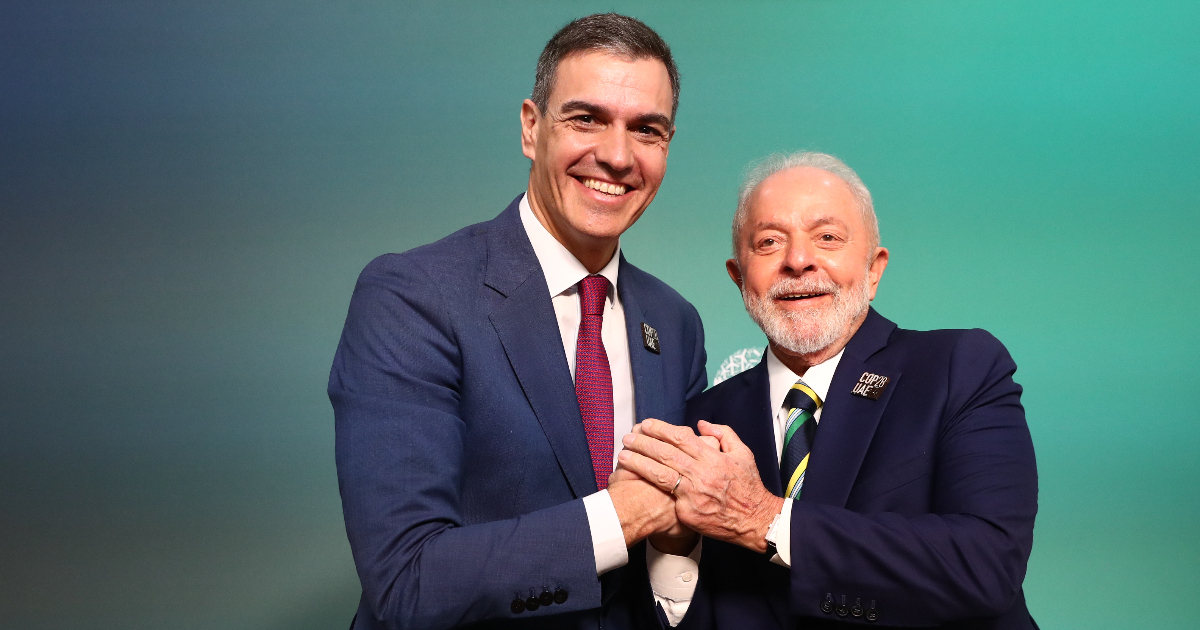
The President of the Spanish Government, Pedro Sánchez, took advantage of the Democratic victory in the United States midterm elections this Wednesday to deliver a campaign message ahead of the general elections on November 29: «The ultra wave that Feijóo and Abascal aim to ride is no longer growing: it is collapsing».
The head of the Spanish Executive celebrated the democratic wave that painted the U.S. Congress and Senate blue with a message posted on X, which garnered over a million views and 70,000 likes in just a few hours.
The Democrats seized control of the Senate and the House of Representatives from the Republicans under Donald Trump, with victories in historically challenging states such as Texas, Iowa, North Carolina, Ohio, and Kansas.
Sánchez linked this result to Lula da Silva's victory in Brazil —who received 51.79% compared to Flávio Bolsonaro's 48.21% in the second round on October 25— to construct a narrative of a global retreat of the radical right.
"Yesterday, American society voted against policies that only bring poverty. Against hatred. Against machismo. Against climate denialism and the privileges of the elites. It happened in Brazil. It has just happened in the U.S. And it will soon happen in Spain," wrote the Spanish president.
The extrapolation, however, has nuances that its opponents were quick to point out. In Brazil, despite Lula's presidential victory, the right maintained control of Congress and the majority of the country's 27 states.
In the case of the United States, economist Daniel Lacalle responded directly to Sánchez: "With the U.S. electoral system, you would not be president. You lost the 2023 elections. Neither the PSOE nor its far-left partners would control Congress. There, the winner is the one who receives the most votes, without investiture agreements."
Alberto Núñez Feijóo interpreted the results in the opposite manner to Sánchez, warning that the republican defeat could foreshadow a "political turnaround" in Spain on November 29 and urging the president to "take note." Santiago Abascal, for his part, downplayed the extrapolation.
The message arrives at one of the most challenging times for the Executive.
On the same Tuesday that the midterms were held, Transport Minister Óscar Puente resigned after appearing before Congress regarding the railway accident in Urda (Toledo), which on October 28 resulted in 69 deaths when a Renfe AVE collided with a stationary Iryo train. "Out of political dignity, coherence, and empathy for the victims," Puente justified his departure.
That disaster was added to the one in Adamuz (Córdoba), which occurred in January 2026, claiming 46 lives, accumulating more than 115 victims in two railway accidents in less than a year.
Furthermore, there are other open fronts: the sentencing of former minister José Luis Ábalos to 24 years in prison in June 2026 for organized crime, bribery, and embezzlement; the entry of the Civil Guard into the federal headquarters of the PSOE in May as part of the "Leire case"; and the prior resignation of the former secretary of organization of the PSOE, Santos Cerdán León due to a scandal involving alleged kickbacks in public works contracts.
The polls reflect an uncertain scenario leading up to the 29th of November. According to the 40dB survey, the PP leads with 31.6%, followed by the PSOE with 27.4%, and Vox with 18.4%, rising especially among young people, where it hovers around 26%. The CIS barometer, on the other hand, places the PSOE ahead with 31% compared to 25.5% for the PP.
Sánchez brought the elections forward to November 29 on October 5, following the parliamentary rejection of two housing decrees by the votes of PP, Vox, and Junts, which highlighted the breakdown of the majority that supported his government.
With the electoral clock ticking and the accumulated challenges, the president is counting on turning international results into fuel to energize his electorate in the three weeks remaining until the elections.
Related videos:
Filed under: