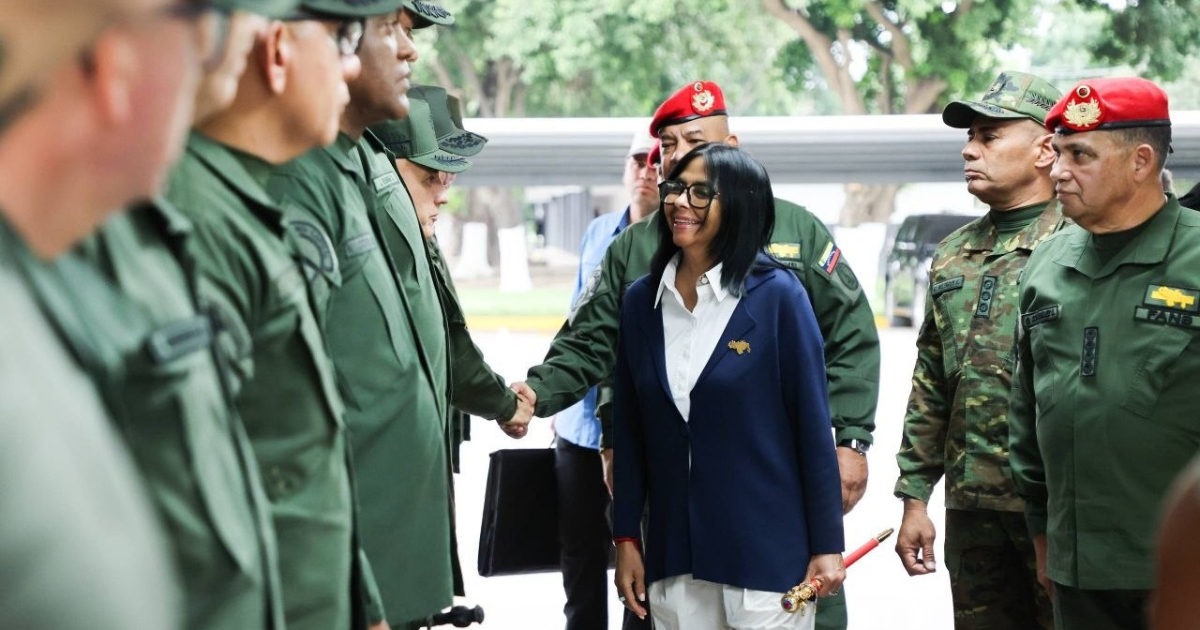
The Trump administration is negotiating with the Venezuelan government of Delcy Rodríguez an agreement on the status of forces —known by its English acronym SOFA— that would lay the legal groundwork for a long-term U.S. military presence in the country, according to U.S. officials who spoke on condition of anonymity to The New York Times.
The negotiations, led by the Department of State under Secretary Marco Rubio, represent an unprecedented shift in the bilateral relationship: until January 3 of this year, Venezuela and the United States were declared adversaries. On that day, U.S. special forces conducted the operation that captured Nicolás Maduro in Caracas and transferred him to a prison in New York, where he faces charges of drug trafficking and narcoterrorism.
In a speech delivered this Monday in Washington, Trump referred to “our conquest of Venezuela”, a phrase that encapsulates the new power dynamic between the two countries.
The SOFA agreement would regulate activities such as naval visits, joint training, military exercises, and humanitarian assistance. The specific details—number of personnel, locations, and duration of presence—would be left for later negotiations.
A senior official from the State Department pointed out that any discussion about permanent military bases is "very, very far away" and that there are currently no negotiations on that specific issue.
The military cooperation between both countries already has concrete precedents. In June, Southern Command carried out an airstrike in the Bolívar state that killed Héctor Rusthenford Guerrero Flores, founder of the Tren de Aragua, with intelligence from the CIA and the involvement of Venezuelan forces.
Weeks ago, Venezuela attacked an ELN camp in the state of Apure with support from U.S. intelligence and drone technology, leaving at least 23 dead according to the organization Fundaredes.
Venezuela's geographical location—caribbean coastline and land borders with Colombia, Brazil, and Guyana—makes it a strategic enclave for regional operations, something that Washington does not overlook.
On Monday, Rubio met in Washington with the new Venezuelan chancellor Oliver Blanco, appointed on October 29. According to the State Department, they discussed political reconciliation, possible elections, and the release of political prisoners, without any public mention of the military agreement.
At the end of October, officials from the State Department had already provided a formal briefing to Congressional advisors regarding the imminent negotiations.
Rodríguez, who has historically criticized U.S. interventionism, governs with the explicit support of Trump since the fall of Maduro. The president has stated that Venezuela "is not ready" to hold elections, while opposition leader María Corina Machado —Nobel Peace Prize 2025— unexpectedly returned to the country last week after nearly 10 months in exile and is demanding presidential elections by July 2027.
The residual chavismo, which maintains between 10% and 20% of public support— including sectors of the armed forces and security bodies—could become the main focal point of internal resistance to any military cooperation agreement with Washington.
For Cuba, this geopolitical realignment has direct consequences. The island has lost the preferential supply of Venezuelan oil that has sustained its economy since the 2000s, and faces increasing pressure: in August, Defense Secretary Pete Hegseth warned that “all options,” including military ones, remain on the table concerning Havana.
The new Venezuela aligned with Washington represents the dismantling of the axis that was the cornerstone of Cuban foreign policy for more than two decades.
The State Department noted that the U.S. has negotiated SOFA agreements with more than 100 countries, some of which host tens of thousands of troops, while in others it maintains only advisors or small units. The U.S. embassy in Caracas, reopened after seven years of closure, currently has a full-time military attaché and a handful of Marines.
Related videos:
Filed under: