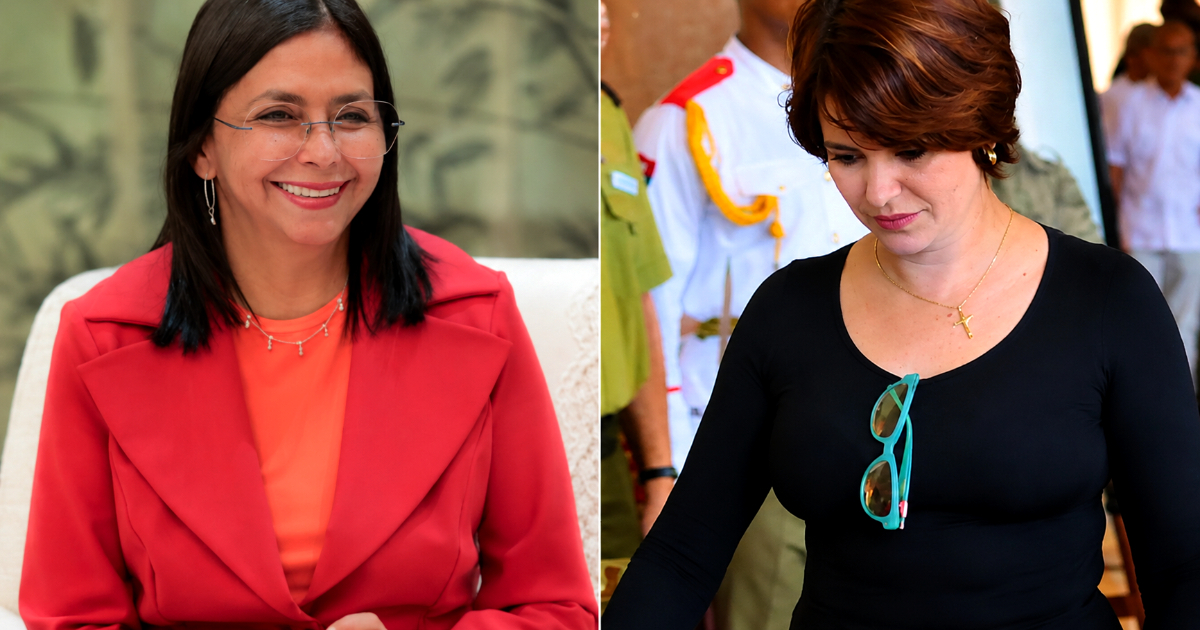
The Spanish activist Ana Hurtado, known for her support of the regimes in Cuba and Venezuela, has reacted with clear bewilderment to the announcement of a "democratic transformation" made by the acting Venezuelan president, Delcy Rodríguez, one of the key figures of chavismo during the administrations of Nicolás Maduro.
“I don’t understand. What do you mean by democratic transformation? What is being discussed?”, Hurtado wrote on Facebook on October 29, accompanying his questions with a surprised emoji.
Hours later, he reiterated his astonishment by sharing a post by Venezuelan communicator Miguel Ángel Pérez Pirela announcing Rodríguez's speech on democratic transformations in Venezuela. This time, he simply added three astonished emoticons.
The reaction is particularly striking because it is not in response to a proposal from the Venezuelan opposition or a demand from Washington, but rather to the words of a leader who has held some of the most important positions within Chavismo and who now promises to reform the political system of which she has been a part for years.
When chavismo speaks of democratizing itself
In her speech on Thursday, Rodríguez announced a political and institutional transformation, promised elections organized by a renewed electoral authority, and defended judicial reforms, guarantees for political participation, and the protection of private property.
He also raised the possibility of returning properties expropriated during the chavista governments and acknowledged abuses in the enforcement of the so-called Law Against Hatred, which has been used for years to target critical expressions.
"I come from the system we are transforming and changing, and I do not hide it", stated the acting president, who introduced herself as the right person to lead this process precisely because of her experience within the Venezuelan State.
The announcements still need to be translated into verifiable measures. Rodríguez did not set a date for the elections nor explained how the independence of the institutions he promises to reform will be ensured. However, his speech represents a significant shift from the traditional rhetoric of chavismo.
And there appears the contradiction that seems to have puzzled Hurtado.
For years, Spain has defended the political systems of Cuba and Venezuela as democratic and socially just alternatives to Western democracies, questioning the allegations regarding the lack of freedoms and the authoritarian nature of those governments.
In April of this year, an article titled "Cuba, a dictatorship?" was published on Cubadebate, in which he denied that the Cuban system could be classified as dictatorial and argued that the existence of a single party did not necessarily imply a dictatorship.
According to Hurtado, there is political participation in Cuba, and citizens are not deprived of the freedom of thought. He even went so far as to present the Armed Forces and the Ministry of the Interior as expressions of the uniformed people.
Years before, she had defended that the socialist project was "sacred" and had questioned why criticisms of the Cuban government were publicly expressed on social media.
Now it is one of the main leaders of chavismo who acknowledges the need to reform institutions, expand political guarantees, review expropriations, and correct abuses committed under the very system that Hurtado has fiercely defended as a model of "21st Century Socialism".
If the revolutionary model already provided the democratic guarantees that its proponents proclaimed, why does it need a democratic transformation of such magnitude?
A contradiction that also reaches Havana
Hurtado's bewilderment allows us to observe a broader political tension between the new discourse from Caracas and the traditional positions of the Cuban regime, which continues to uphold the leading role of the Communist Party and rejects political pluralism.
The Spanish woman, residing in Cuba and married to Senén Casas Más, son of the late General Senén Casas Regueiro, maintains a close public identification with the Cuban leadership and its political project.
Recently, the figure of Raúl Castro was once again reaffirmed, and the slogan “Conflict with Raúl, conflict with me” was revived, popularized by the official artist Kcho.
His posts do not represent an official position of Havana, but they reflect the confusion that the reformist language now adopted by one of the previously key political allies of the Cuban regime can provoke among supporters of revolutionary continuity.
Rodríguez has requested that her management be judged by the facts. For now, her promises do not equate to a completed democratization. However, it is enough for a historical leader of chavismo to speak about democratically transforming the system for some of the certainties defended for years by her supporters to begin to be called into question.
Related videos:
Filed under: