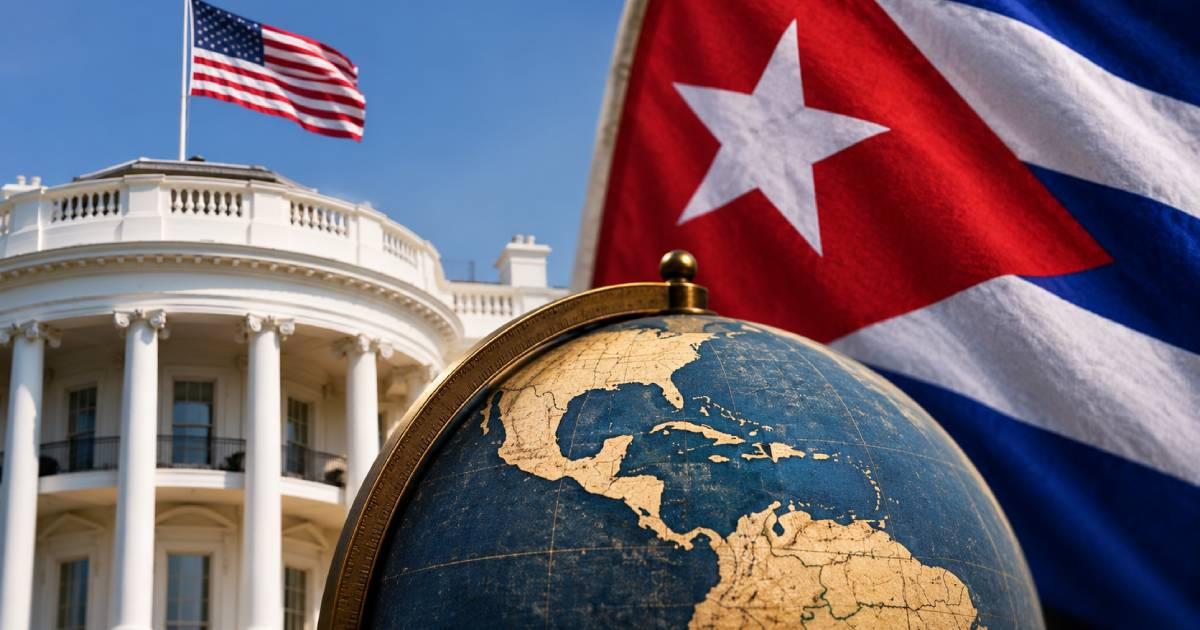
The U.S. State Department released on Tuesday a report from the New York Post regarding the so-called Donroe Doctrine, the strategy employed by President Donald Trump to strengthen U.S. influence in Latin America. A senior official from his administration stated that Washington continues to focus efforts on Cuba following the operation that culminated in the capture of Nicolás Maduro in Venezuela.
"We are taking care of Cuba. We have maintained momentum at full speed in the Western Hemisphere," declared the official, whose identity was not revealed, to the American newspaper.
The State Department also shared the report on its official X account, highlighting the strategic priorities of the U.S. administration in the hemisphere.
"Trump and Secretary of State Marco Rubio have prioritized up to 20 countries in the Americas to contain threats, secure supply chains, and stop the flow of illicit drugs and migration, according to a senior administration official," the message notes.
Although the institutional publication does not explicitly mention Cuba, the shared report does address Washington's pressure on Havana and its relation to the political transformations occurring in Venezuela.
Cuba remains under pressure following the capture of Maduro
The New York Post presents the U.S. military operation on January 3, 2026, which resulted in the capture of Nicolás Maduro and his wife, Cilia Flores, as one of the main events in the new hemispheric policy.
The newspaper notes that the subsequent negotiation of oil agreements between Washington and the interim Venezuelan government, led by Delcy Rodríguez, has had direct consequences for Cuba.
For decades, the Cuban regime relied on the supply of Venezuelan oil under preferential conditions, a relationship that was disrupted after Maduro's fall.
According to the newspaper, the loss of subsidized Venezuelan oil supply, along with the tightening of U.S. sanctions, has increased economic pressure on Havana.
The newspaper also recalls that Trump has expressed his belief that the Cuban communist government will fall before his term ends.
The high-ranking official consulted by the newspaper insisted that the events in the Middle East have not diverted U.S. attention from its regional priorities.
"We carried out the entire project in Venezuela while the one in Iran was underway, and we are taking care of Cuba," he stated.
What is Trump seeking with the Monroe Doctrine?
The so-called Donroe Doctrine combines the name of Donald Trump with the historic Monroe Doctrine, proclaimed in 1823 to reject new European colonial interventions in America.
The reinterpretation driven by the current U.S. administration aims to limit the influence of powers like China and Russia, strengthen military and economic cooperation with allied governments, and ensure access to the continent's strategic resources.
A high-ranking U.S. official assured the newspaper that China is facing greater challenges in maintaining its influence in the region.
"China is on the defensive. For the first time, it is being forced to compete fairly and to confront the fact that this is our hemisphere," he stated.
The report mentions trade and security agreements with Latin American countries, actions against organizations dedicated to drug trafficking, and measures to reduce Chinese influence over strategic infrastructures.
The spokesperson for the National Security Council at the White House, Anna Kelly, defended the administration's approach.
"After years of neglect, President Trump established the Monroe Doctrine to restore American preeminence in the Western Hemisphere," he stated to the newspaper.
The State Department had already linked the Monroe Doctrine to Cuba
The dissemination of the report does not mark the first time that the State Department has used its official channels to promote messages related to the Monroe Doctrine and Cuba.
On October 24th, the institution amplified three publications regarding the U.S. strategy towards the Island, including a televised comment that described Washington's actions as an application of the Monroe Doctrine.
Those publications were linked to Marco Rubio's call for Cubans interested in promoting political changes to make discreet contacts with the Central Intelligence Agency (CIA).
A day later, the CIA itself released messages in Spanish directed at Cuban citizens, while the U.S. Southern Command also made references to opportunities for political change on the Island.
Previously, in August, the State Department had released a video asserting the Monroe Doctrine, in which Cuba was featured among the historical scenarios used to illustrate American influence on the continent.
In June, during a visit to the Guantánamo Naval Base, Secretary of War Pete Hegseth also defended the Monroe Doctrine and warned that the United States was prepared to respond to various scenarios related to the Cuban government.
The release of this new report by the State Department reinforces the presence of that strategy in official U.S. communication.
At the moment, no new operation against Cuba has been announced. However, statements gathered by the New York Post indicate that the Trump administration continues to consider the Island within its hemispheric priorities, following the U.S. intervention in Venezuela.
Related videos:
Filed under: