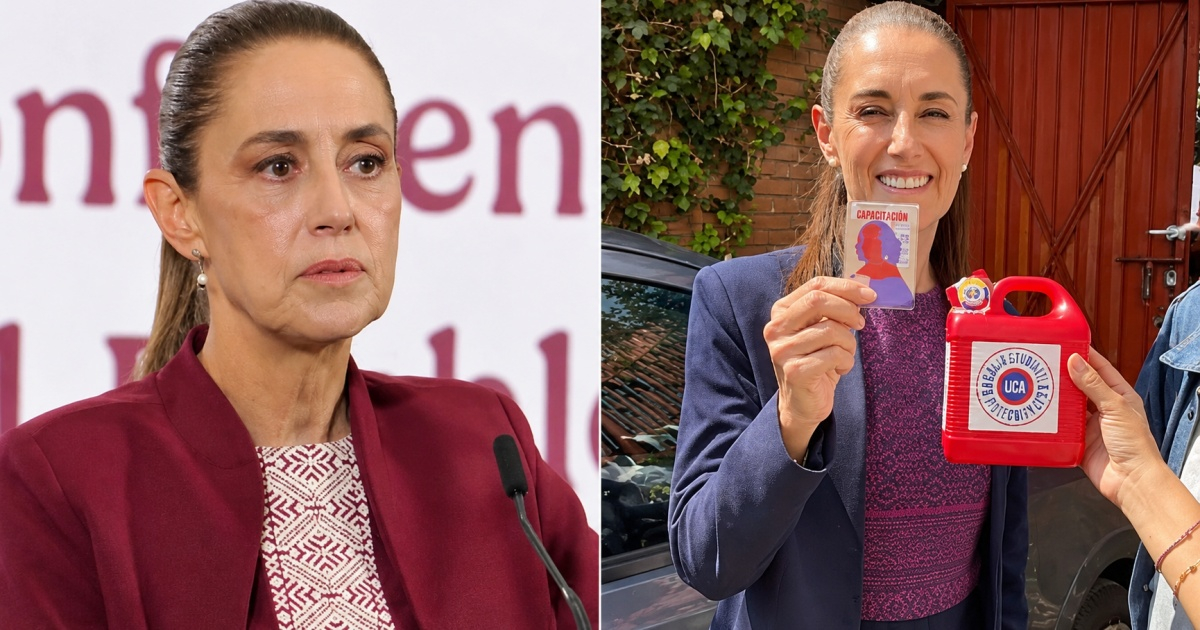
The Mexican president Claudia Sheinbaum publicly supported the campaign "A Liter of Gasoline for Cuba," promoted by the Antifascist Cultural League (LCA), a collective of over 200 artists, writers, and journalists aiming to gather 40,000 liters of fuel to send to the island via a tanker managed by civil society.
Sheinbaum's endorsement was announced by LCA itself and echoed by the Cuban embassy in Mexico, as well as by state-run media on the island, which portrayed it as a gesture of "solidarity."
A photograph shared from the initiative shows the president holding the campaign print alongside Paco Ignacio Taibo II, director of the Fondo de Cultura Económica (FCE) and one of its main promoters, and a red canister featuring the LCA emblem.
The collection and its organizers
The campaign was launched on October 19 during the International Book Fair at the Zócalo in Mexico City.
The initiative operates by selling collectible stamps for 25 Mexican pesos each, an amount that the organizers present as equivalent to the cost of a liter of gasoline.
The prints are available in FCE and Educal bookstores in Mexico City, Guadalajara, and Monterrey.
Among the organizers are filmmaker Sergio Arau, actors Damián Alcázar and Jesús Ochoa, and writer Elena Poniatowska.
The organizers aim to raise funds to send 40,000 liters of gasoline to Cuba via a tanker ship. However, they have not publicly specified the date of the transfer, the vessel that would be used, or the necessary permits to carry out the operation.
From Pemex shipments to a citizen collection
The initiative comes after Mexico eliminated its oil supplies to Cuba, which had represented a significant portion of the island's energy supply during 2025.
That year, under the government of Sheinbaum, Pemex covered about 17% of the fuel consumed in Cuba, with exports valued between 500 and 560 million dollars annually, according to the published estimates.
At the end of January 2026, Pemex canceled the shipment of the vessel Swift Galaxy, which was scheduled to arrive in Cuba at the end of that month.
The suspension occurred amid pressures from Washington regarding energy supplies to the island and before Donald Trump signed an executive order on January 29 that opened the possibility of imposing tariffs on countries providing oil to Cuba.
The suspension of the shipment was not accompanied by a public explanation that would clarify its reasons. Sheinbaum then argued that Mexico's decisions regarding oil supply were sovereign.
In May, Pemex dissolved Gasolinas del Bienestar, the subsidiary created to manage those shipments, and Sheinbaum confirmed that Mexico was redirecting its assistance to Cuba towards other modalities.
"Yes, they are receiving oil from Russia, so we are turning to other humanitarian support," the leader stated.
The current support from Sheinbaum for the collection thus represents a new way of assisting the supply of fuel to Cuba, this time through a campaign promoted by Mexican organizations and personalities, rather than a direct operation by Pemex.
Who would receive the fuel?
One of the main uncertainties of the campaign is the final destination of the gasoline once it arrives in Cuba.
GAESA, the business conglomerate associated with the Cuban Armed Forces, maintains a significant presence in strategic sectors of the economy, including the marketing of fuels through business structures such as CIMEX.
A recent analysis on the use of intermediaries to access imported fuel has highlighted the marketing and distribution mechanisms related to the military conglomerate.
However, the organizers of the collection have not publicly specified which entity would receive the gasoline or how its distribution would be ensured.
This lack of information makes it impossible to determine whether the donation would directly benefit the population or if its distribution would occur through state structures.
The amount that the campaign aims to raise is also limited in comparison to the country’s energy needs.
If we take as a reference an estimated national consumption of between 15 and 18 million liters of hydrocarbons daily, the 40,000 liters would represent approximately between 3.2 and 3.8 minutes of that volume.
The comparison is indicative, as the total consumption of hydrocarbons includes various petroleum products and is not limited to gasoline alone.
Related videos:
Filed under: