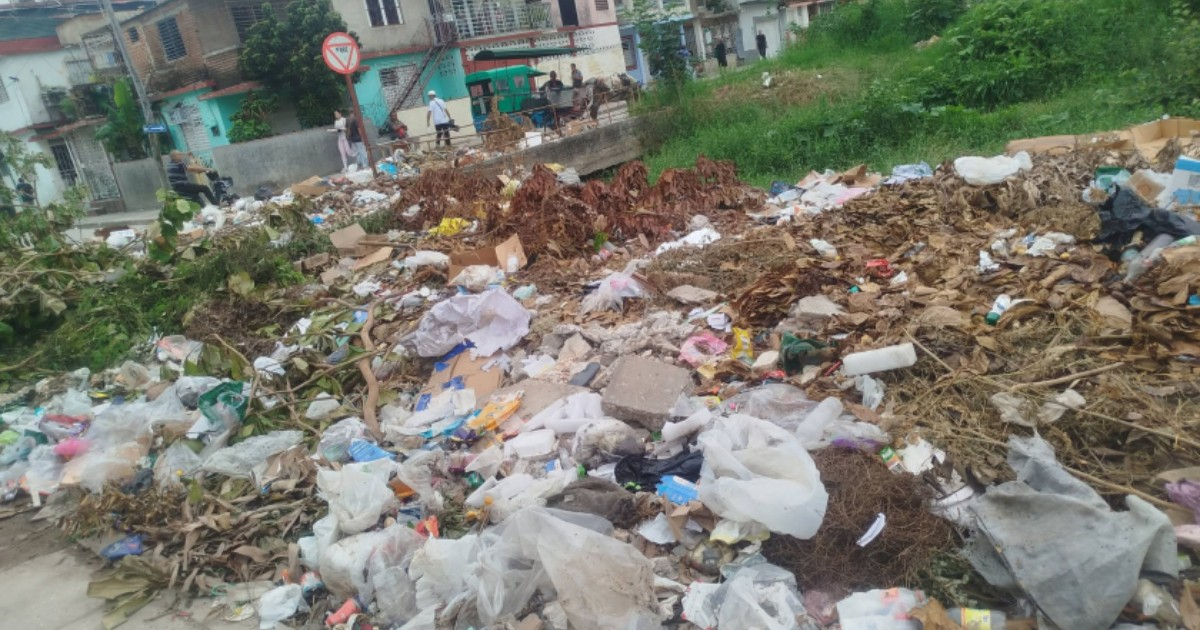
A resident of Holguín identified as René Hernández posted on Facebook photos documenting the collapse of the garbage collection service in the city: streets blocked by piles of waste, vacant lots turned into makeshift dumps, and sidewalks overwhelmed with plastic bags, debris, cardboard, and decomposing organic matter.
"It is a shame of a province, this Holguín. These garbage dumps are responsible for so many diseases that are circulating today... and it doesn't seem to interest anyone," wrote Hernández, who noted that it was not the first time he had reported the issue.
"There is nothing to hold onto and no one to turn to. Without a doubt, we have been left alone. What is the point of having so many positions and leaders if they are unable to solve the problems?" he added.
The post sparked a flood of comments from residents of Holguín, who agreed in describing a total institutional neglect and nostalgically reminisced about what their city used to be.
"Our province, one of the cleanest there used to be. What a sadness to see how everything is now," lamented a user.
Another recalled the city's historic nickname: "The City of Parks, the most beautiful. What name shall we give it now?"
The comments also described direct consequences on daily life.
"Streets that have turned into one-way traffic, and you have to increase your speed due to the bad odors, and if they light a fire, the gases invade homes, healthcare facilities, places where people are eating," reported a user.
The outrage was directed squarely at the authorities. “We have fallen into total oblivion. They don’t care about the people at all, and that's been proven; all they care about is their own well-being and increasing their savings,” wrote a neighbor.
Another user was more succinct: "That doesn't concern anyone; unfortunately, the people are left alone in an endless battle."
A third party pointed out underlying structural issues: “Negligence at the highest level. Waste management should not be centralized; each municipality should handle it. Nowhere is it free; that service is included in your rent or property.”
"What sadness, as Holguín has always been one of the cleanest places, without words, there is no solution for anything here and no hope, it gets worse every day," summarized another user.
Throughout 2026, residents of Holguín have reported dumps near schools and daycare centers, burning landfills in the neighborhoods, and piles of waste in front of residential buildings.
In October, residents alerted about a garbage dump near the Plaza de la Marqueta, next to food kiosks, noting that the collection truck passed by but did not pick up the waste.
The health consequences are severe. The Ministry of Public Health acknowledged in September a simultaneous increase in dengue, diarrhea, hepatitis, and respiratory infections directly linked to deficiencies in environmental sanitation.
The Global Dengue Observatory reported 11,235 estimated cases in Cuba as of October 4, which is 9.2 times the historical average expected for this period.
Given the magnitude of the problem, the Pan American Health Organization donated 50 fumigation machines to Holguín in September to strengthen the control of the Aedes aegypti mosquito across its 14 municipalities, while the Cuban government acknowledged deficiencies in waste collection at a national level without providing concrete solutions for the province.
Related videos:
Filed under: