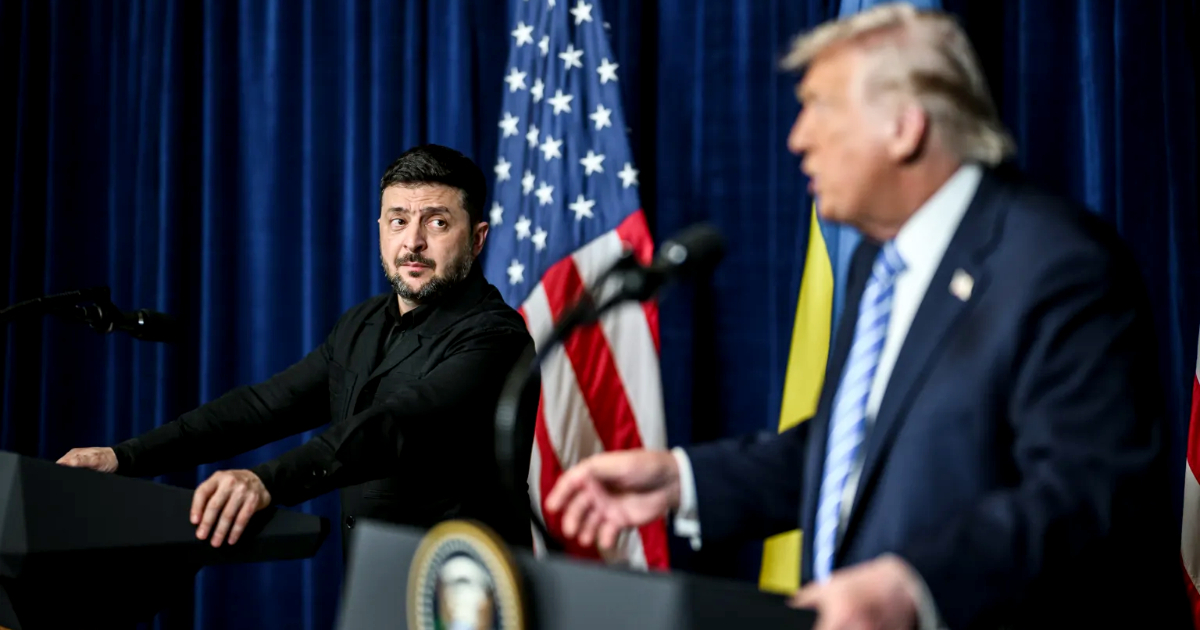
The Ukrainian president Volodimir Zelenski warned this Saturday, in an interview with CNN, that the proposal from the administration of Donald Trump to redesign the European security architecture carries a serious risk, as Moscow shows no signs of wanting to negotiate an end to the war, but rather aims to impose a new continental order tailored to its interests.
According to the agency EFE, Zelenski stated that the Russians “do not want to think about how to end this war,” but rather “to start with a new security infrastructure in Europe,” and that is precisely what makes it dangerous.
The Ukrainian leader emphasized that the threat weighs more heavily on the countries of the European Union than on Ukraine itself, given that Kyiv is not a member of either the community bloc or NATO: “It is more dangerous for the European Union than for us. However, we all live in Europe.”
To illustrate his rejection, Zelensky referred to a historical reference rich in symbolism: “We do not want to have a Yalta 2. We are not ready for such a format. We do not want to be divided by Russia,” he declared, referencing the Yalta Conference of 1945, where Stalin, Roosevelt, and Churchill agreed on the division of Europe without consulting the affected countries.
The warning comes after days of intense diplomatic activity driven by Washington. On Thursday, Trump welcomed Kirill Dmitriev, special envoy of Russian leader Vladimir Putin, at the White House and announced that they were close to an agreement that would cover "more than Ukraine" and could involve "all of Europe": "It's going to be very big. It's going to be a great and beautiful agreement, and everyone will be thrilled", he stated, without providing further details.
His son-in-law and envoy Jared Kushner detailed on social media platform X that Washington is working on five objectives: ongoing security consultations, reliable communication channels in crises, greater military transparency, measures to reduce escalation risks, and a lasting framework for European stability.
Kushner also participated via video conference in two days of meetings in Brussels with officials from NATO, the EU, and European powers.
This episode is part of a long series of pressures from Trump on Zelensky—which include threats to reduce military aid, the demand to stop attacks on Russian refineries and statements that Ukraine needs “a new president”—in stark contrast to a notably softer diplomacy towards the Kremlin.
While the diplomatic controversy was unfolding, Russia launched a massive attack this Saturday with 172 drones and 36 ballistic missiles against Kyiv and other Ukrainian regions, damaging critical energy infrastructure, the Northern Bridge, and a kindergarten, resulting in at least nine injuries.
Zelenski himself denounced on X that "Russia is preparing for trilateral talks by launching ballistic missiles at Ukraine's critical infrastructure."
The EU and Europe reject Trump's plan
The proposal generated immediate and unanimous rejection among European leaders, according to Euronews.
The head of EU diplomacy, Kaja Kallas, was emphatic from Warsaw: «There is already a European security architecture. The problem is that Russia continues to violate the treaties that underpin it. Putin does not have a veto over European security».
The Polish Foreign Minister Radosław Sikorski was even more direct: «An agreement about the future of Ukraine and Europe over our heads would not only be reckless. It is, in fact, impossible».
The Ukrainian Foreign Minister Andrii Sybiha, meeting with Kallas in Warsaw, rejected the idea that Moscow could act as a guarantor of continental security: «We need to talk about protecting ourselves from Russia, not about negotiating with the Russians regarding spheres of influence in Europe».
The spokesperson for the European Commission, Paula Pinho, warned that there is a "considerable amount of work" left before reaching any peace agreement and that the EU will determine its own security matters.
Trilateral negotiations between the United States, Russia, and Ukraine are scheduled for November 10 and 11 in Abu Dhabi, marking the first round since February 2026, when discussions were halted as Washington shifted its focus to the conflict with Iran.
Related videos:
Filed under: