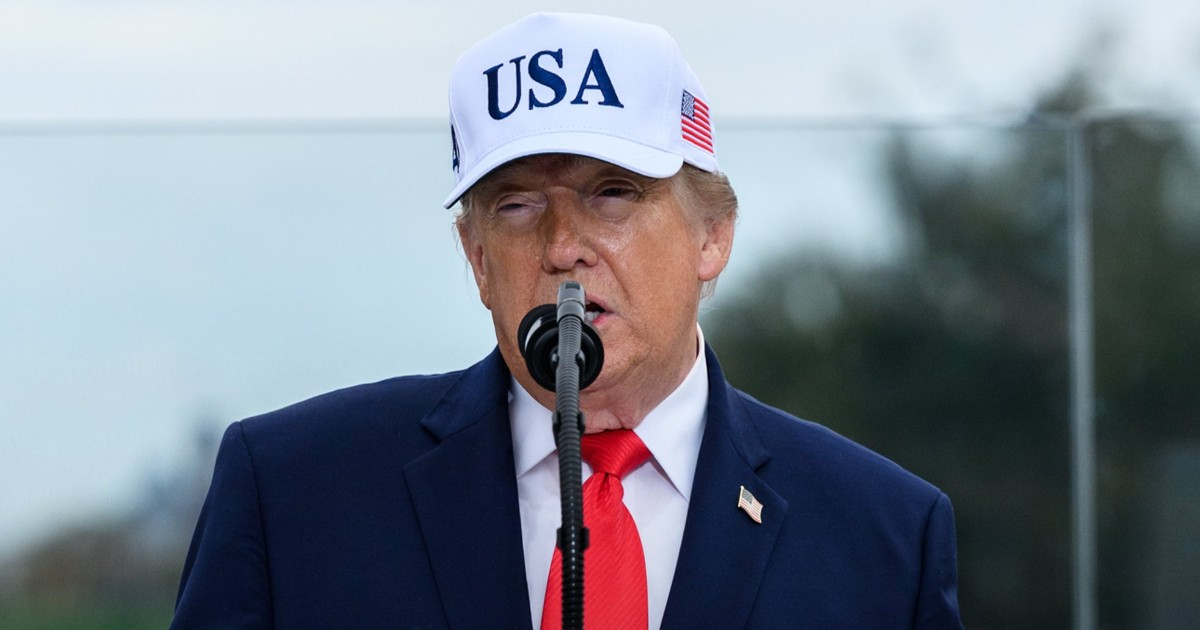
The president Donald Trump admitted for the first time that his policy of mass deportations was "too harsh" and that it cost votes for the Republicans in the midterm elections on November 3, in which the Democratic Party regained control of both chambers of Congress.
The confession came in a lengthy interview with CBS's 60 Minutes program, conducted by correspondent Ross Douthat and aired on Sunday. When directly asked if the immigration policy had gone too far, Trump answered candidly: "I think it was too harsh. I think it may have been too harsh, yes."
The president distinguished between two types of deportees: those with criminal records —for whom he stated he received "very good reports" regarding their expulsion— and those who had been working for years without having committed any offense except for entering the country illegally.
Las políticas de deportaciones y sus consecuencias políticas siguen marcando el debate migratorio en Estados Unidos. Mantente al día con toda la información en nuestra sección de
"I receive very good grades for removing the bad ones. But it harms me because we also remove people who had good jobs, who committed a single infraction or violation of the law: they entered the country illegally," he stated.
Trump gave a concrete face to that contradiction when he spoke about hotel workers: "When you enter a hotel and say 'let me see your pass,' and there’s a woman who has worked there as a housekeeper, as a cleaner, as this, as that, as a waitress. Many good things. And suddenly they are being taken out of the country. It’s hard. It’s a hard thing."
He also mentioned employees from landscaping companies, some of whom had been residing in the United States for a decade or more and were paying taxes. "I think that ultimately hurt me," he acknowledged.
The CBS exit polls confirmed that perception: 58% of voters believed that the administration's immigration measures had gone too far. The Latino vote, which Trump had partially won in 2024, reversed significantly: Democrats garnered 62% of the Hispanic vote, and 17% of Latinos who supported Trump two years ago backed Democratic candidates this time, according to a UnidosUS survey.
The Republican defeat was historic: the Democrats achieved a projected majority of 244 seats in the House and 54 Senators compared to 44 Republicans, marking the first time since 2006 that a party has simultaneously lost both chambers in a midterm election.
Trump expressed openness to negotiating with Democrats regarding some form of legal status for undocumented immigrants without serious criminal records, describing a potential agreement as "feasible." He noted that some Democratic legislators had already reached out to him and mentioned the new senator from Texas, James Talarico, as a possible point of contact on immigration matters.
However, the concrete signals point in the opposite direction. One day after the electoral defeat, Secretary of Homeland Security Markwayne Mullin posted on social media: "Deportations will continue." Three days later, Trump appointed Stephen Miller—considered the chief architect of mass deportations—as the new Chief of Staff of the White House, replacing Susie Wiles. Miller took office this Monday.
For the Cuban community, the impact of immigration policy has been particularly severe. Arrests of Cubans by Immigration and Customs Enforcement (ICE) increased by 463% between late 2024 and early 2026, with over 42,000 Cubans having pending deportation orders.
According to the Migration Policy Institute, 80% of the approximately 980,000 deportees in the first 18 months of Trump's second term had no criminal records, which reinforces the president's own admission that the policy was broader than what his own voters were willing to accept.
Related videos:
Filed under: