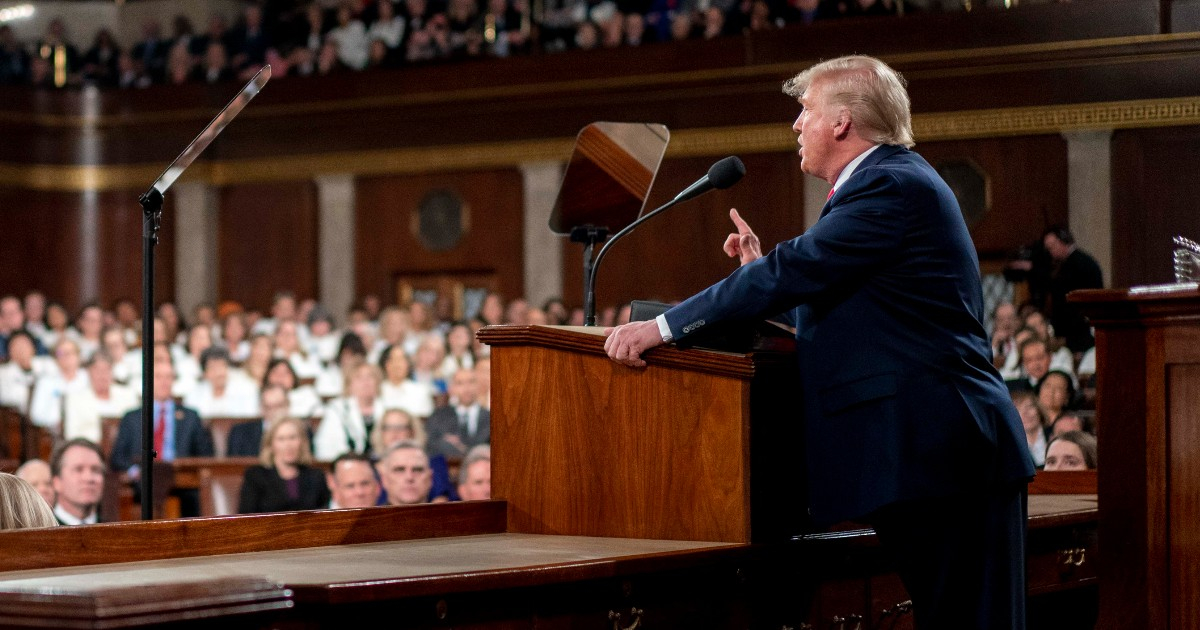
President Donald Trump admitted in an interview with CBS's 60 Minutes that his deportation policy was "too harsh" and expressed his willingness to negotiate with Democrats for some form of legal status for undocumented immigrants with no serious criminal records who have been working in the United States for years.
The interview, conducted by correspondent Ross Douthat and aired on Sunday, was the first that Trump granted to television after the stinging Republican defeat in the legislative elections on November 3, in which the Democrats regained control of both chambers of Congress for the first time since 2006.
Trump made a distinction between three groups: those who want to deport everyone, those who support sanctuary cities, and a middle sector that would expel criminals but allow those who have been working for a decade or more to stay. "Get rid of the murderers. Get rid of the rapists. Get rid of the drug traffickers, but let the people who have been here for 10 or 15 years reach an agreement," he stated.
Las declaraciones de Trump abren un nuevo capítulo en el debate migratorio. Sigue todos los desarrollos sobre políticas, estatus legal y deportaciones en nuestra sección de
The president gave a concrete face to the debate by describing the situation of hotel workers: “When you enter a hotel and say 'let me see your pass', and there is a woman who has worked there as a housekeeper, as a cleaner, as a waitress. Many good things. And suddenly they are taking her out of the country. It’s hard. It’s a tough situation.”
When asked directly whether an agreement could create some form of legal status for those workers, Trump replied with a single word: "Feasible." He also mentioned that several Democratic legislators had already contacted him to explore a negotiation and cited new Texas Senator James Talarico—who defeated Republican Ken Paxton on November 3—as a possible interlocutor.
Trump acknowledged that immigration policy "helped and harmed" the Republicans in the elections. "I receive very good marks for getting rid of the bad ones. But it harms me because we also removed people who had good jobs, who committed just one infraction: they entered the country illegally," he stated. A CBS exit poll indicated that 58% of voters believed that the administration's immigration measures had gone too far.
However, Trump did not present any bill, timeline, eligibility criteria, or concrete legal mechanism for that possible status, which makes his words a rhetorical signal without immediate practical translation.
The actions of his own administration are heading in the opposite direction. On Friday, Trump appointed Stephen Miller—considered the chief architect of mass deportations—as the new White House Chief of Staff, replacing Susie Wiles, effective this Monday. The appointment of Miller as Chief of Staff was described by Senate Democratic leader Chuck Schumer as a "promotion," not a course correction, and he stated that Trump "has learned nothing" from the election results.
MAGA base sectors reacted strongly. Commentator Tomi Lahren said she was "confused" because she had voted for "mass deportations" and now it seemed he was receiving "amnesty." Others labeled Trump as a "chief traitor."
For the Cuban community, the impact of immigration policy has been particularly severe. According to data published in October, the arrests of Cubans by ICE increased by 463% between late 2024 and early 2026, and over 42,000 Cubans had pending deportation orders in the United States.
There is a relevant legislative precedent: the Dignity Law, promoted by the Republican representative María Elvira Salazar, which proposes a temporary legal status of ten years for immigrants with no criminal records who have resided in the country for at least five years, but has never advanced in Congress. The Secretary of Homeland Security, Markwayne Mullin, was more direct following the electoral defeat: "Deportations will continue."
Related videos:
Filed under: