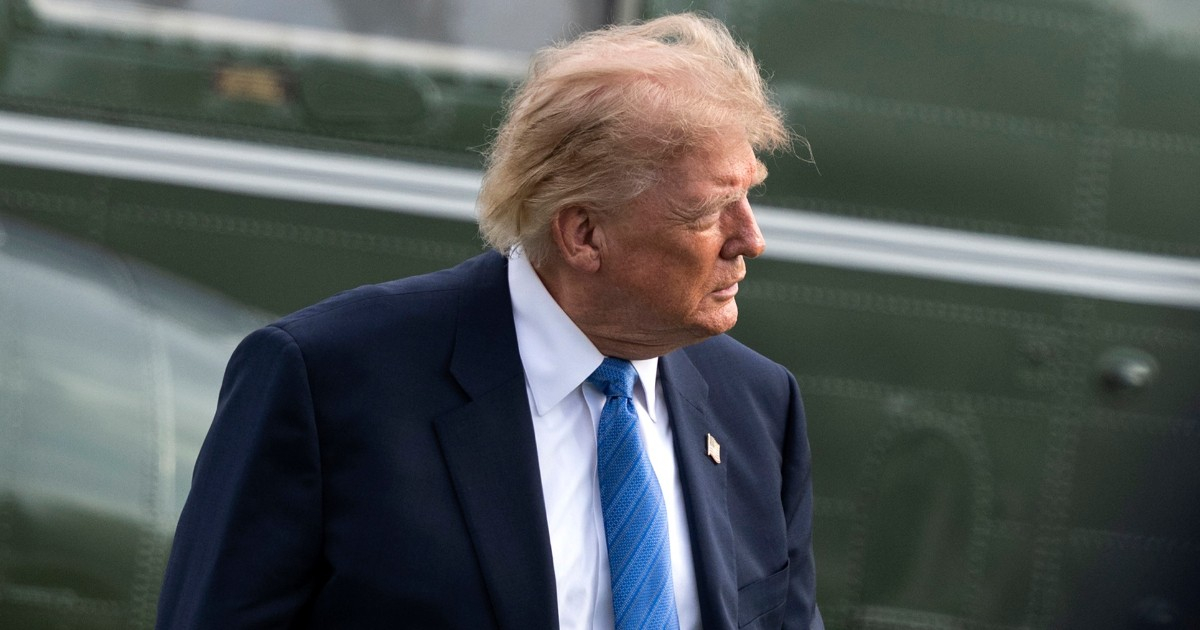
President Donald Trump offered his most extensive analysis to date on the overwhelming Republican defeat in the legislative elections held on November 3, in a 60 Minutes interview on CBS conducted by correspondent Ross Douthat, presenting a range of justifications that span from the abstention of his own voters to the war with Iran, as well as poor economic messaging, deportations, and Fox News.
The Democrats regained control of both chambers of Congress in that election, gaining more than 40 seats in the House of Representatives and at least seven in the Senate, with projections attributing them 244 representatives and 54 senators compared to 44 Republicans.
The central explanation from Trump was that his name was not on the ballot. "Number one, I was not on the ballot, but I campaigned hard for some people. And I believe that if I had been on the ballot, it would have been a very different situation," he said. This justification contradicts his own pre-election strategy, where he repeatedly urged his supporters to vote "as if" he were on the ballot.
When pressed on why that call didn’t work, Trump pointed to two reasons: "I don’t think they voted, really. I don’t think they voted. I think in some cases they didn’t like the candidates. And that’s, you know, their prerogative.”
Regarding specific candidates, he acknowledged that some of his endorsements turned out to be problematic. He defended his support for Texas Attorney General Ken Paxton and Darline Graham in South Carolina, although both lost their respective Senate races. He argued that Paxton would have lost anyway and that Graham "fought hard."
The war with Iran played a central role in his analysis. Trump said he did not disagree with the assessment of his vice president JD Vance, who posted on social media that "the reason we lost is the war", although he added a nuance: "The only thing I wish he had said is: if you had to do it again, would you? And that’s Iran. Would you attack Iran? My answer is a resounding yes." He dismissed escalating the conflict after the midterms: "I’m not looking to do that. I don’t think there’s a reason for it."
The rise in gasoline prices, linked to the conflict with Iran, was another reason cited. "They didn't like the fact that gasoline went up because I had it low in Iowa. It was at $1.85 per gallon. And when you see $1.85 and it rises to three and a half, four dollars... the war was blamed for that," he noted. CBS News exit polls showed that three-quarters of voters rated the economy as bad or not very good, and 70% of that group supported Democratic candidates.
On economic matters, Trump defended the results of his management but admitted to communication failures: "I think it was poor communication. Perhaps on my part, but I talked about it all the time. So I don’t know, how much can I talk about it?"
About immigration policy, Trump acknowledged that the deportation of immigrants with jobs and no criminal records hurt him electorally: "I receive very good marks for getting rid of the bad ones. But it hurts me because we also deported people who had good jobs, who committed just one infraction: they entered the country illegally." He admitted that the policy "may have been too harsh" and expressed openness to negotiating some form of legal status for undocumented individuals without serious offenses, describing a possible agreement as "achievable."
He also blamed Fox News for contributing to Republican losses by giving too much airtime to Democratic voices, a point he had made on Truth Social days before the interview.
The appointment of Stephen Miller as the new Chief of Staff —announced on the same day as the interview, replacing Susie Wiles— suggests that the immigration agenda will not change course despite Trump's public admissions. The new Congress with a Democratic majority will be sworn in on January 3, 2027.
Related videos:
Filed under: