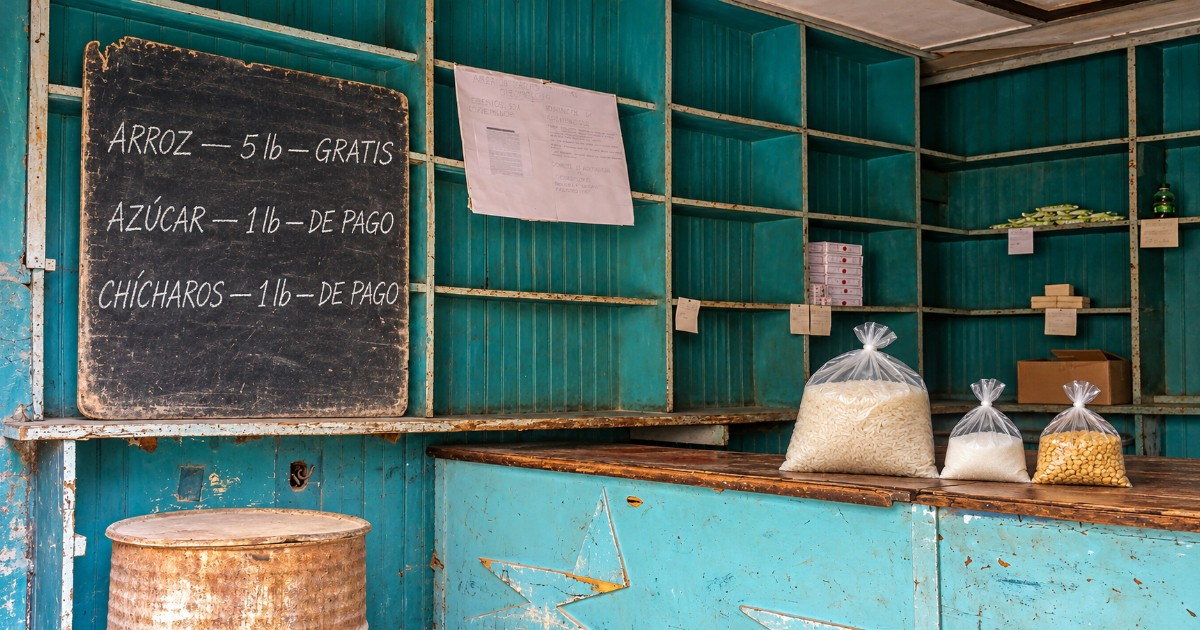
The Ministry of Domestic Trade (MINCIN) published on Monday the status of the food distribution module for individuals in vulnerable situations, acknowledging that weeks after its announcement, several municipalities in the country have still not received even the delivery corresponding to September. The module includes five pounds of free rice from a Chinese donation, along with one pound of sugar and one pound of peas that the beneficiaries must cover.
Prime Minister Manuel Marrero Cruz promised in early October that more than 883,000 Cubans classified as vulnerable would receive this package monthly until January 2027, as a result of a new targeted social protection model that replaced the universal subsidies of the historic ration book.
However, the official report from MINCIN highlights the accumulated delays. In Havana, the municipality of Regla was still awaiting the start of the September distribution, while San Miguel del Padrón and Arroyo Naranjo were still in process. In Granma, the situation was so critical that it was decided to distribute September and October simultaneously, although Buey Arriba, Bartolomé Masó, and Cauto Cristo had not yet begun. For the October delivery, Ciego de Ávila had not even started.
Meanwhile, the MINCIN reported on the distribution of a free module from the World Food Programme (WFP) for the September-October bi-monthly period, which includes four kilograms of rice for all beneficiaries, plus one kilogram of peas and one liter of oil for pregnant women, children under five years old, minors with chronic illnesses, and children with low weight and height. Camagüey was the only province that had completed this delivery; the others were either in distribution or pending to start.
Delays on paper contrast with specific complaints on the ground. In Guantánamo, the Provincial Assembly limited the distribution of oil and peas from the PMA module to just 11,653 people out of a registry of 49,842 registered consumers, citing a lack of inventory. In Camagüey, elderly residents of La Gloria reported that their names were missing from the lists; one woman recounted that her 85-year-old mother went twice without being able to receive assistance.
The exclusion criteria have also not been uniform or transparent. In Contramaestre, Santiago de Cuba, a module was denied to an elderly person because their daughter lived in Brazil, a rationale that is not specified in any published regulation in the Official Gazette. A retired individual with heart problems from Bayamo, who had previously been classified as vulnerable, also did not find his name on the list at the store when he went to collect his module.
The actual scope of the program is insufficient given the magnitude of the crisis. The Cuban Observatory of Human Rights (OCDH) estimated, after conducting over 1,300 interviews in 79 municipalities, that 94% of Cubans live in extreme poverty and that eight out of ten people have had to skip a meal due to lack of money or food. The official number of vulnerable individuals rose from 310,000 in July 2025 to more than 883,000 in October 2026, prompting historian Ivette García González to warn: "They are not segments. It is the majority of people, the average citizen."
Related videos:
Filed under: