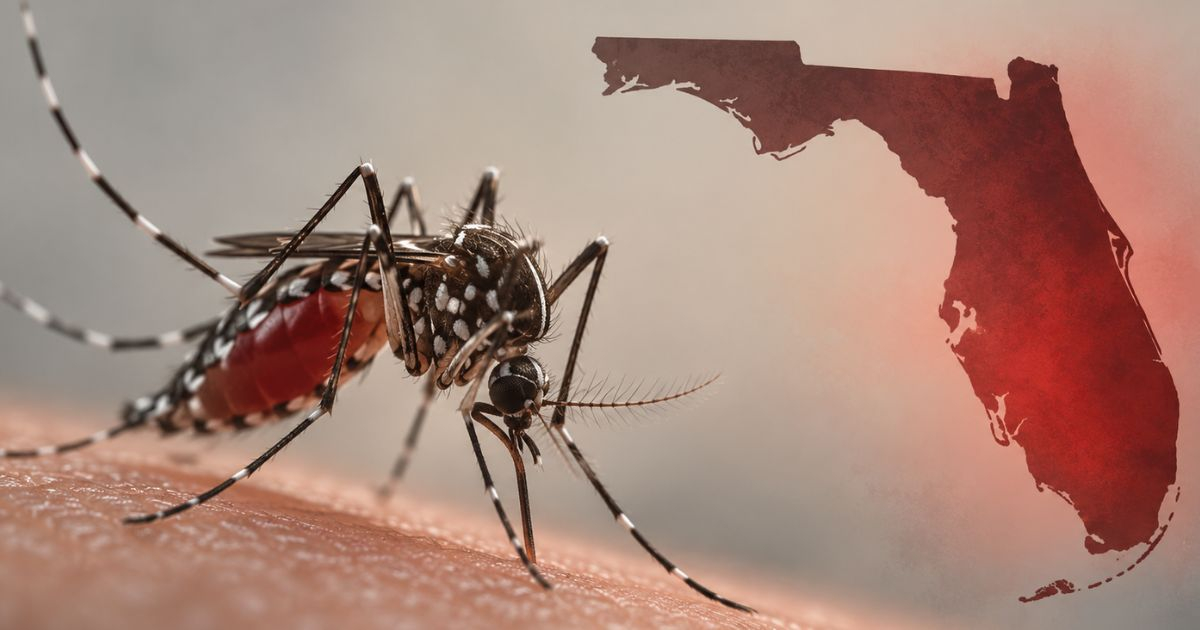
Dengue is no longer just a disease in the United States associated primarily with foreign travel: Florida is experiencing an unprecedented recent rise in infections acquired within the state, where local mosquitoes have now transmitted the virus to more people than those who returned infected after visiting other countries.
The situation was analyzed in a report published this Monday by The New York Times, which captures the warnings from scientists and public health officials about the spread of dengue within the United States.
Specialists believe that local transmission could become an increasingly common phenomenon.
The latest epidemiological surveillance report from the Florida Department of Health, for the week of October 25 to 31, records 524 cases of dengue acquired within the state during 2026, compared to 382 related to international travel.
The difference indicates a significant change in the behavior of the disease: historically, most of the infections detected in the continental United States were among individuals who had traveled to countries where the virus circulates.
However, now in Florida local infections surpass imported ones.
The growth is also evident when comparing the figures with the previous year. According to the state closing report of 2025, Florida recorded 62 locally acquired cases at that time.
In 2026, that amount has already multiplied by more than eight, before the year has even ended.
The main focus of transmission is in Hillsborough County, where Tampa is located, with 407 local infections. Next is Pinellas, with 80, while Miami-Dade reports 12 cases and Orange, where Orlando is situated, has a total of 10.
The concentration in the Tampa area has surprised specialists, who are used to seeing more dengue activity in southern Florida.
There is still no definitive explanation for why the outbreak gained such intensity in that region.
Gabriela Paz-Bailey, head of the dengue division at the Centers for Disease Control and Prevention (CDC), explained to the newspaper that researchers are examining possible factors, including the arrival of the virus through travelers from the Caribbean.
The specialist considers it unlikely that the continental United States will experience outbreaks of the magnitude recorded in Puerto Rico, but warned that local infections could become a frequent reality.
"But I do believe that we will continue to see cases of locally acquired dengue, and that this will become the norm," he stated.
Ira Longini, a biostatistician at the University of Florida, also predicts that outbreaks could worsen in the coming years, though he specified that current figures remain much lower than those recorded in countries where the disease is circulating intensively.
Dengue is primarily transmitted through the bites of infected mosquitoes, especially Aedes aegypti and Aedes albopictus. When one of these insects bites a person with the virus in their blood, it can become infected and subsequently transmit it to others.
This allows dengue, initially introduced by travelers, to continue spreading within a community, even among residents who have never left the United States.
Travel continues to play an important role. The report from the Florida Department of Health reveals that 323 of the 382 cases associated with international travel during 2026 had Cuba as the country of exposure, a particularly significant proportion for communities with frequent connections between both territories.
The Island is also facing a significant increase in dengue during 2026, according to estimates from the Global Dengue Observatory, although these figures come from statistical models and not from a national count of confirmed diagnoses, due to the lack of official data.
In Florida, weather conditions could also be favoring the proliferation of mosquitoes. Warm temperatures, humidity, and heavy rainfall create favorable environments for the reproduction of these insects, especially when water accumulates in yards, containers, and public spaces.
Climate change is another factor that scientists study due to its potential influence on the geographic distribution of transmitting mosquitoes. However, experts are still investigating how much each circumstance has contributed to the current outbreak.
The rise in infections has forced the enhancement of health measures. The counties of Hillsborough, Pinellas, and Pasco declared local emergencies to facilitate mosquito control and mobilize resources.
In particular, Hillsborough extended its state of emergency on November 5 until Thursday, the 12th.
The authorities increased aerial and ground treatments after detecting virus activity in mosquito populations in various neighborhoods.
The expansion of dengue had already been warned about weeks ago, when Florida had recorded 296 local infections by October 3, in what experts described as the largest state outbreak since the 1930s. In less than a month, the number exceeded 500 cases.
The disease has also resulted in at least one death in Florida during 2026. This is Gay Rabb Small, a woman from Tampa who passed away on September 4, exactly on her 80th birthday.
Her death was confirmed by health authorities in September. According to her daughter in The New York Times, the woman usually walked several kilometers along the Tampa coast and had not traveled in the weeks leading up to her illness.
The family explained that she began to feel unwell at the end of August, presented with tremors, and was transferred to a hospital, where she received a diagnosis of dengue. Her condition deteriorated rapidly, and she passed away due to multi-organ failure associated with the infection.
Currently, there are no dengue vaccines available for use in the United States, so prevention primarily relies on avoiding bites and reducing mosquito breeding sites.
Official recommendations include using repellents registered by the Environmental Protection Agency (EPA), wearing clothing that covers arms and legs, installing screens on doors and windows, and eliminating standing water in pots, buckets, tires, and other containers.
Related videos:
Filed under: