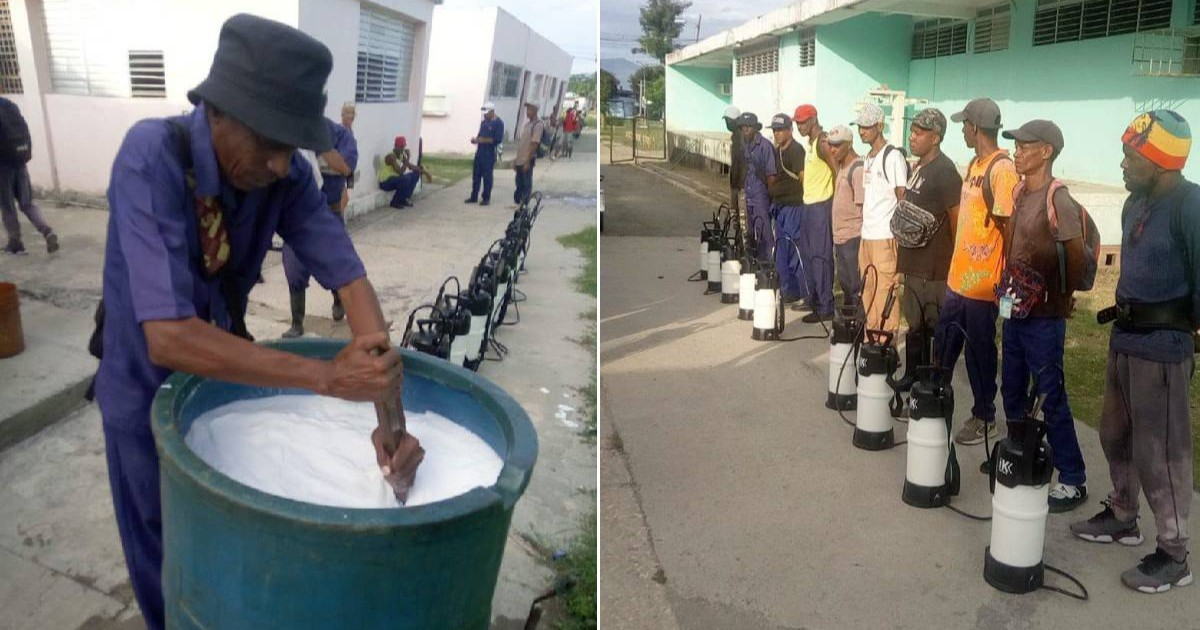
The General Directorate of Health of Santiago de Cuba has added new portable fumigation equipment to its vector control brigades, a reinforcement that arrives amid a dengue epidemic that has already surpassed 15,800 estimated cases across the island in 2026, according to the Global Dengue Observatory of the London School of Hygiene & Tropical Medicine.
Images posted in the Facebook group of the Provincial General Directorate of Health show groups of between seven and ten workers lined up with IK brand backpack sprayers, black and white manual pressure equipment manufactured by the Spanish company Goizper. The packaging of the boxes shows the name "Empresas Melo, S.A.", a distributor visible in the photographs.
The Red Cross has maintained an active presence in eastern Cuba since Hurricane Melissa struck the region in November 2025. In the year since then, the organization has delivered medications to more than 35,000 people, and its prevention campaigns against mosquito-borne diseases reached 7,494 individuals in the eastern provinces, according to a report by the International Federation of Red Cross.
The new IK sprayers are low-volume applicators useful for residual and larvicidal treatment, technologically distinct from the thermal foggers with greater range. Both types of equipment address the same urgent need: to compensate for the paralysis of motorized brigades caused by a lack of fuel.
This limitation has been acknowledged by the provincial health authorities themselves. Dr. Yaimara Gutiérrez de la Cruz, director of the Provincial Center for Hygiene, Epidemiology, and Microbiology of Santiago de Cuba, admitted at the end of September that adulticide fumigations would be conducted "depending on the availability of fuel in the municipalities."
The lack of fuel hindering fumigation efforts in Santiago adds to a crisis in vector control that provincial authorities acknowledged since April 2026, when infestation rates of Aedes aegypti had already exceeded the historical average of the previous five years. Santiago de Cuba, Palma Soriano, and Contramaestre were among the areas with confirmed active transmission.
The national epidemiological context is alarming. The accumulated cases of dengue in Cuba during 2026 are 10.6 times higher than the expected levels for this time of year, and in October alone, there were an estimated 4,624 new cases. The dengue outbreak is surging in Cuba with nearly 16,000 cases in 2026, a figure that contrasts with the official data from the Ministry of Public Health, which has stopped publishing comparable national updates since June of this year.
In September, the PAHO and WHO donated 50 thermal foggers to Holguín and announced an additional 90 units for other eastern provinces. The arrival of the IK sprayers in Santiago represents another timely relief in the face of a structural crisis that has been exacerbated by the regime's resource shortages for years.
The emergency appeal by the International Federation of Red Cross and Red Crescent Societies for 18 million Swiss francs, launched after Hurricane Melissa, had received only 38.6% of the requested funds as the first anniversary of the disaster was marked.
Related videos:
Filed under: