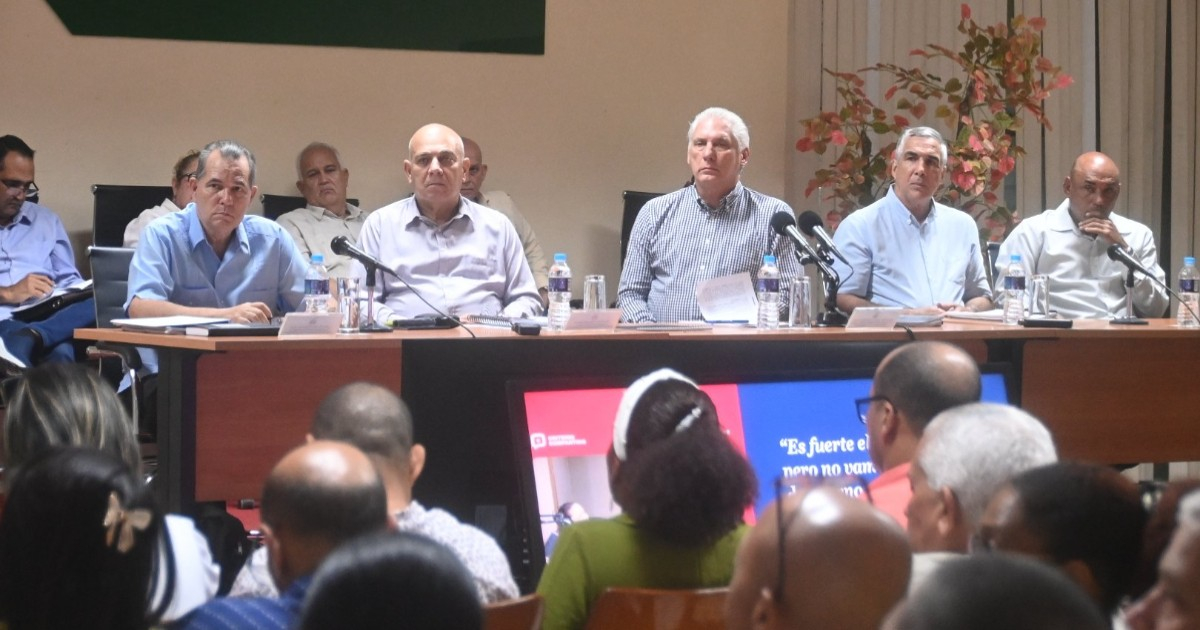
Miguel Díaz-Canel returned this Wednesday to place the responsibility of advancing food production on the members of the Communist Party of Cuba (PCC), at the conclusion of the visit by the Secretariat of the Central Committee to the state food industry during a meeting with party members and workers in the sector.
On his X account, the leader summarized the central message of the event: "We reaffirm the pioneering role of the activists in this decisive process for #Cuba."
The meeting served as a platform for the conclusions of a series of visits conducted by the Secretariat and the auxiliary structure of the Central Committee to several key ministries —Energy and Mines, the National Institute of Hydraulic Resources, Agriculture, Public Health, and the Central Bank— a methodology agreed upon at the XI Plenary of the PCC, held in June 2026, which approved a package of 176 Economic and Social Transformations.
The Minister of Food Industry, Alberto López Díaz, reported that his sector will need to implement 100 of those 176 measures, distributed across 23 thematic areas, and drew a direct equation between energy and food: "more kW means more food."
López Díaz acknowledged internal limitations in the sector and called for a change in attitude among the leaders, urging them to seize the opportunities presented by the reforms: "Transformations need to be treated like a sugar mill, extracting all the opportunities they offer to the business system."
The speech comes as Cuba faces one of its worst energy and food crises. The Electric Union reported this Wednesday just 1,000 MW available against a demand of 2,250 MW in the early morning, with a projected deficit of 1,820 MW for the nighttime peak. The Felton thermoelectric power plant has been out of service since Tuesday due to a scheduled maintenance period of 21 days.
In informal markets, criollo rice ranges between 480 and 500 Cuban pesos per pound in Villa Clara, eggs reach 130 pesos each, and oil exceeds 2,550 pesos per bottle, in a country where the average state salary was 7,354 pesos monthly in August —equivalent to less than five dollars at the informal exchange rate—.
The CEPAL projects a contraction of the Cuban GDP of 10.3% in 2026, the worst in Latin America, accumulating a decline of approximately 26% since 2020. According to a study by the Cuban Observatory of Human Rights published in August, 94% of Cubans live in extreme poverty and 84% distrust that the reform package can improve their situation.
The call this Wednesday follows a pattern that Díaz-Canel has repeated throughout 2026. In January, he already asked militants to be at the forefront of solving problems, and in October, during a visit to the Ministry of Agriculture, he warned that “if there are no foods, there is no social stability”. Each of these calls generated waves of criticism on social media, where many Cubans point out that the Communist Party is part of the problem, not the solution.
The Prime Minister Manuel Marrero Cruz acknowledged in October that the results of the 176 measures would not be felt until 2027, while Cuba imports between 70% and 80% of the food it consumes and rice production fell from 304,000 tons in 2018 to just 79,000 tons in 2025.
Related videos:
Filed under: