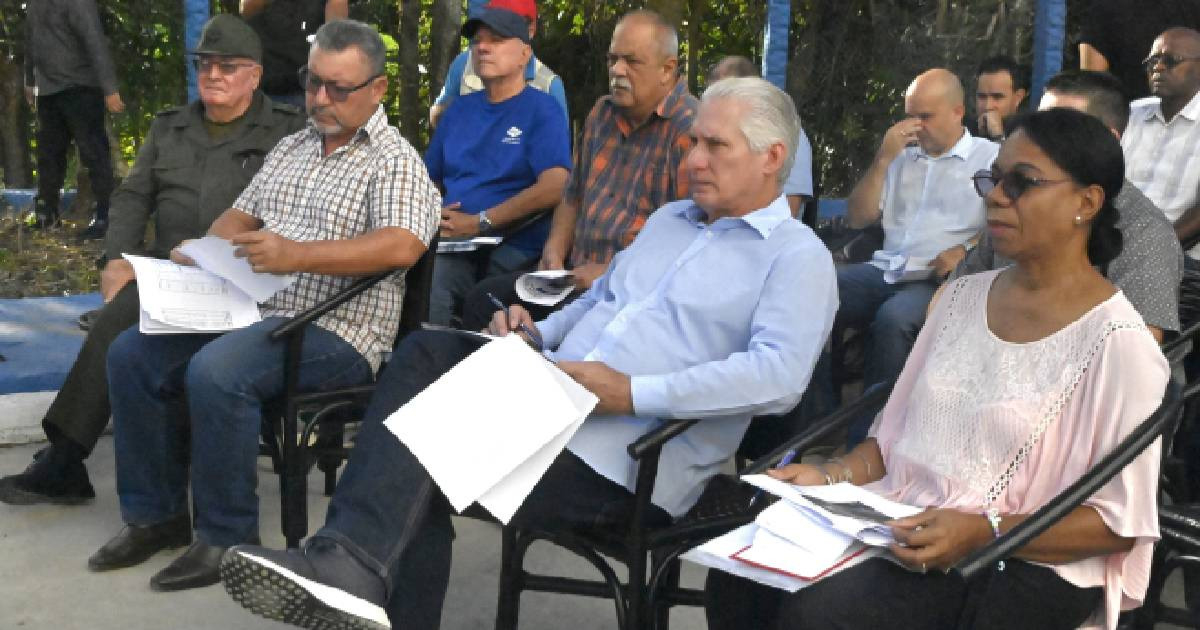
The Cuban leader, Miguel Díaz-Canel, conducted a new inspection of hydraulic facilities in Havana on Thursday, where over 309,000 people continue to be affected by water supply issues, according to data provided by the company Aguas de La Habana.
The general director of the entity, Yosvany Rubí Bazail, reported that the number has decreased compared to the more than 500,000 affected recorded on November 5. The visit included the Alamar Water Tanks in Havana del Este, the Family Care System (SAF) El Rampeño in Vedado, and the hospital known as Maternidad Obrera in Marianao, according to the official site of the Presidency.
In the Alamar Tanks, which supply over 90,000 people, the official explained that the main source of supply, El Gato, provides about 60% of the water destined for La Habana del Este, Regla, Guanabacoa, and Cotorro. He attributed the decrease in those affected to the installation of newly repaired well pumps and other ongoing actions.
For his part, the General Director of the Electric Union, Rubén Campos Olmo, reported on the installation of generators in well fields in the capital, although he acknowledged that the work is dependent on the availability of fuel.
During the meeting, the program for photovoltaic solar parks was also discussed, which will provide 200 MW of generation capacity to the aqueduct systems, with the aim of reducing their dependence on the National Electro-Energetic System and maintaining supply during power outages. The completion of the 10 parks is scheduled for August 2027.
The new inspection adds to the intensified presidential visits that began in August, when the government announced the Comprehensive Water Supply Assurance Program in Havana. However, supply issues persist in numerous neighborhoods of the capital.
At the beginning of this month, the National Institute of Hydraulic Resources (INRH) reported that 2,681,770 Cubans were affected by service interruptions across the country, equivalent to 34.5% of the population. Of these, approximately 536,000 resided in Havana. Electrical issues accounted for 66% of the interruptions, while 25% were due to breakdowns in pumping equipment.
Official figures contrast with reports from residents who have gone weeks or months without running water. Catherine Gonzalez, for example, had been without supply for over 20 days along with 14 other families in a building at Calzada 755, among whom there were infants and the elderly. According to her complaint, when the water finally came for a few minutes, they could barely collect two buckets.
Other documented cases include 45 days without water in Mulgoba, more than six months in Zamora, Marianao, and nearly two years without piped water supply in Las Margaritas, Santa María del Rosario. Aguas de La Habana also acknowledged that some pipes in the capital have not undergone significant renewal in 60 to 70 years.
Díaz-Canel himself admitted days ago during his radio program Criterio Compartido that the water crisis is "real, serious, and complex" and that it cannot be resolved "with just a speech or a single measure."
In the tour, participants included the Army Corps General Álvaro López Miera, Minister of the Revolutionary Armed Forces; the First Deputy Prime Minister Inés María Chapman Waugh; the Minister of Energy and Mines, Vicente de la O Levy; the President of INRH, Antonio Rodríguez Rodríguez; the First Secretary of the Party in Havana, Liván Izquierdo Alonzo, and the Governor Yanet Hernández Pérez.
Related videos:
Filed under: