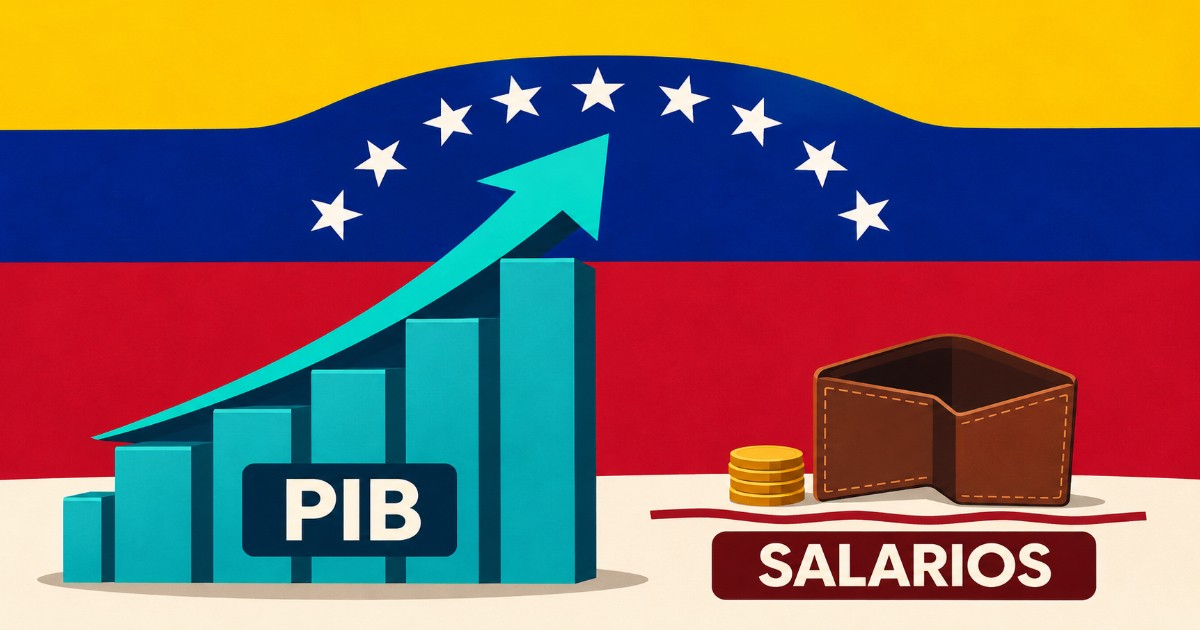
The Central Bank of Venezuela announced this Thursday that the country's Gross Domestic Product grew by 7.42% in the third quarter of 2026 compared to the same period the previous year, marking 22 consecutive quarters of economic expansion.
The result was mainly driven by non-oil activity, which grew by 6.28%, and by the private sector as a whole, which recorded an increase of 8.02%, according to the press release from the agency.
The construction sector led the growth with a leap of 35.75%, largely driven by investments aimed at repairing the damage from the double seismic event on June 24, when two earthquakes with magnitudes of 7.2 and 7.5 struck the north of the country, resulting in at least 6,509 deaths and damages estimated by the United Nations Development Program to be around 6.7 billion dollars.
Other sectors also showed dynamism: financial and insurance activities grew by 29.29%; tourism by 8.95%; agriculture by 7.13%; and manufacturing by 4.32%.
The acting president Delcy Rodríguez celebrated the figures on her Telegram channel and stated that "of every 100 dollars received from oil and mining between January and November of 2026, 99 were allocated to the payment of salaries for public sector workers and pensions: 14.71 billion dollars."
However, that figure stands in stark contrast to the reality faced by Venezuelan workers.
The legal minimum wage has remained frozen at 130 bolívares per month since March 2022. At the official exchange rate of the BCV— which this Friday surpassed 911 bolívares per dollar— that amount is equivalent to just about 14 cents of a dollar per month, according to data from the EFE agency.
To compensate without altering the legal base salary, the government pays two bonuses totaling 240 dollars per month, deposited in bolívares at the official exchange rate. Unions and workers warn that these bonuses do not affect social benefits, vacation pay, profit-sharing, or severance payments.
The gap between macroeconomic growth and the real purchasing power of Venezuelans is highlighted by another piece of information: according to the Center for Documentation and Social Analysis of the Venezuelan Federation of Teachers, a family of five required $761.35 just for food in September, which is a 0.79% increase compared to August.
That figure represents more than 4,800 times the legal monthly minimum wage.
The international financial context adds another dimension to the picture. Since the capture of Nicolás Maduro on January 3, 2026, the United States has been managing Venezuelan oil revenues through an escrow account. Between January and September, Washington received about 12.26 billion dollars and returned 98.7% of those funds to Venezuela.
The CEPAL had projected in April a growth of 6.5% for Venezuela's GDP in 2026, the highest in South America, after an expansion of 8.9% in 2025. The recovery, however, comes after an accumulated contraction of more than 80% of the GDP between 2014 and 2021, one of the most severe recorded in peacetime in the hemisphere.
The BCV described the quarter as a sign of "greater confidence among economic agents in the national production apparatus," but union leaders and workers from various sectors warn that this growth has not reached the pockets of those who sustain the economy with their daily work.
Related videos:
Filed under: