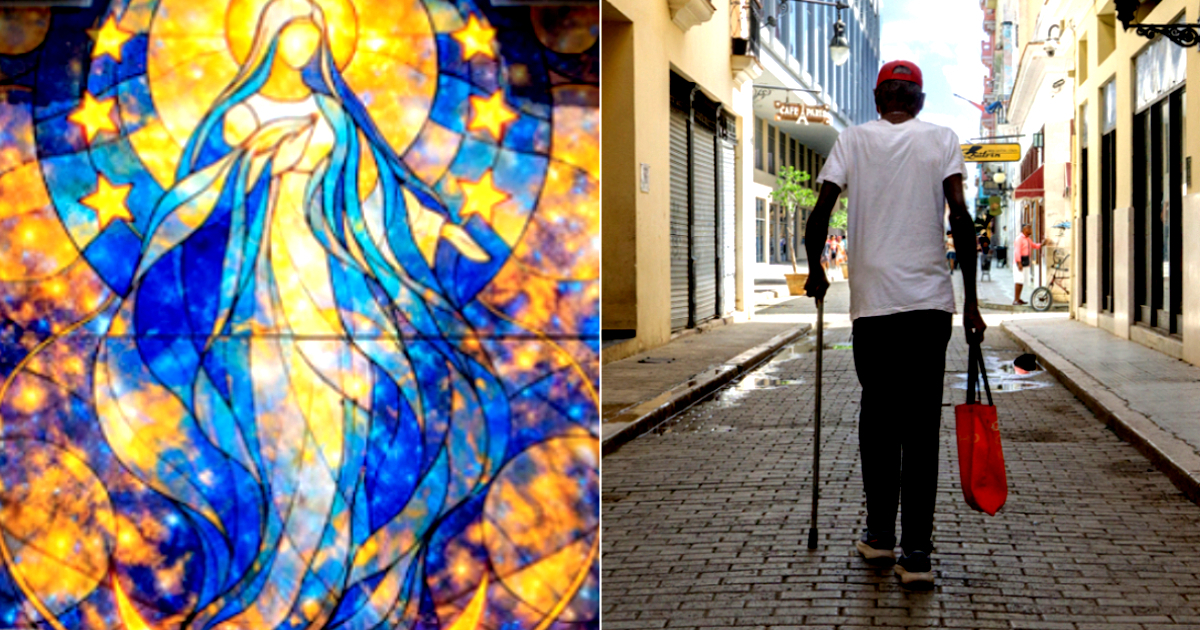
The deterioration of public services, extreme poverty, the neglect of the elderly, and the growing influence of churches paint the portrait of Cuba presented by Robert F. Worth in an extensive report published by The Atlantic titled The Collapse of Cuba.
Posted at the end of October, the work becomes particularly relevant after Miguel Díaz-Canel thanked a delegation of U.S. bishops this Saturday for the role of the Church in facilitating humanitarian aid coming from abroad.
The recognition by the leader came at a time when religious and humanitarian organizations are taking on an increasingly visible role in assisting the population, as state provisions prove insufficient to meet the needs of hundreds of thousands of Cubans.
The day before, Cáritas Cuba had announced the arrival of a third U.S. shipment to Matanzas, containing 700 food modules and an equal number of hygiene kits intended for vulnerable families. The operation is part of an assistance program funded by Washington and implemented through humanitarian organizations, with significant involvement from the Catholic Church.
A country where public services cease to function
For nine days in August, Worth traveled across the island accompanied by photographer Moises Saman. He encountered deteriorated roads, communities nearly paralyzed by blackouts, hospitals lacking resources, and a population resorting to increasingly precarious survival strategies.
On the Malecón of Santiago de Cuba, he met a 76-year-old woman and her daughter, who were surviving by begging and collecting plastic bottles. Their main breadwinner had died of cancer, and, as they recounted, they did not receive any state assistance. In their home, they slept on metal frames covered with cardboard instead of mattresses.
The deterioration of the healthcare system is reflected in the story of a nurse from Cayo Granma, who is responsible for caring for the 870 residents of the small island and for patients from nearby communities.
The shortage of doctors, medications, and potable water had exceeded their capacity to provide care. The water supply had been interrupted for three months, as he explained, and bacterial and skin infections had increased.
“We have to work miracles here,” she confessed to the journalist. She stated that she did not plan to retire because there was no one who could replace her.
The testimonies collected by The Atlantic are supported by recent indicators. The Cuban Observatory for Human Rights estimated in August that 94% of Cubans live in extreme poverty, according to the methodology of its IX Study on Social Rights, based on 1,318 interviews conducted in 79 municipalities.
The research also found that eight out of ten respondents had skipped a meal due to a lack of money or food.
The energy crisis continues to exacerbate these shortages. Just the day before, the Electric Union predicted a shortfall of 1,860 megawatts during peak hours, while millions of citizens continued to face water supply difficulties, closely related to the lack of electricity to operate pumping systems.
The Church occupies spaces left by the State
One of the central findings of the report is the growing prominence of religious organizations in a society where public institutions have lost their capacity to meet essential needs.
In the church of Los Escolapios in Havana, Worth found makeshift classrooms, children receiving religious education, and volunteers distributing lunches of rice and beans.
His interlocutor, the priest Iván Guerra Álvarez, recalled that after 1959 the regime had occupied religious facilities and established mechanisms of surveillance. Now, the Church was attempting to reclaim some of those spaces.
We are the largest institution in Cuba outside of the Government, explained the priest, convinced that the Church could play a significant role in a future political transition.
In Baracoa, the journalist met the Pentecostal pastor Raúl de Jesús Muñoz Munder, whose congregation has about 1,100 regular members and periodically organizes the distribution of food and medicine to those in need, even outside of their religious community.
According to the pastor, the Assemblies of God have increased from two to 40 churches in the region over the past three decades. Worth presents this growth as part of a broader social transformation, although he acknowledges that there are not enough independent statistics to measure evangelical expansion across Cuba.
Current events provide concrete examples of this shift in responsibility.
The economist Pedro Monreal warned on November 13, in his analysis Cuba: imprecise vulnerability, insufficient social assistance, and misery with no light at the end of the tunnel, that the government currently recognizes 883,436 vulnerable individuals, while the latest available official data on effective social assistance beneficiaries, corresponding to 2025, barely reached 303,298 individuals.
Monreal makes a distinction between those who have been identified as vulnerable and those who actually have a recognized budgetary benefit. His analysis concludes that remittances and international humanitarian aid have taken on a decisive role in protecting households.
The UN, for its part, reported on November 11 that its humanitarian program had cumulatively benefited 1.7 million people by September, through interventions related to food, drinking water, and health.
Community assistance has also become essential for sectors that previously relied on their salaries and pensions. A report from Associated Press published on November 13 described how hundreds of Cubans, including retirees and workers, are lining up for long periods outside the charity dining hall of the Quisicuaba Association in Central Havana. Some even sleep on the sidewalk to secure a meal.
They are different manifestations of the same phenomenon: community assistance, international donations, and family networks are meeting needs that the state system cannot satisfy.
From revolutionary disillusionment to an uncertain future
The report also describes the distancing of former supporters of the Revolution from the system they defended for decades.
In a shelter run by the Catholic Church, Worth spoke with a veteran of the Angola war who had Che Guevara tattooed on him since he was 18 years old. He had served for two years in Africa and bore combat scars.
His response, filled with insults and hostility towards the current Cuban leaders, reflected the disillusionment of someone who had devoted part of his life to defending the Revolution and ended up relying on religious assistance.
Worth also notes the impact of the tightening of U.S. oil restrictions, although it highlights that none of those interviewed during the tour directly attributed their situation to Washington. Several pointed to the decisive deterioration due to the pandemic and the accumulated shortcomings of the Cuban economic model.
The journalist does not predict when or how a political change might occur. Rather, he describes the paradox of a regime that maintains its control structures while diminishing its ability to provide the services that constituted one of the main sources of legitimacy of the so-called "revolution."
The final scene of the report takes place in the Santa Ifigenia cemetery in Santiago de Cuba.
After traversing impoverished neighborhoods, makeshift hospitals, and streets filled with garbage, Worth discovers a meticulously maintained site: perfectly manicured lawns, clean pathways, and uniformed soldiers precisely executing the military ceremony in front of the mausoleum of José Martí, beside the grave of Fidel Castro.
The contrast becomes even more striking when a gust of wind carries the smell of burning trash from the nearby streets to the cemetery.
Related videos:
Filed under: