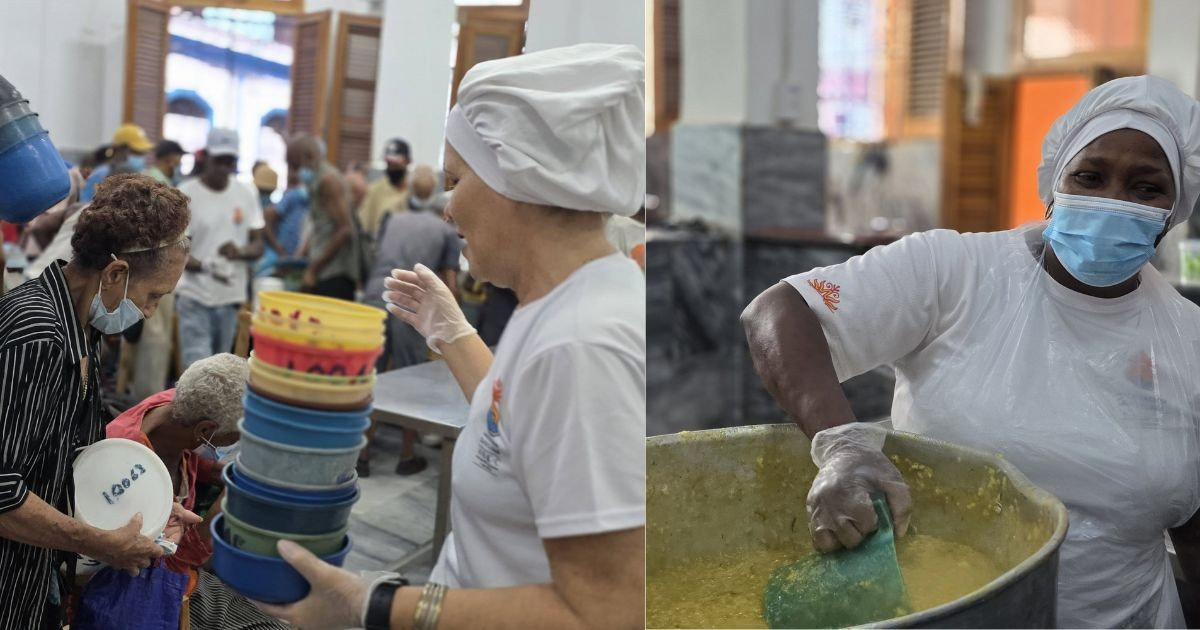
Every night, hundreds of people gather on a street in Centro Habana in front of the Asociación Quisicuaba, with some even sleeping on the sidewalk to secure a spot in line.
When the doors open at seven in the morning, volunteers distribute portions of rice, eggs, and pasta —sometimes with a bit of chicken— and bottles of chocolate milk. For many of those waiting, that is their only meal of the day.
Among those waiting in line, homeless individuals are not the majority. They are retirees, teachers, retired doctors, single mothers, and workers with active jobs whose salaries no longer suffice to feed themselves, according to a report by the Associated Press published this Friday.
Fernando Fernández, 71 years old, is one of them. A former cook and security guard, he regularly visits the dining hall and sometimes arrives the day before to secure his place. "We are having a very hard time. I have to get there at dawn. Sometimes I even have to stand in line the day before," he told the AP. His wife Josefa, 80 years old, can no longer accompany him due to illness. Together, they survive on her monthly pension: 3,200 Cuban pesos, just over three dollars.
Marelys Ponce, a 34-year-old single mother of five, started attending the soup kitchen just over a month ago. "I started coming because the situation is tough, and I don’t have anything to feed them," she explained to the media while waiting in line with two of her children. The other three receive lunch at school.
The Kardecian Spiritist Association Cruzada Quisicuaba, founded on October 12, 1939, in the Havana neighborhood of Los Sitios, engages in extensive socio-cultural and assistance work. Its projects have received support from international organizations, including UNESCO, as well as European cooperation and solidarity organizations.
This association has identified 12,500 vulnerable individuals just in Havana. Its president, Dr. Enrique Alemán, described what is happening as "a new dimension of vulnerability": "We do not see here illiterate people or other forms of marginalization, but rather individuals who are products of Cuban society facing particularly vulnerable circumstances."
The collapse of the ration book is part of the backdrop of this crisis. The Cuban regime allocated about 2 billion dollars annually to import food to maintain the rationed basket, but today state stores barely provide a few products, such as rice and sugar, of low quality, and with significant delays or interruptions.
The prices in private markets make it impossible for those dependent on state income to afford food: a carton of eggs can exceed 3,000 pesos—almost the entirety of a monthly pension—and a bottle of oil costs over 2,700 pesos. Inflation reached 28% year-on-year in September 2026, with food and beverages rising by 42.66%.
The government itself has acknowledged the magnitude of the problem. The Minister of Labor, Jesús Otamendiz Campos, reported in early November that 883,000 people were classified as being "in a situation of greater vulnerability" after visiting over 1.3 million families. President Díaz-Canel publicly admitted that Cubans expect "fewer blackouts and more food."
The regime's response has been to replace universal subsidies with targeted assistance: Prime Minister Manuel Marrero announced in October a monthly allocation of five pounds of rice, one pound of sugar, and one pound of beans for those in greatest vulnerability, initially until January 2027.
A few days before the AP report was published, the National Revolutionary Police conducted a “cleansing” operation in Centro Habana —the same streets where Quisicuaba operates— removing homeless individuals and taking them to unidentified “care locations.”
Related videos:
Filed under: