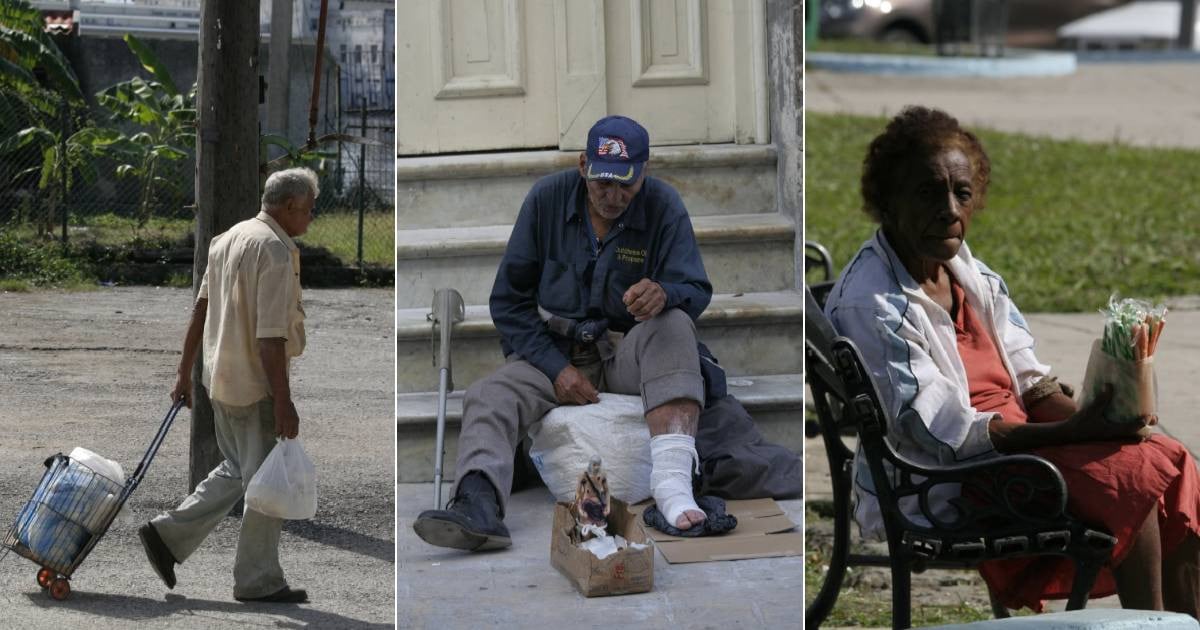
Images of elderly Cubans begging or selling candies and peanuts to make a living sparked a wave of outrage on social media following a report by activist Roberto Jesús Guerra Pérez about the abandonment of a significant portion of the senior population.
In a post on Friday on Facebook, Guerra questioned how individuals who have worked their whole lives have reached old age without guarantees to meet their most basic needs.
"Those who govern Cuba, as if it were their own farm, should look at these photographs and explain what response they have to them. Every elderly person who has to beg or sell to eat deserves more than a speech and occasional help. They deserve a sufficient pension, care, and companionship," he wrote.
And he added: "I stop at their faces and wonder how many times they have heard that the future would be better. They grew old and the future found them on a sidewalk, searching for ways to survive. What a cruel way to ask them to keep 'resisting' after a lifetime of work."
The text received dozens of comments from Cubans both on and off the island. One user claimed to know individuals who have gone over eight months without receiving their pensions and described the difficulties in even accessing the money that is rightfully theirs.
"Besides the fact that the pension is minimal, they cannot receive it every month. Because there is no money, and when they go to collect it, there is no electricity. That money was earned through their work; it is not a gift," she commented.
Other testimonies reflected the despair of those who are already facing that situation or fear ending up in the same conditions. "I never imagined having this old age," wrote one woman, while another user summarized their concern with a powerful statement: "Unfortunately, this is how we will all end up. Only those with family abroad will be saved. The rest of us will be picking up cans and begging."
A third person recalled the expectations that accompanied several generations of Cubans. "Many of us lived through the whirlwind of the revolution and believed in a promised future that never arrived," they noted.
A report from the Food Monitor Program and Cuido60 warned in May that 55.6% of individuals over the age of 60 in Cuba reported total loss of access to food, 53% allocate all their income to food, and 80.2% face difficulties obtaining essential medications.
For its part, the Cuban Observatory of Human Rights documented that nine out of ten seniors over the age of 61 go without one meal a day and that 44% of homeless individuals are over 70 years old.
Precarity is also reflected in income. The minimum pension in Cuba is 4,000 pesos per month, equivalent to just over four dollars at the informal exchange rate, while economists estimate that a person in Cuba needs around 96,000 pesos per month to cover basic needs.
In June, the Granma government acknowledged that it did not have the funds to pay pensions for more than 111,000 people.
Other recent episodes illustrate the difficulties faced by the elderly population. Senior citizens in Camagüey reported that they do not appear on the food distribution lists intended for people over 65 years old and that the Social Work staff does not assist them.
The case of an elderly woman who walked along San Rafael Boulevard in Havana also made headlines, crying out for help to find food, as well as that of another woman in Sancti Spíritus who survives alone in a crumbling house, with no regular access to food or state assistance.
Cuba reports 733 dependent individuals for every 1,000 working-age inhabitants, the highest figure in its history, and it is the most aged country in Latin America and the Caribbean.
Official projections warn that by 2040, 36% of the population will be 60 years old or older. The scenario anticipates increasing pressure on a social security system that is already struggling to provide sufficient income and decent living conditions for a portion of its retirees.
Related videos:
Filed under: