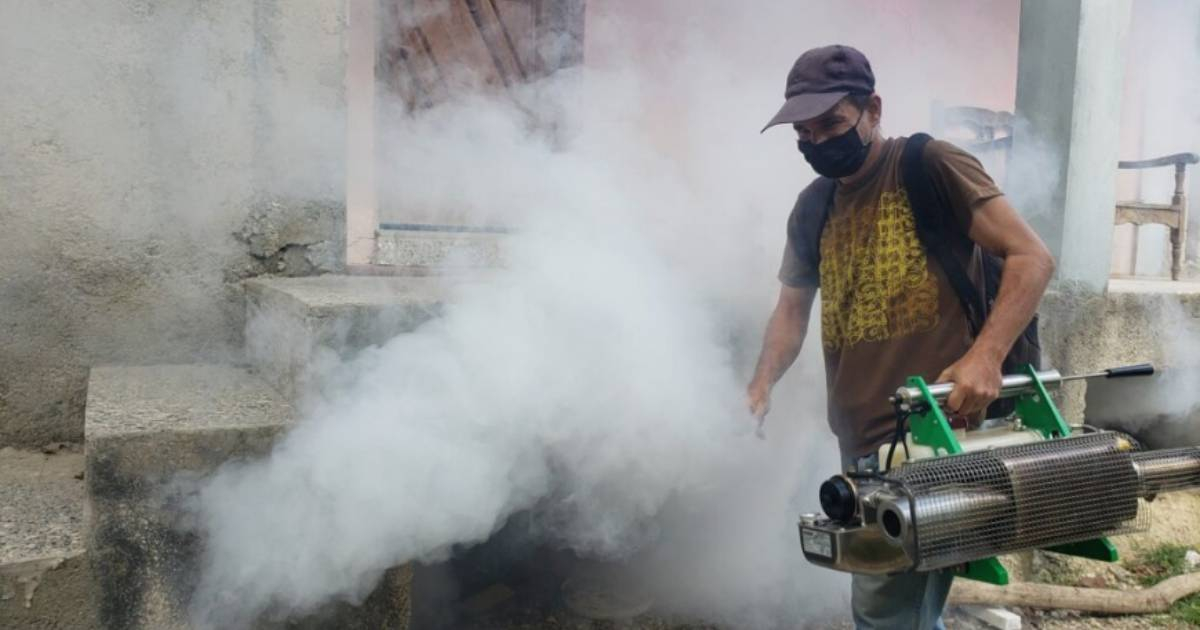
The Ministry of Public Health of Cuba (MINSAP) acknowledged this Sunday that the island is facing simultaneous active transmission of dengue and chikungunya in each of its provinces, with dengue being the disease with the highest incidence.
The admission came from Dr. Madelaine Rivera Sánchez, the national director of Vigilance and Antivectorial Fight, whose statements were disseminated on their official Facebook account.
At the end of statistical week 44, seven territories reported incidence rates higher than the previous week: Pinar del Río —which tops the list in complexity for both diseases—, Matanzas, Villa Clara, Ciego de Ávila, the special municipality Isla de la Juventud, Santiago de Cuba, and Guantánamo.
Rivera Sánchez warned that the Aedes aegypti mosquito has domestic habits: it lives inside homes and needs clean water to reproduce. Therefore, she urged the population to cover water storage containers, clear out yards and lots, and participate in community sanitation efforts. "The fewer breeding sites the mosquito has, the less likely we are to get sick," the specialist emphasized.
One of the most revealing aspects of the intervention was the explicit acknowledgment of the system's limitations in combating the vector. The national director admitted that vector control actions "have been hampered by the country's economic situation, primarily due to the lack of fuel for the fumigation machines."
As a partial solution, the MINSAP has modified some equipment to replace diesel with water, allowing for fumigation to be carried out in October and so far in November, with a focus on areas of higher transmission. The official strategy has shifted towards larviciding—treatment with abate in water storage within homes—and, to a lesser extent, towards adulticiding.
The shortage of fuel had already halted fumigation brigades in several provinces. In Santiago de Cuba, the Red Cross donated portable spraying equipment to partially compensate for the inactivity of the motorized brigades, according to recent reports.
MINSAP also reported that it is maintaining active surveillance for Zika and Oropouche, with no confirmed cases of either so far in 2026.
The current crisis is rooted in a devastating 2025 regarding arboviruses. According to the Pan American Health Organization (PAHO), Cuba reported 30,692 suspected cases of dengue and 19 associated deaths during that year.
Chikungunya, which reemerged in Cuba in July 2025 after approximately a decade without detected transmission, caused an epidemic that spread throughout the country. According to the report from the Pan American Health Organization (PAHO), by the end of that year, 51,217 cases of the disease had been reported, including 1,959 confirmed by laboratory tests, and 46 associated deaths.
In 2026, the transmission did not stop. The Global Dengue Observatory at the London School of Hygiene and Tropical Medicine estimated 15,859 accumulated cases of dengue in Cuba by October, a figure that is 10.6 times higher than the expected level for that time of year.
However, the last month for which the platform has officially reported data from Cuba is June 2026, so the figures that follow are based on statistical estimates rather than an official count of confirmed diagnoses.
The structural context exacerbates the spread of the vector. Prolonged blackouts affect the pumping and supply of water, forcing families to store it in containers that, without proper treatment, become breeding grounds for mosquitoes.
In September, the Deputy Minister of Public Health Carilda Peña García had already acknowledged the circulation of chikungunya and recognized a “complicated hygienic situation” in several areas with a higher incidence. Two months later, the situation not only persists but has spread throughout the entire archipelago, with the fuel crisis hindering fumigations showing no signs of resolution.
Related videos:
Filed under: